Prior to the pandemic, a year before the 2020 presidential election, creaky old guy gave fiction-writing a try with “And Away We Go.” That debut novel was followed six months later by “It’s Dark in Here.” Both feature the thrilling adventures of Hack Remington, a “disaster reporter” for The Sacramento Buzz.
Find them in their entirety below. But first … buckle up!
And Away We Go (2019)
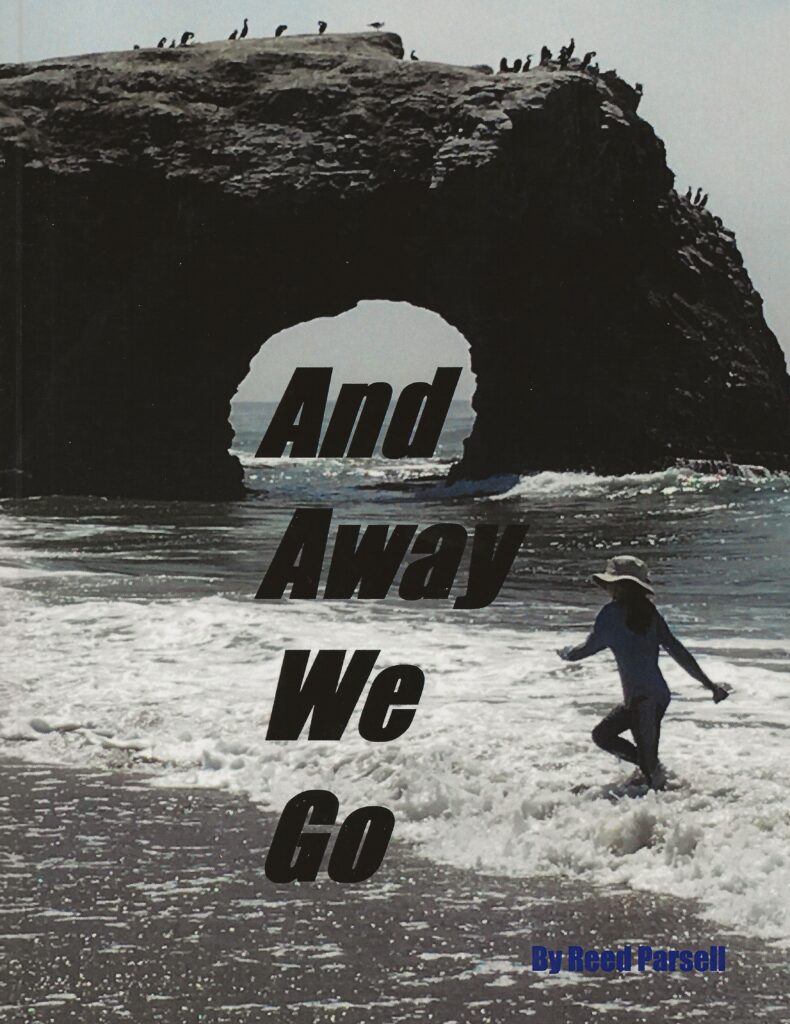
Life is a mixed bag for newly minted “disaster reporter” Hack Remington. First, the bad news: His ex-wife is having a career crisis, his son wants to move out of state, and one of his cats is absurdly obese. His city is badly bungling a homelessness problem. His planet is breaking (earthquakes), melting (glaciers), dying (coral reefs), leaking (king tides) and burning (wildfires). Worst of all, idiot-in-chief Alfred Toole is running for re-election and as Election Day 2020 nears, tensions are boiling over into violence. The good news? Hack’s love life is getting better, thank you very much.
Although I feel no breeze, the thick and colorfully flowered brush gathered below a forest of palms ripples pleasantly. A few birds that I lack the biological smarts to identify flap from treetop to treetop, back and forth, in a repeating pattern. The sound of ocean waves, as it always does, helps to restore my feeling of calm.
As I scan the ocean’s horizon, a distant spray catches my eye. A flash of something dark passes briefly beneath it. Is that a migrating whale? Suddenly, closer to shore, two fins emerge from the stunningly blue water before, two seconds later, disappearing below. Those must be dolphins, because sharks don’t usually travel in tandem, do they?
Again with the dearth of biological smarts.
I am hardly the first person to think that one could linger for years in such a setting. The senses, so used to being bombarded in the modern world, are soothed on a beach. Time passes serenely. Anxieties, to whatever extent they exist, melt away.
The overall effect is unreal.
This could be just the place for me. God knows I need a break. Things have been rough lately. Really rough. Wood wheels rough. Richard Nixon hasn’t shaved in three days rough. Dogs don’t know what they’re barking about rough.
Rough, rough, rough.
Forgive my awkward humor. I am as exhausted as I have been since my son was born, three days and three mostly sleepless nights after my ex went into labor. If only I could find a hammock! Or even a blanket on a dry stretch of fine-grain sand, umbrella optional. Any smooth, six-foot-long space for me to stretch out on and sleep it all off.
My mind is frazzled and my joints are achy. Alas, neither one of those conditions is foreign to me, especially during the past three months of my nearly sixty-year life. So much has happened, so much has been endured. So much to tell you about. Seems to me that you might be interested in hearing about it. Whoever you are, wherever you are … whenever you are.
Ah, there’s a spot to lie down. Argh! It hurts so much to sit, even to just extend my hand to stroke the surface, testing the softness. It feels good enough. My rolled-up sweatshirt can be my pillow. I promise that as soon as I awaken, I will begin to tell you my story.
But first I must sleep. And getting to that blissful stage could take a while. How can I ignore those faint screams coming from another world?
“It’s another one of those days,” Nancy said glumly as I walked past her desk on the way to my perch at the back of the newsroom. I stopped, looked quizzical and silently waited. She raised her eyebrows and nodded toward her left. I rested my forearms on her cubicle’s hip-level wall, sighed, and took a quick glance where she had motioned.
Carlos Rodriquez was seated and hunched over a box into which he carefully was placing framed family photographs that had been displayed next to his monitor. I caught a glimpse of his three teenage children, gleefully waving at the camera while wearing Mickey Mouse beanies at Disneyland, before they disappeared behind a dictionary, an Associated Press style book and an alarmingly stained coffee mug. Tools of the trade.
Carlos, the obituary writer who lately also had been tasked with the hospital and senior citizens beats – there is some logic to that pairing, I suppose – had since the late 1990s displayed a respectful and caring touch in his profiles of the recently deceased. The dead, who included a few friends of mine and my father-in-law, were the subjects of cleanly written twenty-five-inch stories that smoothly wove basic biographical information and survivors’ adulatory quotes.
In other words, Carlos was a true professional, one of many talented print journalists that helped make The Buzz one of the nation’s most respected second-tier newspapers. We weren’t the Times or the Post or the Journal, but we “broke” a lot of big news stories and held many powerful people accountable.
A half-dozen of our photographers and writers, including Nancy, had won Pulitzers. Our downtown bureau once covered the hell out of the Capitol, where the governor and legislators set the political tone in a state whose economy had become the world’s fifth-largest. At our peak, The Buzz’s three hundred or so editorial employees filled the enormous newsroom and even spilled out into large rooms and offices on other floors of the sprawling, historic red-brick building.
In the early 2000s our executive editor gathered us all together and warned that classified and retail advertising revenue was poised to plummet due to the increasing role websites and other Internet functions were playing in disseminating news, entertainment and, more to the point, ads. Some of us were surprised, many of us were alarmed, and few of us had any obvious career alternatives. For the most part, we were journalists because we wanted to be, not because it was a high-paying profession (at The Buzz level, it was decent, not great) or because the job came with prestige (enough people still subscribed or had living parents and grandparents who did, so there was at least an almost universal awareness of what The Buzz was).
Like many other baby boomers, I was inspired by the Woodward and Bernstein exploits of the 1970s. Newspapers exposed corruption. We were the scrappy good guys.
In the years following our executive editor having spotlighted the industry’s impending demise, we were subjected to a morale-sucking parade of hiring freezes, buyouts, layoffs, budget cuts, furloughs, dubious retirements, downsizings, outsourcings, duty mergings, responsibility addendums, frills erosions and benefits retractions that have served to reduce payroll and other expenses. This day, which found Carlos and apparently a few other old-timers being shown the door, came with a feeling so familiar to Nancy and myself that it was almost numbing. We had been spared. Again. Nancy because of her award-sanctioned reportorial brilliance, and me because, well …
It still seems incredible to say it, but I was a recently minted international media sensation! The Buzz could not afford to lose me, at least until the hubbub would inevitably subside. For much of The Buzz’s era of gradual decay, I held on to my full-time employee status thanks to a few mundane but important reasons. I worked hard. I was versatile. I received favorable performance reviews. I kept a low profile. And all my enthusiasm-free applications for jobs outside the industry led nowhere.
Then one day the ground shook with a magnitude of 6.4, the next evening an even bigger quake struck, and I was still keeping those lovin’ good vibrations with me.
A year ago I was in the Mojave Desert town of Ridgecrest, about to check out of a hotel on my way back from Death Valley National Park. I had spent the previous three days driving and walking about Furnace Creek, Badwater, Dante’s View, Ubehebe Crater and other Death Valley attractions, gathering facts, impressions and imagery for what was likely to be my last newspaper travel story. Death Valley was among the first places I wrote a travel story about, three decades before, so that fact and the park’s fatalistic name provided some symbolism to honor the end of this much-loved aspect of my career.
It was the Thursday morning of July Fourth and I was getting an hourlong walk in before the muscle-muting monotony of the eight-hour drive home. I wanted to return to Sacramento in time to have a beer before checking out the fireworks. Or rather in time to have a few beers, forget about the fireworks and go to bed with earplugs to block out the holiday’s dusky and tiresome cacophony of jolting bangs and dogs’ anxious barks.
I had strolled to the desert city’s outskirts, where a two-lane road led straight as a yardstick toward a perpendicular line of reddish mounds. Within those hills were canyons of surprising beauty, where a state highway and dry creek bed shared a choreographed path between the sun-lit steep walls and clifftops. (Sorry – I still occasionally slip into travel writing mode.) As I gazed toward those hills, contemplating whether driving through them was worth adding an hour to my return home, and despite there being no train tracks nearby, I heard a locomotive bearing down on me.
A big earthquake had begun, and it was the noise almost as much as the shaking that held my attention. Instinctively I turned my cellphone’s camera feature on, and despite being jerkily pushed and pulled as if I were in the middle of some narrow, rickety suspension bridge swaying over a river, I tapped “video” and the red record button. I stumbled into the empty roadway and pointed the lens toward the hills.
Suddenly there was a “Pop!” as the pavement, about twenty feet in front of me, cracked open. A tear began ripping through the roadway, the middle of it coming directly at me. The point of the tear was fifteen feet away. Ten feet. Five. A younger me might have been quick and agile enough to leap to one side or the other, but I was frozen. The crack went right between my feet, and before I knew it, I was straddling a three-foot-wide crevasse that was at least ten feet deep.
Then just as suddenly as it appeared, the shaking stopped and the locomotive noise vanished. I couldn’t immediately figure out how to move without falling into the crack. My groin felt strained and my knees started to wobble. Lucky to be alive, for sure, but I needed more good fortune and I needed it quickly. Then I saw a big rig approaching from about a half-mile away and figured when it came upon an old guy whose legs were spread across a ditch and from whose white-hair-topped head were emerging cries of “Help!”, some Good Samaritan would emerge from the cabin and extend a hand. Before I was swallowed up by the Earth, ideally.
To take my mind off the pain and the danger I checked out the cellphone’s handiwork.
One virtue of my having been frozen while the crack approached was that I really nailed the visuals. Having filmed and edited more than a dozen videos for travel stories, I was savvy enough to do a couple of basic things correctly: shoot horizontally, and when I tracked the crack, move the phone steadily rather than abruptly. The end result, after a nip at the front and tuck at the end, was an eight-second look at the earthquake from what I presumed was a unique perspective. A perspective, I correctly imagined, that would be catnip for the press.
Sure enough, soon after I sent a first-person account and the video to The Buzz’s barebones holiday newsroom staff and the “package” was posted on our website, I received a call from the editor. Not merely the editor on duty, but the executive editor.
“Media from all over the world are asking to run your video!” he exclaimed in totally uncharacteristic jollity. “If we had any money lying around, I’d at least consider giving you a small bonus!” He knew that I had fed the beast in a big way, and after all the internal bad news we had swallowed in recent years, this was one tasty meal. Perhaps portentously sensing there could be second helpings at the catastrophic-event buffet, he ordered me to stay a couple of extra nights in Ridgecrest to file follow-up reports.
So it was that on Friday evening I again had left the hotel for a stroll, having spent the day interviewing townspeople about their earthquake experiences and taking hundreds of pictures that, frankly, were not one-millionth as interesting as the “crack” video I had taken the day before. In fact, I was doing as so many people do these days – looking at my phone while walking, in this case scrolling through photos – when incredibly, an even larger locomotive roared through town. This quake turned out to register 7.1 on the Richter scale, making it the largest temblor California had felt for more than twenty years.
I was on a downtown sidewalk that lined a relatively busy street. Instinctively, again, I tapped “Camera,” “Video” and the red button and pointed the cellphone’s lens down the road. The pavement seemed to be rolling, other pedestrians were stumbling or in some cases falling, and building fixtures were blurred by their hard, sharp motions. A pickup in the oncoming, far lane started to weave. I watched in horror as it veered across the center strip and was literally bouncing right at me, poised to deliver a surely fatal blow. At the last possible moment its spinning tires regained traction and the vehicle turned sharply away. As it did so, something came flying out of the truck bed. I caught whatever it was with my left hand and arm while I kept the cellphone as steady as I could in my right hand.
Turns out that the flying object was an Australian shepherd. When the trembling stopped, and again an eerie silence descended upon us, the ejected pooch and I regarded each other with what I assume was mutual surprise. I set him down on the concrete and read the tag on his collar: “Chance.” There was no contact information, no other information of any kind. Just “Chance.”
The truck from which he had catapulted had disappeared around a corner. Chance and I both stared in that direction for probably ten seconds before we again looked at each other. “Good boy! You okay, fella?” I asked.
Chance sat on his hind legs and licked my left hand, panted and continued to stare at me.
“You seem fine. Now if you’ll pardon me, I have a job to do. Good luck, buddy. Hope you end up with someone who doesn’t put you untethered into the back of a pickup truck.”
He seemed to understand he was dismissed and lopped off toward where the truck had turned. I squelched some regret for not having stuck around to see to his safety, but there was something about Chance that reassured me he would figure things out.
Realizing my phone was still shooting video, I pointed it this way and that, capturing people’s initial reactions to this second earthquake in less than 36 hours. Some looked dazed, many looked frightened. At least one person – a crisply dressed woman in her 40s who had exited a shiny SUV that had collided with a stop sign. and whose ornate necklace was glaring in the fading sunlight – was ticked off. “What the fucking fuck!” she yelled a few times, gesturing upward with closed fists and a scowl that would have made a professional wrestler bound over the ropes and flee.
For me, the next hour was a frantic gathering of comments, photos and videos while there was still natural light. My phone eventually ran out of power and as I was reinvigorating it with a mobile charger, a call came in. Nancy was on the line.
“You are ON FIRE, my friend,” the ace reporter said. Her chuckle turned into a hard giggle before morphing into an uproarious laugh. After regaining her composure, she said the following fateful words:
“At least two security cameras caught you catching that dog. Television stations throughout the universe are showing the rescue over and over again. News websites are probably crashing from all the hits they are getting on your heroism, your there’s-nothing-to-it act. Someone identified you as a Buzz reporter. Now we’re getting requests from CNN, Fox, MSNBC, ABC, CBS, NBC, BBC, CBC, the Weather Channel and probably every other station up to and including HGTV, the Russians, the Chinese and the Martians begging that you appear in an on-air interview.”
Indeed, during the next three days I nearly went hoarse answering the same three or four questions from innumerable reporters, anchors and bloggers. The videos taken by those two security cameras, sometimes packaged with the video I shot of the pickup truck bouncing menacingly and oh-so-teasingly toward the dummy holding up his cellphone, played on what I understood to be millions of backlit screens worldwide. One network morning show managed to corral Chance and have him sit, happily drooling, by my side during one interview. Chance’s human companion – I hope because he was ashamed of putting his pooch in such peril by hauling him around in the truck bed – declined to be on camera.
Upon my return to Sacramento, the executive editor declared during what passes for a newsroom celebration – a box of cheap generic cookies and a bucketful of water bottles – that thanks to my being “the right dweeb in the right place,” The Buzz theoretically made a lot of money with all the video hits, likes, shares and whatnots. I have never really understood the revenue-generating power of such things, but in this case, I received two tangible benefits. My job security was promoted to about as good as it gets in print journalism, and I was proclaimed to be the newspaper chain’s “disaster reporter.” If anything catastrophically bad seemed to be happening, off I would go while everyone at The Buzz would hope lightning would strike for a third time and that I would generate more media catnip (i.e., viral videos).
In essence, thanks to my having become a journalism icon due to about 20 seconds of random good fortune, I was given the green light to do whatever I wanted to do. That lofty status was still in place thirteen months later, as I watched Carlos put his career to rest in a mid-sized cardboard box.
After I said a few words of condolence and encouragement to the laid-off obituary writer, I continued to my cubicle. As I settled in, I waited for copy editor Kurt, who grouchily inhabited the nearest occupied work station, to say something strange. It didn’t take long. Addressing me over the three permanently empty cubicles between us, which looked a lot like the fifteen permanently empty cubicles behind and to the sides of us, Kurt said, “Bananas.”
To say Kurt and I are friends would be a bit of a stretch, because to my recollection we never have seen each other outside of the office. There is a mutual respect, though, an easy camaraderie and shared political bents that together can be tallied as forming a comfortable work relationship.
I have known Kurt for more than twenty years. He doesn’t look like much but thanks to his adept touch with headline writing and a sensitive, restrained approach to editing, he is the sole survivor of what had been an immense copy desk. Once there were more than fifty editors partitioned out in news, business, sports, features and special projects. Kurt was good enough, and lucky enough, to have been spared during every single “job action.” He wasn’t outwardly bitter but rather seemed grateful to still be making a living in this dying profession. He knew his number would be up soon, but he didn’t whine about it, which I admired. I also was amused at how he saw not just his own little career world collapsing, but all of civilization with it. He liked to point out random things that were imperiled. As were, I inferred, bananas.
“Doomed, are they?”
“That’s right, dude. Thanks to deforestation, climate change and parasite infestation, the days of cheap bananas are going the way of rhinos, pikas and melanoma-free childhoods. Those smoothies you’re always drinking are going to get less tasty, if that’s even possible.”
I was about to respond with some crack about Kurt’s workplace diet of burned microwave popcorn and diet soda drinks when Nancy came hustling over to say, “There’s a homeless encampment getting razed under the I-5. Seems kind of catastrophic to me, which is right in your wheelhouse. So why don’t you tag along, and we’ll give it the old ‘team coverage’ treatment, Hack?”
Yes, I am a newspaper reporter and my name is Hack. Or rather that is what I have been called since early in my career, when I was a general assignment reporter in a very small town in the flat farm fields of western Kansas. One morning there I turned in a story that mistook creosote for “Crisco.” The curmudgeonly editor, who as a matter of daily routine had donuts for breakfast before delighting in eating my lunch, soon came over to my desk waving a piece of paper, sporting a snarly grin on his unshaven face, and showing traces of donut powder around the rims of his thin, disjointedly up-bent lips.
“Crisco? I tell you to write a story about people preparing their chimneys for winter and you think they are dealing with vegetable grease? What, so they can make biscuits in their roaring living room fireplace? I don’t know what they taught you in journalism school, but the word that applies is creosote. Next time you don’t know what the hell you’re writing about, which will I guarangoddamntee happen the next time you write anything, try using that big old book that’s next to your typewriter. It’s called a dictionary, you hack!”
A reporter sitting nearby, in fact the only other reporter on the 1,500-subscription daily paper, naturally was listening in. Everybody is in everybody’s business in a small town, and any incident that involves confrontation, flirtation or inebriation is fodder for gossip at whatever gathering follows, whether it be a Rotary Club meeting at the town’s only “good” restaurant, a football game at the only high school or an after-church social at the mayor’s wife’s house.
Yes, those are all small-town stereotypes not backpedaled with “I’m exaggerating of course buts” or even “I say somewhat in jest thats.” My experience with small towns in the Midwest thirty-five to forty years ago was that they invariably had the reputation of being “very friendly,” but if you actually moved from any large city to one, it wouldn’t take long to realize that you were being constantly surveilled, talked about and disapproved of.
And if you moved to a small town in, say, Texas, and didn’t drawl or wear Wranglers everywhere except in the shower, you would immediately be called a “Yankee.” To your face. A practically spitted sentiment that was not followed by its rightful follow-up, “Congratulations for kicking our asses in the Civil War, and please forgive me for being so hung up on something that ended one hundred and twenty years ago. I hope someday to grow up and realize what a fool I have been for buying into that baldly racist ‘It’s our heritage’ crap all these years.”
My last name is Remington, by the way, which nicely complements the “Hack” nickname because in those early career years I wrote stories on manual typewriters. Unless you are a student of communications history you might have no idea what I mean by “manual,” much less “typewriter.” No matter. Just let me say that once upon a time, people had to exert at least a skosh of energy to get things accomplished by using contraptions that were not connected to Wi-Fi. Believe it or not, we didn’t even mind.
Nancy wanted to make a phone call on the way to the illegal encampment, so I drove. As we approached one intersection I asked, “Go straight?” She quickly said, “You go forward. Forward, not straight. Have you forgotten?” Nancy was a lesbian, you see. This was one of the many ways we enjoyed each other’s company. During my first few months at The Buzz, I had asked Nancy out on a few dates. She too was a new employee, and glad to have the company as we got to know the paper and the city.
We got along great, so when the key moment of the pivotal third date arrived and I made a move to embrace her, she put her hands on my shoulder and said as gently as anyone ever could have delivered such news, “Sorry, Hack, but I’m gay.”
Once I was alone that night I drowned my sorrows in way too much vodka, was violently ill the next morning, and called in sick to work. Calling in heartbroken, and embarrassed, would have been more honest. The only booze I have had since is beer. The only hangover I have had since is between stomach and belt buckle.
At the underpass where the homeless encampment was to be cleared out, the four-lane street that went underneath was connected to the freeway by two onramps and two offramps, one or the other on every corner of the intersection. I imagine it looked precisely and pleasingly geometrical from above, but the scene at ground level was difficult to appreciate.
On one sidewalk that passed under the freeway, and on one of the adjacent pieces of sloping land that was triangulated by freeway, street and ramp, was a dense and disorganized scattering of tents and tarps of many colors and various states of disrepair, shopping carts, buckets and paper bags upright and otherwise, and litter like you would see should a full garbage truck be grabbed by a giant hand from the heavens, turned upside down and shaken like a balky ketchup bottle. Visible patches of dirt and weeds represented the most attractive elements of the troubling tableau. If you had to express a preference between the flies and the stench, you might find yourself warming to the onetime maggots.
There was a law-enforcement presence on all four corners, whether it be officers or vehicles with their bubblegum lights flashing. A maintenance crew from the California Department of Roads and Bridges – colloquially known as Caldrab – was standing around waiting for two hazardous-materials people to give the all-clear. Dressed in hazmat gear as they were from head to toe, the workers were of unrecognizable gender and form. Soon I would see what they were dealing with and contemplate whether despite everything they had on, they were underdressed for the task.
Across the street, on the other sidewalk, were huddled the most recent inhabitants of the decidedly low-income housing “project” whose future existence could be measured now in minutes. They had managed to gather up what appeared to be nicer belongings than those that were about to be bagged or bulldozed. As Nancy later explained to me, the standard operating procedure in such “cleanup” operations is that once the area has been cleared out and the public-servant trash collectors have filled up their dump trucks, gathered up their shovels, pocketed their puncture-proof gloves and left the scene, the “unsheltered” will re-cross the street and set up camp again. Nancy said she has heard such operations referred to as “maid service.”
My role that morning was interested observer and videographer-if-warranted. Nancy was the lead on this one. I followed a half-step behind when she walked toward the homeless people, a class of citizenry sometimes referred to in Buzz stories as “people experiencing homelessness.” Several unhappy, sleepy faces regarded us warily as we crossed toward them. A pit bull barked and bared his teeth at us. There was some sort of leash attached to his neck, but I wasn’t sure who or what was holding the other end, if it was being held at all. I tried to think of a way I could protect Nancy should the angry dog pounce. You know, be the hero when danger comes calling. That has always been a fantasy characteristic of mine, an absurd self-delusion that had never once asserted itself in real life.
So perhaps on this day, rather than “saving” Nancy I probably was thinking instead about fleeing as a lame way to protect myself. Nancy, who unlike me lifted weights, ran 10Ks and generally took excellent care of herself, could handle that situation better than I ever could.
In any event, no animals attacked as Nancy settled into a chat with a bearded senior citizen named Brett. Or rather, he just looked old. In fact, Brett was only in his 40s. Too much sun and poor nutrition can take a toll on one’s appearance, for sure.
“How many times have you had to pack up your stuff and clear out of an encampment?” Nancy asked.
Brett was sucking down to the filter a cigarette butt he had found on the sidewalk. The stinky stick was bobbing up and down as his mouth moved when he replied, “Dozens. Really too many times to remember, not that I would want to. It’s insulting and pointless.” He carefully extracted the burned-out butt from between his lips and dropped it onto the sidewalk again. Unlike Smoker No. 1, though, he ground what was left of it with his heel.
“How so?” Nancy had the talented reporter’s gift of asking short questions and quickly getting out of the way.
“Well, hell. We got basically nothing. Just whatever we can scrounge up to keep warm and dry and no more than semi-starving. Some of us has got health issues. Some of us is just down on our luck, been cheated or exploited or run off. Some of us has got dogs to take care of, or handicapped friends or family members to feed and care for. She-it. We’re not harming anyone. It’s public land. We have a right to be on it. But they keep chasing us off. They do their big bad government thing and when they done and drive away, we just go right back to where we were, but it takes a lot of effort, man. And we lose some of the stuff we need to survive on so we have to go out and look or beg for it again. She-it.”
Brett turned away and a few of his compatriots told Nancy similar things, but with less precision and more cursing. Eventually she and I crossed over to the ongoing hazmat operation.
One of the two bulkily clad workers was leaning over what looked to be a dinner-sized plate or a flying disc. The worker slowly grabbed the round object with a thickly gloved hand, lifted it and suddenly recoiled, bolting upright and stepping back. A mushy wad of feces had shot up from the hole and splatted against the worker’s plastic face plate. Behind us, we heard laughter and celebratory sounds from the recently uprooted throng, who numbered about 50.
“Booby trap.” The deep and ever-soothing voice of Sheriff’s Deputy Clement Sawyer III flowed effervescently over Nancy’s and my shoulders. We turned to face a very tall and handsome black man who for years had become a great inside source for both of us. We had such good working relationships with him that when no one else was around we called him C-Saw. He called us The Mucks, short for muckrakers. Such informal banter is not unheard of between reporters and a cop, but this was an exceptional case.
C-Saw was poised to elaborate about the airborne excrement when another, less-comforting voice insinuated itself into our conversation. County Supervisor Robert “Red” Dickson, no less. Well, now that I think of it, there might not have been less. We had never gotten along for years, and today was not going to mark the beginning of a reconciliation. He seemed anxious about our talking with one of his employees about a situation in which he himself wanted to assert control. The terms “handle the media” and “stay on message” were deeply ingrained in his political ethos.
“Caldrab gave these unsheltered citizens 72 hours’ notice to evacuate. CHP officers are here to maintain order. The Caldrab crew will tag and bag everything of any value that they retrieve, and those materials can be claimed from the secure storage site any time within the next 90 days. Any items that are unclaimed will be responsibly destroyed,” Dickson mansplained to Nancy, who of course was well-acquainted with all the formal procedures in place for clearing out homeless encampments.
“Thanks for the information, Red,” she said without a trace of sarcasm. Like I told you, she’s a pro. “Does it concern you that the people who had to evacuate the site are likely to reoccupy it as soon as the cleanup crew and CHP leave?”
The hint of a frown passed quickly over Red’s face, but something about his eyes suggested that his irritation with the question was lingering.
“Well, Ms. McCann, that possibility is certainly something that is of concern to all of us,” he replied with white teeth flashing. “We would rather that these citizens took advantage of the many convenient and generous social-services programs that the city and county offer, such as subsidized housing and free employment seminars. Although we care about these people very much and are trying our best to help them get back on their feet, we also have to protect the law-abiding, tax-paying residents who drive by this unsettling camp every day on their way to their jobs, or to drop their kids off at school. Children are very observant, very impressionable. Seeing this kind of scene can have a very jarring impact on their view of the world. We have a responsibility to protect them and, needless to say, the environment. These types of camps are very unsanitary and they can pose a threat to public health.”
“How so?” Nancy asked.
“There is no running water and no — forgive me for being so specific, Ms. McCann, but we have to face facts – proper sewage disposal at these kinds of camps. We cannot allow what amounts to a breeding ground for diseases to continue to pose dangers to the general public.”
At this point Nancy removed another tool from her reportorial tool belt: a friendly expression that suggested she wanted to hear more. She rarely cut anyone off. If you let someone talk, and he completes vocalizing his thought, and the person he’s being interviewed by doesn’t immediately say anything, and if he has an involuntary desire to please, which of course most politicians do, he can then forge ahead to say things that he went into the interview having no intention to say. Sometimes digging his own grave by free-ranging from his intended, possibly insincere script.
Employing the pregnant pause is not an especially secret tactic, but it can be an extremely effective one. It is underused not just by journalists, but also by people of any profession or circumstance who are having arguments or even just general conversations. Everyone has deeply felt things that they want to say, and given enough time and encouragement might say. Most of us also want to hear what is on other people’s minds, no? Nancy does; it’s her bread and butter.
“Surely you can see what a problem this is, Ms. McCann,” the occasionally undisciplined Dickson, stepping into the void, continued perilously as his eyes again betrayed mounting anger. “These vagrants … excuse me, these unsheltereds I’m sure have excuses for squatting on publicly owned properties. They need to pull themselves up by their bootstraps and stop being the whiny, parasitical presence –”
He stopped, knowing he had gone way out of bounds. “That’s off the record, of course. I don’t want to sound mean and judgmental. Rather, as always, I have everyone’s best interests at heart and as an elected official I want to do everything I can to help the community.” With that, the elected official flashed his teeth and excused himself.
“What a Dickson,” I said to Nancy.
“Someone needs to remind Red that saying ‘off the record’ after the fact doesn’t cut it,” she said.
“Stop being so parasitical,” I replied. Once again, the sound of another person cut into our exchange. This time it wasn’t a voice, but rather a chuckle. I turned to see a woman a few yards away who was wearing a Caldrab helmet and safety glasses, but was not part of the cleanup crew. She was tall, slender and smiling. Information officer, I guessed. And a very cute one at that. While Nancy kept working on her story, I casually eased over to introduce myself.
“Name one starting pitcher from each National League team in 1969,” my best bud Dan asked that evening as we settled into our cheap seats in the river-side ballpark. The Mighty-Mights were hosting the Palmdale Mach Ones in a very lightly attended game on a typically warm night. Actually, the small crowd was typical, too, as it was a weeknight game toward the end of a long, loss-filled season.
We had been posing such memory challenges since shortly after we met when we were juniors in high school, in 1976. Which itself is the answer to a trivia question. Sure, “When was the bicentennial?” is the obvious one. But Dan and I were more likely to refer to it with, “When did Rick Monday defy the protestors and run around the outfield with the American flag?”
“I’ll list the obvious starters first,” I responded that recent evening in Stockton. “Tom Seaver with the Mets. Bob Gibson with the Cardinals. Fergie Jenkins with the Cubs. Juan Marichal with the Giants.”
“Four down, eight to go,” said Dan as we stood for the playing of the national anthem. I kept pondering the trivia question while an enthusiastic teenager, perhaps one of the ticket office workers’ daughters, trained her considerable lung power on the microphone that was placed near home plate. The ritualistic celebration of perilous fights, glaring rockets, bursting bombs and the like seemed to last a bit shy of eternity. She almost hit the high notes, got most of the words right and held on to the word “free” for only about five shaky seconds in the rousing ending phrase, “… O’er land of the free, and the home of the brave.”
Once we had sat down again, in the front row but well past third base along the left-field line, I said, “Was Don Wilson with the Astros that early?”
“Yes. Good one.”
“Don Sutton with the Dodgers, Phil Niekro with the Braves, Steve Blass with the Pirates …”
“So far so good. Four to go.”
Palmdale’s leadoff batter watched four fast but misguided pitches go by and trotted to first base.
“I’m not sure I can get either of the expansion teams. Drawing a blank on the Expos and, uh, Randy Jones with the Padres?”
“Wrong-oh about San Diego. They had a brother of one of the other guys you mentioned, though.”
The second Palmdale batter hit a should-be double-play grounder to the Stockton shortstop, who stepped on second base for one out before throwing the ball five feet over the leaping first baseman’s glove and into the stands.
“Niekro’s brother? Joe?”
“Bingo. What about the Phillies and Reds?”
The runner on second, with one out, tried to steal third. He was called out on a play that was close only because the catcher’s throw bounced and the third baseman tripped on his way to cover the bag.
“Jim Maloney with the Reds. I need a hint about Philadelphia.”
“One of their starters was a wise man.”
“Rick Wise! Any hint for the Expos?”
Dan thought about it for a second, then rose to the occasion with, “He wasn’t rock-solid.”
“Bill Stoneman!”
The third Palmdale batter watched two strikes go by before swinging wildly at what would have been ball one. Side retired.
While canned 1980s music blasted out of the speakers and bounced off the mostly empty seats, an extremely large creature came through a gate in the backstop and onto the field, dancing to the beat. It was Casey, the Mighty-Mights’ mascot.
Minor-league baseball franchises often have quirky names, one of the many ways in which their owners try to lure fans to watch and root for teams whose purpose is not to win but rather to mold young, promising prospects into what the “parent” organization hopes will become productive major-league players. Palmdale’s team name is a reference to the nearby air base where pilot Chuck Yeager broke the sound barrier in 1947. Stockton’s team name is a reference to a poem written one hundred and thirty-two years ago in Massachusetts.
Yes, seriously.
The scoop, as we say in journalism, is that Stockton has long laid claim to being the town that inspired Ernest Lawrence Thayer to write his one and only poem, “Casey at the Bat: A Ballad of Republic Sung in the Year 1888.” Thayer had spent the previous summer covering baseball for The Daily Examiner in San Francisco, which was within easy horse-and-buggy distance of Stockton, which before its incorporation several decades earlier was known as Mudville.
Holliston, Massachusetts, not far from where Thayer grew up, has a neighborhood named Mudville and also claims to be the famous poem’s setting.
The gist of the poem is that the home team is two runs behind in the ninth inning, stages a two-out rally to get two runners on base, and up steps the squad’s star slugger with a chance to win the game with a homerun. Alas, the “Mighty Casey” strikes out without so much as a foul tip. That explains the Mighty-Mights’ nickname, I suppose, but not why two towns on opposite sides of the country were so invested in claiming the sucks-in-the-clutch loser.
Dan and I had been meeting at Stockton baseball games for a quarter-century. He lived in the Bay Area, so Mighty-Might Park required a similar-size drive from both of us. He taught history and political science at Banford High School and was very aware of current events. Between that and the regrettable fact that we did not have the opportunity to see each other much, we tended to yackety-yack through all nine innings and really only perused the on-field antics.
During the bottom of the fourth inning, with the game scoreless, I introduced the topic of Harold Toole. Toole, of course, was the president. Neither Dan nor I cared for the bloated old man, whose 2016 victory was sketchy at best and who himself is a few flies short of a picnic. When we emailed or texted each other, Dan would refer to him as “toole,” not wanting to dignify him with a capital letter. My preferred way to reference Toole in writing was to borrow fellow journalist Charlie Pierce’s approach of putting an asterisk after his title: President* Toole.
“Think he will win again?” I asked Dan. The general election was less than three months away. Polls showed Toole trailing his opponent, a wonky but energetic woman who could suffer a series of debilitating strokes and still be a smarter and more effective leader than the current president*.
“No way,” Dan said. “The electorate can be pretty stupid, but I get the sense young people are finally going to be invested enough in how terrible Toole is that they will vote. Women can’t stand the guy, either.”
The Mighty-Might batter hit a high pop fly to short left field. The left-fielder, shortstop and third baseman all tracked the descending ball and yelled at the same time, “I got it!” After they untangled themselves from the impromptu mound they had formed on the grass, one of the players scampered over to pick up the ball and ran toward third, but the batter beat him there. The scorekeeper had the unenviable task of ruling which player’s resume would be stained with a three-base error.
“I think he might win,” I said. “Of course, there’s the whole thing of whether he and his supporters will accept defeat. I fear how that might play out.”
“Who among us doesn’t long for a return to American civilization as it was in the early 1860s?” Dan quipped.
The Stockton batter struck out but the ball got past the catcher and the runner on third was able to score. When the catcher threw toward first base, the ball ricocheted off the sprinting batter’s helmet and dribbled out into left field. The second baseman retrieved the ball and for some reason threw the ball wildly toward home. The catcher wasn’t there, so the batter was able to end up on third base. However, the umpire called him out because he had run out of the baseline on his way to first. Various players and coaches from both teams surrounded the umpire and even out where we sat, we could hear and enjoy some of the screamed profanity.
“What I worry about most is some sort of ‘Wag the Dog’ move by Toole,” I said, starting to be aided in my speculations by the two $10 beers sloshing around in my stomach. “Would anyone be surprised if he started a war and ordered that the election be postponed due to there being a national emergency?”
“You don’t think he will do what worked last time, and talk about gangster invaders pouring across the Southern border? Get his base inflamed with anger and fear?”
“That fire needs more wood,” I replied, a bit more amused than what was warranted by my joke, although Dan laughed along, amiably.
The inning ended when the batter, already down two strikes, whiffed on an attempted bunt. Then the mascot and some of the younger ushers got atop the two dugouts and started throwing wrapped-up hot dogs toward the sparse crowd. More than one of the paper-shielded missiles struck seat or concrete and seemed to explode, sending buns and processed meats flying. No one’s arm was strong enough to reach us, although Dan stood, waved and yelled to try to get their attention.
We got caught up on each other’s family life. I told him how my son was doing, what was up with my ex, and briefly about the Caldrab woman I had met earlier that day. I said she appeared to be my age and had a nice smile.
“What’s she look like?”
I paused because no obvious description leaped to mind. “Tall and slender,” I began. Then mulled her over some more.
Palmdale started a rally when the new inning’s second batter had a check-swing single. The next batter got aboard when Stockton’s centerfielder lost the ball in the lights and it bounced off his outstretched glove while his body was crunching down to avoid getting hit on his head, which unhelpfully was pointed away and toward the ground.
“She’s definitely attractive, but I can’t quite put my finger on why I say that. Her skin is a beautiful color, darker than mine and maybe a little like yours,” I told Dan.
“What’s her ethnicity?” asked Dan, who himself has a bit of this and a bit of that in his family tree.
“I’m not really sure. There’s stuff going on there but I can’t pinpoint the specifics, nor do I particularly want to. Doesn’t matter to me. She’s cute!”
Meantime, the side had been retired when with two outs one of the speedier Mach Ones hit what looked to be a base-clearing triple, but because he passed one of the other, slower baserunners he was called out. Palmdale had managed to take the lead, though, at 2-1 going into the bottom of the fifth.
The mascot reappeared, leading two children who were about 12 years old to the on-deck circle closest to third base. He – it? – handed a golf club to each kid. They were to hit three golf balls toward a flag that ushers had propped up in right field. It was a closest-to-the-pin contest, and the winner would receive a $25 gift card to the Mighty-Mights’ merchandise store.
When the first kid swung, he missed the ball and instead sliced off a mitt-sized divot that landed in front of home plate. That probably ticked off the groundskeeper, but the crowd expressed unrestrained glee. The second kid had better luck with his first swing, swatting the ball so well that it cleared the right field fence and splashed into the river. The two hundred of us spectators roared, to the extent we could do such a thing. The four subsequent attempts each was a little better than the one before, so the second kid ended up as the victor. Not long after I saw him on the turnstile sporting a new “Don’t Mess with Mudville” T-shirt.
Dan talked for several minutes about how great things were going with his wife and two children. He recounted a recent camping trip in which he and Sonja had gone for a moonlight stroll on the beach while their teens tended to the campfire and took turns playing the guitar. His family updates tended to be unremittingly idyllic. It was a little hard for me not to be envious, but there are things to be said for my own family’s dysfunctionality. Stick around and I will elaborate.
Our conversational wanderings drifted along a familiar, pleasant path. The off-beat on-field promotions continued apace, too, and involved such antics and props as three-legged races, slingshots, rubber chickens and karaoke. The bottom of the ninth inning arrived with the home team down by two runs. After the first two batters made outs, the next two reached base. Up to the plated strode the Mighty-Might’s leading homerun hitter.
Were we watching a reenactment of Thayer’s old poem?
Maybe what we saw instead was the director’s cut. If the director were, say, Buster Keaton or Jerry Lewis.
The batter hit a weak comebacker to the pitcher, but when he tried to throw to first base for the easy out, he lost his grip as he cocked his arm and the ball hopped toward the third baseman. Or rather, to where the third baseman was a second before before he started to run off the field toward the dugout, probably thinking the game was as good as over and maybe trying to get to the bar, or to the woman, or to a combination of the two, as soon as possible.
(These guys aren’t paid much and very few of them ever get to the big leagues, so who can really blame him?)
I heard the Palmdale coach scream at the third baseman to turn around and “Get the fucking ball, you idiot!” but the shortstop, who hadn’t yet punched out his timecard, picked up the ball and threw it in the general vicinity of first base, even though the batter had long since reached that destination.
Unfortunately for the Mach Ones, their right fielder also had surrendered to the magnetic pull of a wild night out on the town in Stockton and was nowhere near where the errant throw ended up rattling around where the outfield wall met the foul line fence. By the time he retrieved the ball, two runs had scored and the batter, potentially the winning run, was huffing and chugging around third base. Stockton’s manager, who doubled as the third-base coach, was smiling demonically and wheeling his right arm around vigorously. I feared for his rotator cuff and wondered about his sanity.
Palmdale’s right-fielder surprised everyone in the ballpark who wasn’t wearing a Mach One uniform when he threw the ball 320 feet, on a low-trajectory line, directly to the midsection of the catcher who was planted on the third base side of home plate. A mini-moment after the ball disappeared in the catcher’s mitt, the batter arrived in full-throttle locomotive mode. The two competing players launched two feet up in the air and landed four feet into foul territory. Neither one moved until the batter somehow managed to crawl and slap his hand on the plate.
The ball, miraculously, was still tucked securely inside the catcher’s mitt. Unfortunately for the visiting team, however, the mitt was no longer connected to the catcher. They had become separated during the collision.
There was joy in Stockton, for the Mighty-Mights had won.
“Do you get the feeling that baseball isn’t played as well as it was when we were growing up?” asked Dan, who like me became obsessive about baseball and stats and starting pitchers and the like in 1969, when he turned nine years old.
“Kids today are more into football and basketball, I guess,” I responded, walking with him toward our cars in the parking lot. “Maybe soccer.”
“I’m not sure they’re better at any of those sports, either,” Dan said. “At the risk of sounding like a self-aggrandizing geezer, I will suggest that things have gotten worse since back in the day. These guys tonight couldn’t have made the minor leagues in the 1970s, could they?”
“Maybe not. But they are no doubt a hell of a lot better at video games than we were.”
“And maybe have better luck with the ladies.”
We laughed, shook hands and vowed to get together again soon. Perhaps for a day hike in Yosemite National Park.
As I buckled in and inserted my key in the ignition, my ex texted me. “We need to talk,” Cheryl wrote. “Can you stop by the office tomorrow morning? Maybe 11ish?”
I had a hunch tomorrow would be just as interesting as today had been, and I have always been pretty good at hunches.
The advertisement-slathered light-rail car dropped me off outside Cheryl’s high-rise workplace a few minutes before 11. It was Sacramento’s tallest building, and the income of its occupants towered over that of the rest of us slobs.
First Capital of Klamath Universal was its formal name, which was entirely appropriate in that the banking and lending institution’s initials describe how it treated the world. If there was an opportunity to separate people from money, especially a lot of people from a lot of money, FCKU did not hesitate to pounce. Would that opportunity befoul the environment? Violate business norms? Put others in dire financial straits or expose them to enormous risks? Break some hearts? No matter. Greed wasn’t just good at FCKU, it was the mission statement.
Cheryl had risen high in the organization and occupied a windowed office on the 44th floor. On a clear day she had the option of looking out and seeing the snow-capped Sierra Nevada mountain range. She had the option, but knowing her, she probably never bothered to take it. Time is money, and pretty scenery is for retirees.
She rose from behind her desk when I was admitted. Something stirred within me, a feeling of excitement. Funny, but I have known Cheryl for more than forty years, was married to her for half that time, and the physical effect she has on me has never changed. What really makes our relationship peculiar is that she admits to feeling the same attraction toward me. Our playful, biting senses of humor are an enduring link between us, too.
If you had to assign letter grades to what Cheryl and I have together, we would get an A-plus for chemistry, a solid B for history and a flat-out F for economics.
Speaking of report cards, we met in school. The circumstances were romantic in a screwball sort of way. My role in our meeting was screwy, certainly.
I was the editor of the student newspaper, and part of my job was to come up with stories and assign them to the staff writers. Occasionally, I would assign something to myself. When the story idea I came up with was to ask cheerleaders who they were going with to the homecoming dance, I recognized this was something upper management should handle and off I went with pen and pad.
Cheryl was the fourth and final cheerleader I interviewed. That was by design, because I wanted to save the best for last. She was on my radar because I was in the band that played at home football games, and I had admired her sideline boom, boom, shish kah bah escapades from 25 rows up and 10 yards over. We had a good team that scored a lot of points, so there was plenty of cause of celebration among the cheerleading squad. Lots of dancing, jumping, clapping, flipping and dipping. Good times.
Newspaper class met every day during third period, when Cheryl had biology class. Her teacher granted her permission to talk with me out in the deserted hallway.
I was nervous and she seemed to be a little that way herself, which struck me as strange. Cheryl was a very pretty and accomplished cheerleader at a large high school. Every week, she put herself on unrestrained display for hundreds of people. Presumably, that kind of activity calls for a well-stocked preserve of self-confidence. Me? I was just a schlubby scribe and mediocre musician whose presence at sporting events was as one noisemaker among many, and who had a shallow, meaningless crush on her. I had every reason to be nervous when we spoke. What was up with her?
For starters, a newspaper interview is inherently stressful, especially for the uninitiated. And this was indeed a new experience for her; she made a point of telling me that right off the bat. Our talking was not as joyful and carefree as my playing the clarinet at full volume through the very familiar school fight song – the band played it after every touchdown, which kept us plenty busy for two hours – or her smiling, waving pom-poms around and continually kicking up her feet past chin height.
But really, why was she nervous? The stakes were very low for this upbeat high-school newspaper feature story, one in which she was not the only source and not likely to be mentioned in more than a paragraph or two.
We stumbled and bumbled our way through a few questions before I got to the big one: Who was she going to the homecoming dance with?
Cheryl’s cheeks reddened. Her green eyes left mine and went left, then right, then up and around, then after a few more seconds of movement landed back on mine. “I don’t have a date for the dance,” she said, then looked down.
I looked down, too, though probably not at the floor. (I was 17 years old and talking to a cheerleader, so cut me a little slack, please.)
The problem with quick thinking is that it bypasses the normal cognitive functions of gathering information, assessing that information, figuring out the appropriate way to go forward with that information, and objectively weighing the possible repercussions of acting upon that initial impulse. Even after all the decades that have passed since that fateful moment with Cheryl, I cannot say whether I regret what I next asked her.
“Well, I would be happy to escort you to the homecoming dance. Would you like to go with me?”
She looked up and this time, our eyes were locked with a deadbolt.
“I … I … don’t know what to say,” Cheryl said. “I … I … guess so. Yes. Thank you for asking.”
Hearing her answer might not have been the highlight of my life, but it was close, and it definitely made my day. We agreed to meet the next day at lunchtime to work out the details. I thanked her for the interview, assured her she would not be mentioned in the story, and stifled a shriek that was itching to burst out of my mouth. We shook hands, awkwardly of course, and retreated to our respective classrooms.
The next morning at band practice, I took my seat as second chair in the clarinet section next to John. He was the first-chair clarinetist and substantially better at playing than I was, which also was the case with the guy who occupied the third chair. He was a junior while John and I were seniors, so the band director probably had bestowed second-chair status upon me as a mercy move.
While we waited for the rest of the band to assemble and warm up, John turned to me and said he had some exciting news. “What?” I asked.
“I’ve got a date for the homecoming dance! She said ‘yes’ this morning!” he said with a winning grin. John was a handsome, well-heeled young man who would go on to become a very successful lawyer and formidable local politician.
“What took you so long?” I countered. “I lined up my date yesterday.” I somehow managed to restrain myself from sharing the eye-popping details of how I secured a date. Good thing I held my tongue, because John then said:
“Cheryl and I got to talking a few minutes ago. The Cheryl who’s a cheerleader. Know who I mean?”
Blank stare. A hint of shaking. John didn’t seem to notice.
“Well, we sit next to each other in English lit. I’ve always kind of wanted to ask her out, but something about her body language today encouraged me to finally pop the question. She’s going with me to the homecoming dance!”
Probably most people in my shoes would have reacted differently than I did. They would have said cluelessly, in an astonished tone, “Wait! She’s going with me!” Or maybe, if they were a bit more agile in processing unexpected news, say, “That’s wonderful, John. Congratulations.” Then confront Cheryl as soon as possible, forgive and try to forget.
I said nothing. The director called for silence before I could respond to John’s bombshell, and we began blundering our way through some bombastic John Philip Sousa ditty. Or maybe it was “Proud Mary.” Every high school band in every town in every state played that Creedence Clearwater Revival song throughout the 1970s.
I did nothing. Never confronted Cheryl, did not ask anyone else to the dance, did not even bother writing the story. This was one of those teenage setbacks that is deeply felt, burns brightly in the conscience for days, then completely gives way to the next crushing setback, whether it be more rejection, a bad test, more rejection, a big flaming pimple in the middle of the forehead, or more rejection.
Incredibly, John and Cheryl not only became high school sweethearts, but U-Hauled their love on to a coed college dormitory and, soon after, to the altar. They stayed married for not quite five years. The way Cheryl tells it, John decided that being a rising legal star gave him license to take her for granted. He wasn’t just filing briefs but was removing them as well. If his courtroom triumphs and bedroom conquests had been represented by lines on a chart, they would have been steeply rising and intertwined.
At our high school class’s ten-year reunion, Cheryl and I ran into each other and managed to escort the 800-pound gorilla (the homecoming dance incident) out of the room. Fresh off a divorce, she was not in the mood to dive deeply into that particularly twisted turn in her past. I was never big on holding a grudge, so if she wanted to strike up a friendly conversation, I was all for it. We quickly acknowledged the ancient awkwardness, laughed it off and moved on.
Boy did we ever move on. Soon we were dating, intensely, and within a year we got hitched at City Hall. My parents were probably not thrilled with having their precious son marry a divorcee, but whatever misgivings they might have had did not linger long. Everyone got along as they got to know one another, which helped, but the determining factor in Mom and Dad fully welcoming Cheryl to the family was her giving birth to a beautiful boy.
Young Peter was the glue that kept us hitched. He was an overwhelming presence in our lives, the ultimate distraction. He kept us from being introspective about our marriage, because we were consumed by tag-teaming his physical care in the early years, and with ensuring that we presented a united front of discipline, compassion and understanding as Pete navigated his way through the rest of childhood.
When he emptied the nest by going off to college, however, Cheryl and I finally had the luxury to step back from the trees and look at the forest. We were best friends, we both felt that same physical spark, we even still loved each other. But two things were amiss. One was ambition, which I lacked and she didn’t. The second was money, of which I made some but not enough. Not nearly enough. I was beer to her Champagne, Motel 6 to her Hilton, Honda Civic to her Tesla.
“I wonder if we should talk about the D word,” she told me one day.
I carefully marked my place in the mystery novel I was reading, set it down on the end table and showed Cheryl my brave face.
“Be free,” I responded. “Go forth and prosper.”
Neither one of us shed a tear. And we weren’t mad or resentful. It was the right thing to do at that time in our lives, and we both knew it.
Soon Cheryl moved out of our modest house into a studio apartment and focused on making money. She joined FCKU, routinely got to work early and left late, played the game and rose in the ranks to become a vice president of something or other. She got what she wanted: a bigger house, a chic wardrobe, business travel galore and a bulging portfolio of assets. I was mostly disinterested in the details but will admit to fostering a strange mix of envy and horror, deep in my psyche.
Since then we have stayed in close communication. Pete’s being out of our daily lives, even though he lives pretty close by, in San Francisco, posed more challenges for our parenting than our divorce ever did. We missed the intimacy we experienced with him those first 18 years. Cheryl and I had no problem being in the same room with Pete, for holiday meals or whatever, regardless of what her boyfriend or my girlfriend might want.
Not that either Cheryl or I had great success in the dating scene. It was not much of a priority, I guess, and in a way, we still had each other. Over the years, there has been many a time when we have been negotiating parental strategy only to veer off into with-a-wink insults and then lapse into simmering flirtation. Every time we are on the brink of acting upon our shared impulses, though, we step back. Grudgingly, but wisely.
That late morning in her office we briefly hugged, pecked and sat facing each other at a small lounge area before her desk. “To what do I owe the pleasure?” I asked.
“Pleasure? Good god, that’s all you ever think about,” she said, sighing.
“Don’t try to kid me, Cheryl. I see the glint of desire in your eyes.”
“Damn. You see right through my pretense of repulsion.”
“Shall I close the door?”
“I would hate for you to go the way of Nelson Rockefeller, old man.”
“There’s something to be said for dying happy.”
“Well, when you put it that way …”
See? Back at the brink and it wasn’t even lunchtime.
Someone knocked at the door and it opened to reveal Cheryl’s executive assistant, Francine. I’ll never have an executive assistant, I thought not for the first time, and she probably makes more money than I do.
“Dante wants to see you in his office.” Francine stood still, holding the door open in anticipation that Cheryl immediately would get up and go. She was right. I followed.
We entered the corner suite occupied by the president (of something or other) and his staff. In the corner of the corner was Dante’s office, as big as any corporate executive’s office you will ever see, but a tight fit for Dante’s ego. “Oh it’s you, Hack,” he said upon Cheryl’s and my arrival. “Just in time to see the entertainment slash educational opportunity I have lined up for young Cheryl.”
Dante, who was at least five years younger than either one of us, sneered and squared himself behind his desk, on his feet but leaning over to place his clenched fists on the mahogany surface, one on each side of his sleek laptop. His shaved head reflected sunlight streaming in through the ceiling-to-floor glass panes. He nodded to indicate we should sit. “Put him on,” he barked at his open door, which right afterward was gently shut by some obsequious servant on the other side.
The phone rang. Dante punched what must have been the speakerphone button. “Dante,” he said economically. Time is money, and all that.
“Good morning, Mr. Shell. How are you today?”
“Peachy,” Dante said, snarling at the small talk. “You want to know whether we authorized that $15 million loan you requested?” He looked at Cheryl and winked.
“Yes, sir. It would mean so much to the underserved citizens of our community if you would bless us with the funding we need to start our low-income housing project.”
“Remind me what else the money would do,” Dante said, adding a smile this time to his wink.
“It would allow us to construct wide sidewalks and bike lanes, install bike lockers and add bus-stop benches. All those features would greatly improve the lives of people who are down on their luck and desperately could use a helping hand. Our project would help turn many lives around, Mr. Shell.”
Dante took a deep breath and squeezed the trigger.
“We are not comfortable with your ability to pay back this loan,” he told the loan-seeking project manager whose sincerity was tangible and touching. “Sorry, but we have to say no. Maybe if you agree to 20 percent interest instead of 15 percent, we would reconsider. Think it over. Good luck and goodbye.” With a quick jab at the phone, he disconnected the call. Looking up, he beamed, rubbed his hands together and asked if we wanted a drink to help him celebrate yet another crafty business decision.
I turned toward Cheryl and was surprised to see what I saw. Then I turned to her boss.
“Jesus Christ, Dante,” I said. “Aren’t you at all concerned that a journalist was in the room, listening to that?”
“Hah! Good one, Hack,” he replied. “All three of us know a couple of things very well. One, you are too damned ethical to write a story about someone without first telling him that you’re going to write a story. And two, if any details of this phone conversation made their way into your crappy paper, I would publicly sue your sorry ass off and privately kick your little balls all the way up into your throat.”
“No need to pretend you’re macho, dude. I won’t tell a soul, at least not until you’re in prison and civil society is safe again.”
He walked over and slapped me, a bit too heartily, on the back. “You’re a real douche, Hack, but I love your ex and am amused by someone who can’t figure out how to escape from a dying, pissant profession. You’re cheap entertainment. Stop by anytime.”
I nodded and with Cheryl a pace ahead, walked out, leaving Dante to his celebration.
When we were back in her office, I asked, “Did you cringe when he sandbagged that woman? Is Dante’s sadistic schtick finally getting to you?”
“As they say in your pissant profession, no comment.” She sighed, shook her head and added, “Sorry you had to see that. It almost made me forget why I asked you to stop by, and I am late for another meeting and have to tell you quickly.”
“Let ‘er rip, love.”
“Petey wants to move to Florida. That would be devastating for both of us, no? I want you to talk him out of it, if you can. He also listens to your advice and thinks you have a lot of things figured out. God knows why.”
Angeline, the cute information officer, had agreed to meet me at noon in a coffeehouse across from her sprawling downtown building. Caldrab headquarters is a purely utilitarian structure, as are so many state buildings. It is as dull and squat as Cheryl’s building is chic and tall.
Transitioning as I was from Cheryl directly to Angeline, it was a day of “juggling women.” That, at least, was the tongue-in-cheek phrase Dan and I often employed when we palled around in our 20s. Most people in our age bracket were rightly busy socializing in those days, but Dan and I were conspicuous nonplayers in the pairing-off sweepstakes. I worked nights and weekends, he was hard to please, and lots of time passed with little to show for it on our scorecards, so to inappropriately speak.
When I was 26 and starting to see friends move in with their love interests or even go so far as to marry them, there were two women I was particularly interested in. Not too surprisingly, they had a lot in common. Good-looking, smart, funny, gainfully employed, acquaintances from our college days, and never having indicated they wanted more from me than friendship (not that I had ever pressed them on the matter). One had short blond hair and lived in New York, the other had short dark hair and lived in Los Angeles.
I lived in New Jersey and every month or so saw the former, and every week or so spoke on the phone with the latter.
I longed to be the boyfriend of either. Didn’t matter which. Sure, I wondered then as I wonder now whether such a confession represents something touching, or ridiculous, or mundane. I imagine that if I had bothered at the time to give the matter sufficient thought, I would have chilled out and kept my eyes open for other possibilities.
However, what I did instead was resort to a little experiment. I decided to come up with a specific romantic gesture, representing my best guess at what might help break the ice at that particular time, and extend that gesture toward each woman. In the same way, at the same time. By doing so, I calculated, my chances of succeeding effectively were doubled.
For starters, I ordered that flowers be delivered to their homes with cards whose messages were identical other than the “Dear Mary Ellen” and “Dear Denise” introductory bits. Within a day they both called to thank me, and we had nice though non-transformative chats.
Next, I bought them the same little jewelry box from a museum. I wrapped the gifts and mailed them, both in the same fashion. Within a week both women called to thank me, and we had nice though non-transformative chats.
It is with no small amount of pride that I can report to you that there was no third synchronized romantic gesture. What I was contemplating doing next – writing the same long letter to each, expressing my desire to advance our relationship with textual exchanges only such as “Mary Ellen” for “Denise” or “blond hair” for “brown hair” or “French scholar” for “social worker” – went undone. By then I had accepted the fact that my two lovely but straight-arming friends were unswayed and unimpressed, and my desires went unrequited.
Unfortunately.
My subsequent marriage with Cheryl and three more decades of life made me more mature, I would like to think, and better prepared for my date with Angeline. She definitely had intrigued me, despite the fact we had met at a toxic cleanup site. Sometimes, fate strikes in unusual places.
I did not see Angeline when I entered Joe-Joes, which gave me a chance to regard the menu posted on a long rectangular board high across the red-brick wall behind the counter. It showed six columns of items, about twelve items per column. What I wanted was a cup of hot coffee. Not a caffé or a latté. Not a mocha or a pumpkin spice, not a decaf or a nutmeg. Not a sandwich bagel or a sandwich croissant, not a yoghurt or a fruit cup. Not a chorizo or a breakfast wrap, not a sparkling water or a handcrafted tea.
All I want is a goddamn cup of coffee.
When I finally found what I was looking for, two-thirds of the way down the sixth and final menu column, for the not-bargain price of $2.50, I sensed a chuckling presence next to me. It was Angeline. She could not possibly have read my thoughts. We did not know each other at all, really.
“Do you often comment out loud about menus?” she asked with a smile that could melt an iced espresso. Apparently I was unconsciously letting go of my shopping-frustration filters.
“Sorry, Angeline. I got carried away reading through all the slick choices.”
“Understandable. Things can seem too complicated nowadays. I am old enough to remember when a coffee house might have sold tea and maybe some cheese and crackers.”
“How old are you, anyway?”
The question caught us both off guard. I was astonished at my suddenly adopted habit of saying every thought out loud. And she was speechless.
“God, I’m really sorry,” I said, blushing. It’s been a weird day so far and evidently I need a timeout or a nap.”
She chuckled again and smiled. “I am 58 years old and very proud of it! Three years down and seven to go as a state worker. Then I qualify for a modest pension, state-sponsored Medicare supplementary coverage for life and a 10 percent discount at the rollerblading rink. Gotta warn you, though, discussing my credit-card balance is off-limits until the second date, and I would not dare talk about my weight until at least the third date.”
Grateful that she had let me off the hook, and relieved that I apparently had not completely blown it, I thanked her and we ordered. Earl Grey tea and cinnamon raisin bagel for her, guess what for me.
The hour passed quickly as we talked about our families and jobs. She was divorced, too, although no longer in touch with her ex-husband. She claimed to enjoy her duties at Caldrab, but disclosed that every little thing she wrote – press releases, talking points for department leaders, stories for the department’s magazine, emails to introduce special programs for employees, etc. – was subjected to many, many layers of review and approval.
“I can place a few framed photos and a houseplant on my desk without asking permission, but that’s about as free-range as I can get.”
To that I remarked that in terms of micromanaging and quality control, The Buzz represented the reverse. The many layers of editing that I had initially been exposed to as a travel writer had all but disappeared. For the first decade I was there, which we all now acknowledge to have been the newspaper’s golden era of huge staffing, steady raises, matching 401(k)s, holiday bonuses and prestigious prize-winning, I worked with a section editor, photographer, source editor (often for two or three drafts), page designer, copy editor and slot editor. On those rare occasions when a travel story was high-profile, the managing editor might weigh in, too.
By 2020, I was pretty much operating as a reporter without a net. Had I not been designated the disaster reporter, thanks to my dumb luck in Ridgecrest last year, I would be pretty much unsupervised – not assigned anything, not seriously edited. As was the case with Nancy, I would have had free reign to pursue whatever I wanted to pursue.
Scratch that. If it hadn’t been for my accidental earthquake exploits, I would have been laid off or fired in The Buzz’s past year of accelerated staff reduction. No doubt about it. Nancy has that Pulitzer under her built, and I don’t. She has leverage and, if she wanted to, probably could be the one who last turns out the newsroom lights.
I certainly did not get that far into the weeds when I told Angeline about my job. I told her that I had a lot of autonomy, that it was fun for me to learn skills such as videography, and that I was intrigued by the spicy topic of human-made and natural disasters and the grand topic of climate change.
“Do you have much to do with climate-change issues at Caldrab?” I asked.
“Yes, but as you can imagine, that’s a tricky one,” she responded, sipping at what little was left of her tea. She was done with her bagel, and I didn’t have much left of my coffee, either. We had been talking for 50 minutes, and both of us had to leave soon.
“Before I answer that, I want to assure you that I can empathize with what you and your colleagues are going through at the Buzz.”
“How so? I’m intrigued.”
“Well, I don’t know if you were wondering why a person of this certain age – my age, and …?”
“Yes, mine too. I’m 59.”
“The only giveaway is the gray hair, which by the way I like.”
“Really? Do go on!”
“Maybe some other time. What I was going to say is I wonder if you thought it was strange that someone at this point in life would be only a low-level information officer.”
“The only thought I had given to your job is that you seem well-suited for it.”
“Thank you. I suppose, anyway! It is not something that I find fully satisfying, as you probably gathered when I went on and on about being under a microscope. But the reason that I came to this is because I had a son, and his father – my ex, who is not worth mentioning any more than I already have – expected me to stay at home and raise Julian so that we wouldn’t have to deal with daycare.
“I actually agreed with him on that point, but the result was that I was out of the working world for more than 15 years. You may be surprised to hear that in college I was a journalism major, and I too was a reporter. For small dailies in the Central Valley. Then I had Julian, and after he grew up I got a copy editing job in Fresno. That was a pretty good gig, although the hours were bad and I started off feeling really rusty. By the time I got laid off, with all the other remaining copy editors four years ago, I felt as though I was back in the editorial groove. But time was up.”
“Gosh, you can empathize with what’s happening at the Buzz. I’m sorry you got caught up in the industry’s tailspin. So that’s why you ended up with the state?”
“Yes. There was about a ten-month gap between losing my newspaper job and getting on with Caldrab. That was rough, because I hadn’t been divorced for all that long, and I was still struggling to establish a solid financial cushion. It wasn’t hard to leave Fresno, though. Moving to Sacramento was especially nice because my son lives up here. He’s with the DOV, so we’re kind of related workwise, too!”
“The Department of Vehicles and Caldrag. You two sure must have scintillating stories to swap about your workdays.”
“Better than you might imagine. Getting back to your question about whether we deal with climate change. It is a tricky topic at Caldrab because of the stark fact that our department builds and maintains roads and bridges for millions of vehicles propelled by internal combustion engines”
Angeline snorted, but in an endearing way. Yes, I was smitten.
She continued.
“We definitely have evolved from the days when we were creating more and more highways and adding more and more lanes. In my opinion, we’re kind of … you’re not going to quote me on any of this, right?”
“No, definitely not. I don’t consider this a business lunch.” I put my right elbow on the table and rested my chin in the cup of my hand, then grinned.
She blushed, and I might have too.
“I am glad to hear that,” she said, also with a smile. “Thank you. What I was going to say, just between you and me, is that I think Caldrab is in a no-win position regarding climate change. We have a sustainability program that encourages people to walk, ride bikes and take mass transit, but whatever funds we put into programs like that are at the expense of road maintenance. Drivers complain enough as it is about bumpy rides, potholes and faint lane markings.”
“Do you think Californians are ever going to warm to the idea that they should commute without using their cars?”
“Not nearly to the extent that they need to, to the extent that the entire country needs to, really, to have a positive impact on global warming. So I wonder if at Caldrab we are consciously fooling ourselves, or if the executives truly believe that we can make a difference with our sustainability program. Or maybe they think it’s window dressing, and that’s the best that any of us can do.
“I guess what I’m saying is I am skeptical about their sincerity. The sincerity of those who are in charge. People who rise up to that level in state government, to be the deciders at a department as big as ours, have not gotten where they are because they expressed a lot of doubts or skepticism.”
She stopped, glanced at her watch, and looked back at me. With those green eyes, those twinkling green eyes over the equally alluring nose and mouth. All amid that wonderfully colored skin, creased in places that indicated the years had not taken too much of a toll and that suggested she found little to frown about.
Mirrors that I encounter reflect a less-flattering image. That’s as specific as I care to get about my appearance.
Despite my looks, Angeline readily agreed to my suggestion that we meet again.
“Soon, I hope,” she said as we both rose from the table and started heading for the door. “Maybe a real meal next time?”
“Sounds great,” I said, “as long as the restaurant serves coffee.”
“Goddamn coffee, I think you mean.” This, I thought in channeling Humphrey Bogart, could be the beginning of a beautiful courtship.
C-Saw was sitting next to Nancy at her desk when I entered the newsroom with an extra spring in my step, fresh off the Joe-Joe’s date with Angeline. Nancy looked up and motioned me over. C-Saw rose to shake my hand.
It was pretty rare to see a uniformed law enforcement officer in the newsroom, but ever since The Buzz started leasing out parts of the building, there were few places where reporters and their sources could huddle in private. There was a time not too long ago that The Buzz had several conference rooms, as well as a full-service cafeteria, modest-sized library whose shelves were stocked with recent fiction and nonfiction works that employees could borrow, a full-time doctor and nurse who gave us all flu shots and tended to our nonemergency health needs, a fully equipped exercise room complete with spacious men’s and women’s locker and shower areas, and a small gift store.
Some of that stuff was excessive. And arguably we, the employees treated to such luxuries, were a bit full of ourselves. Just as journalists are not in the business of making powerful people feel comfortable, the journalists themselves are not best served by being coddled, cradled and rocked at the workplace to the point where we become complacent and, god forbid, become more of a lapdog than a watchdog.
“What brings you here, deputy?” I asked while also shooting Nancy a nod of greeting.
“He’s here to explain a few things that happened at the homeless encampment we visited the other day,” she said. “I’m trying to pry a few more juicy details out of him, but his guard is up.”
“I never want to be accused of being cozy with the media, even when they’re as obedient and malleable as you two mucks,” C-Saw said with a subtle wink of the eye.
“What kind of details have you been able to squeeze out of Deputy Do Right so far, Nance?” I asked as C-Saw sat down again.
“In all seriousness, Hack,” Nancy said, looking around and lowering her voice, “it’s some pretty serious shit. The hazmat crew picked up more than 500 used needles at the site, for starters. And remember that setup that popped the poop out into the person’s facemask? There were other holes, camouflaged with plates, boxes and other junk, that contained upward-facing dirty needles. Like barbed wire, only sharper and deadlier. Sick.”
“Those are just things that I told Ms. Beene that are on the record. The off-the-record stuff, if your old reliable readers came upon those in a story, they’d be so shocked that they would spit their prune juice out onto the newspaper.”
“Or their hot decaf coffees onto the keyboard,” I added needlessly, still harboring a buzz from seeing Angeline, with some coffee-reference residue. “What do you see as a solution to this growing problem, C-Saw? Oh sorry, Nance, it’s your interview and I don’t meet to butt in.”
“No problem, Hack. I want to hear his answer.”
C-Saw, who tended to stand at attention and sit fully upright, slunk perceptibly in the seen-better-days newsroom chair. If I had as clean an outfit as he had on, crisply ironed and amended with a gleaming gun belt, I would not expose myself to the seat’s stained, ancient blue cloth. But C-Saw gives off such an unflappable, authoritative air that the chair would not dare to leave a mark on him.
“I wish I had something helpful to say about that,” he said, a faint hint of disappointment in his bass voice. “This is more than just a question of where can we put these people, or rather where can we help them sleep that is safe for them and palatable for the rest of the public. Some politician or group might point to what they think is a great location for tents, small cabins and sanitary facilities, and that might be feasible in terms of budgeting. But if that location is within or even near a residential neighborhood, the homeowners scream bloody murder. The NIMBY refrain.”
“Not in my backyard” is what C-Saw was referring to. You may know that, but then again, as I have mentioned before, I am not entirely sure of my audience. Onward.
“What can be done about that kind of attitude?” Nancy asked.
“I am not a politician, but what I know about politicians is that they need to stay on good terms with those who have money. The developers, big-business owners, investors and the like. Politicians are not getting a dime from transients. A candidate for office, incumbent or challenger, who has a war chest is not guaranteed victory, of course. But if he doesn’t have much cash, and his opponent is being bankrolled by the money people, he should be prepared to go down. In politics, bullshit talks but money walks.”
“You kind of sound like a flaming liberal, deputy,” I said. “I bet all your colleagues are not thinking that the ‘unsheltered’ deserve the benefit of the doubt.”
“That’s another problem without an answer that I can think of, Hack. Maybe being a black man makes me think about homeless people in a less judgmental way. I might have more empathy for them than some of the white deputies have. Not all of them, though.
“One thing I’ve noticed since Toole got elected is that we are privately starting to share our opinions with each other, at the shop or when we’re together on patrol or whatever. And the lines are being drawn on whether we feel empathy, or anger. Those lines are getting thicker and we’re retreating further from them.”
C-Saw paused, blinked and sat up straight. He shook his head as if to clear the cobwebs.
“Damn, I am being way too philosophical, especially in front of a couple of breaking-news hounds like you two mucks.”
A voice rose in another part of the newsroom. I excused myself from Nancy and C-Saw and walked toward the commotion. If bad things are happening, as the disaster reporter, I need to know what they are – though be careful to stay out of the line of fire.
“Amputation isn’t the answer to our financial problems, Seth,” said Terry, the Buzz’s longtime garden writer who also wrote a weekly column about golf. Her voice was quivering when she added, at higher volume, “Management keeps getting rid of veteran reporters because the vampires who now run this company don’t see the value in what we are doing.”
“Be careful what you say, Terry,” Seth said. If she heard him, she was not deterred.
“This is a town where gardening and golf are major interests. I know of many people who subscribe just so they can read about gardening and golf. Do you think they are not going to notice that all of a sudden every garden story is something we grabbed off the wires, from New York, Washington or Chicago? Stories that talk about weather and plants that have no resemblance to what applies here, in Northern California? Do you think golfers won’t be annoyed that their interests are being ignored?”
Seth, an assistant editor who had faithfully served as executioner throughout the newsroom’s years-long tailspin, responded, “I am sorry we have to let you go, but this is a necessary step. You are not seeing the bigger picture, Terry.”
“I’m seeing the bigger picture, all right.” Her voice rose yet again. “The bigger picture is people like you don’t have the guts or the integrity to stand up for what’s right. You do what you’re told to do because you want to keep your job. If you had any integrity you would have quit years ago, like some of the other managers have.”
Seth’s face turned red. “That’s not a fair thing to say, Terry.”
“Fair? I’ve been here for thirty years and given my all for this newspaper, and for the readers, every single day. Now I am being told I have one week to leave, and, ‘Here’s $30,000, which is a very generous severance package.’ That’s pretax, and that’s not going to last long.”
Terry positioned herself right in front of Seth, both her feet planted, hands held behind her back and face inches away from his. This time, she spoke softly, although with a palpable edge. “I forgive you, Seth, because you’re pathetic and I feel sorry you. Your day of reckoning will come, no matter how much brown material is smeared on your nose. I don’t wish you harm, but I do hope it hurts.
“And now if you’ll excuse me, I will finish the stories I have been working on and start packing up my desk. I don’t want to leave a mess for anyone to pick up. Go tell your minders that you have successfully completed your mission. Maybe they’ll toss you a doggie treat.” She turned and sat down in front of her computer and started to type.
Seth, who as Terry made reference to is well-practiced in the art of ass-kissing, assuredly was not used to having his own ass handed back to him in such a public way. He was used to a much different sort of reaction on those many occasions when he had told employees that their services were no longer needed: disbelief, certainly, but usually accompanied by dejection and sometimes-tearful acquiescence.
Terry was too proud and too composed to provide him with such a simple way out. Terry was not a close acquaintance of mine, and if anyone gossiped about her I never heard such talk or listened to it. I suspected, however, that she knew darn well that this moment was coming. Like Kurt, myself and several other old-timers, she probably brushed aside that sense of foreboding and chose instead to stick it at the Buzz out as long as she possibly could.
Being a journalist, in our eyes, represents a badge of honor. We are serving the public, whether every member of the public recognizes that fact or not. We are not by any means perfect, but without our doing our jobs to the best of our ability, the society that we all live within is going to suffer. That is something else that has become apparent during the Toole presidency. Calling us “fake” or the “enemy” takes us all to a dark place where the media are so beaten down and mistrusted that whatever misbehavior or crimes reporters uncover are downplayed, disbelieved or dismissed.
A compliant media is worst of all. That cancer has been spreading among the profession for quite a while now, and there will be no cure until at least a few of our political leaders forcefully and passionately come to our defense. That will not happen with President Toole. It may never happen at all.
As Seth fled the scene of his showdown with Terry, I continued on to my little nest in the back of the newsroom.
“What was all that about?” asked Kurt, who was slouched before his keyboard, banging away. A scraggly Van Dyke had lately materialized around his mouth, and his graying hair was long enough to host a ponytail. He was dressed in shorts, sandals and a rock-concert T-shirt. Copy editors never had a public role at any newspaper I know of, so there was no dress code to abide by, not that it would have mattered to Kurt.
Wearing a tie or a tasteful blouse might have played a role in some Buzz copy editors surviving earlier rounds of job reductions, but ultimately it was output that mattered the most, and those copy editors who didn’t produce as much as their colleagues did were jettisoned. With luck, they soon found other places to show off their professional attire.
Kurt edited stories without agonizing over grammatical or even factual nuances, and he quickly wrote headlines and captions that in whatever respect exceeded the mundane. He produced more than anyone else without making major mistakes, and so he remained. As long as he didn’t smell or think like a boozed-out beach bum, it didn’t matter if he looked like one.
Since I was the only person who sat within 40 feet of the guy, his B.O. was not really at issue, either.
“The bell tolled for Terry,” I said as I plopped down on my chair, curious to see what sort of reaction that news would get from the offbeat Kurt.
“Terry goes and you stay. Have I got that right?” he asked, turning away from his keyboard and doing his best to look astonished.
“Hardly seems right, does it. I won’t argue,” I said. Which was an honest comment on my part, because every time there was a “job action” at the Buzz, I felt an uneasy mixture of relief and guilt. The paper’s bigwigs can insist, with as sincere an expression as they can muster, that such staff reductions are based solely on need, part of a “streamlining” process that will put the inky old gal back on the road to recovery. But perhaps more so than is the case with any other profession, journalists are adept at seeing through the smoke. We tend to be questioning and skeptical creatures, not prone to being played for suckers. At least, that is when we are functioning as we should be.
“I guess you’re still here because you cost less than you used to, thanks to that Mojave Desert doh-see-doh,” Kurt commented.
“Yeah, again I won’t argue. Which goes against my nature in talking with you,” I said. “You’re referring to the TV partnership, right?” Following the Ridgecrest earthquakes and all the worldwide attention my video exploits received on newscasts, the producers at ANN – American News Network, the original 24-hour cable channel founded by surfing legend and self-made billionaire Tad Tender – made a proposal to my bosses. ANN would pay half my newspaper salary and sponsor all my travel costs for covering disasters in exchange for exclusive rights to all my stories, photography and, most importantly, videography.
ANN was playing a hunch, a long shot. As Kurt was implying, that hunch probably was all that stood between me and the bread line.
After a few moments of shared silence, as we both contemplated yet again what a lucky bastard I had been, Kurt said, “I wonder if they asked Terry if they could make a deal.”
“What do you mean? Like, ‘Would you mind working for free from now on?’ ”
“No. It’s her salary and benefits that they object to, but I think they have always appreciated her stories.”
I waited for Kurt to elaborate. He reached for an open bag of potato chips and munched on a mouthful. I did not approve of his diet, but I did envy and to a large extent copy it.
“So what I think they should do, or should have done …” Terry wiped his mouth with the back of his hand and took a long pull on a diet soda. After setting the can down, he continued, “I think they should have seen if she were interested in writing about gardening and golfing in some sort of freelance agreement. ‘Here’s how much per story we would pay you,’ and at least give her the chance to continue sharing her expertise with the paper and its readers. Rather than just summarily firing her because they think they can’t afford to keep paying her salary and benefits.”
That struck me as a sensible idea. What did the Buzz have to lose by at least asking Terry if she had a price that both sides could agree on? The few of us old-time writers who were left, including Nancy and myself, more or less chose what we wanted to do. Anything was better than nothing, and there were only a couple of assignment editors left to tell us what to do. Ann and Jason were so busy with all the other duties they had absorbed from departed editors that they cared more about the fact that we wrote than they did about what we wrote about.
Why not see if Terry would agree to keep writing content that was indisputably popular among our readers? Why not at least try?
“That’s not the way it works around here,” Kurt said, answering my unasked but obvious question. “Everything about this place screams erosion. Fewer staffers, less-pertinent stories, more mistakes, earlier deadlines, and to top it all off worse circulation. If subscribers don’t get their paper that morning, they have to talk on the phone with someone in Asia.”
“You paint a grim picture, Kurt,” I said. “Got anything funny to say to cheer me up? Have you caught any particularly funny typos today?”
“Just the usual crap. Council and counsel. Insure and ensure. Comprise and compose. Like and such as.” He crunched on another bunch of chips. “I listen to myself say that kind of thing and realize it’s a shock I am still here doing copy editing. No one cares about little details in a culture where the comments section for newspaper story posts gets more eyeballs than the story itself. Who really cares whether there is a dangling modifier? No one but us old fogies, I guess, and we’ll all be dead soon.”
“Thanks for cheering me up, Kurt. I can always depend on you.”
He smirked and got back to work. I went through my emails and tried to think of a story idea, since it had been a few days since I wrote something, and no one was telling me what to do. The timing was perfect, because not ten seconds into my ruminations, Ann the assignment editor appeared at my desk.
“Get your papers in order, Captain Catastrophe. You’re going to Australia for a week.”
As usual, Elaine greeted me warmly when I arrived home that evening. She wore no clothes. She walked around me while looking me up and down, gazed intently into my eyes with palpable hunger, rubbed my leg and said, “Meow.”
“Time for dinner, eh?” I said in a googly-goo voice reserved only for my two cat companions. I lightly knuckle-rubbed the top of her head before stroking her long back and tail a few times. “Where’s your brother?”
“Meow,” said George, who was attempting to get up from having been splayed on the sofa, probably for hours. To say he was the larger of the two would be like saying Jupiter is bigger than Mars. They got that way because, and admittedly this is partly my fault due to lax oversight, he would eat a lot of Elaine’s food. She would be about halfway through her portion when George, having made quick work of his own bowl, would lumber over and push her aside. She didn’t seem to take it personally, even though in other respects she was the dominant cat.
She was a tabby, he was all black, and although I would never call them my “babies” they were nice to have around. He loved belly rubs, which considering the size of his belly entailed a lot of hand movement on my part. She slept tucked tightly next to me, and no matter how many times I unintentionally would bump her and send her scooting across the blankets when I moved this way or that, she would return to the tucked position.
On those increasingly frequent occasions when I had to go away for a few days, I was fortunate to have someone to call who would look in on the cats without charging me. That person was Cheryl, who despite having no pets (they waste time!) enjoyed the occasional exposure to my little friends. They liked her a lot, too. She had them at “Pfft!” – when she opened the first can of stinky chicken and turkey bits.
“Hey Cheryl,” I said when she answered my call.
“Let’s see. You know better than to ask me for money, and although you desperately want to see me again, you’re too proud to admit it. So you must be calling about the fur balls.”
“Bingo. Can you look in on them starting tomorrow evening, for about a week?”
“Whoa,” Cheryl said, taken aback. “That’s a long time! I’d have to go a mile out of my way coming and going to work. What’s in it for me, Mr. Mooch?”
“The joy of petting our adorable friends and smelling the things that they find delicious. Oh, and you also get to practice your panning-for-gold skills when you clean their litter boxes.”
“You really know how to sell it. Of course I will help – and figure out a way for you to repay the favor. Not in the way you would like, but …”
“Cheryl, I feel I must remind you that I am not like every other man in your life. I am not after one thing and only thing only.”
“Oh, so you’ve changed? That’s nice to hear.”
We bantered for a few more minutes, then I got busy packing and retired to bed as soon as possible. The marathon that is traveling to Queensland’s northern coast was about to begin.
At 5 a.m. I was dreaming about living in a dirty tent on the banks of a polluted river, hypodermic needles lying all around and feces flying through the air, when I awoke to a soft paw on my neck. Tap and drag it went. Tap and drag.
Elaine, my infallible alarm clock, thankfully always kept her talons to herself when she nudged me this way. An hour later, she and her bloated bro had fallen back to sleep and I had groaned my achy bones off the bed, blearily made and drank two cups of coffee, dressed (more groans, especially as I stretched to put on my socks), grabbed my backpack and headed out. “Goodbye cats, and goodbye bathroom. I look forward to seeing you all again soon,” I said as I closed the door, bracing myself for what was ahead.
The sun was creeping over the horizon when I boarded light-rail in East Sacramento. As is always the case when there are three cars instead of the needed four, there was no place to sit. I leaned against a rear window and surveyed the commuters who sat and stood between where I was and the other end of the car. From what I could see, all but four of my sixty or so fellow sardines were either staring at their handheld devices or listening to something with earbuds linked to those little flat machines. Two people were reading books, and one guy was napping, or at least had his eyes closed.
The fourth person was, incredibly, as if transported from some other era, reading the Buzz. The fact that he had managed to open up a newspaper section in that tight space suggested he was a determined and loyal subscriber, exactly the kind of person Nancy, Terry and I were writing for.
Terry, who would be gone by the time I returned. Fare thee well, comrade.
At the end of the light-rail line I boarded Amtrak toward the Bay Area. The two-hour journey was quiet, smooth and scenic. Where the train goes between Benicia and Martinez on an old steel bridge that spans where Suisun Bay meets the Carquinez Strait, I am transfixed by two sights: the massive, modern bridges for automobiles that loom over the tracks on both sides, and the Naval warships anchored off to the east, awaiting either reuse or recycling. Past Martinez, for 20 minutes I stare at the water as the train hugs the shoreline in mesmerizing, steady motion.
It’s usually on this portion of the trip, on the return, that I drink a beer. Oh my gosh, how I enjoyed taking that kind of a mellow break from the busy-ness of life. It almost brings me to tears thinking that I may never … sorry, getting ahead of myself.
My day’s adventures in transit continued in Emeryville, where I boarded an Amtrak bus that took a full load of us across the San Francisco-Oakland Bay Bridge to the Ferry Building. One of the nice things about taking a high-profile bus across that bridge is it affords more unobstructed views of the bay. We whizzed by the toll booths, too, leaving hundreds of vehicles in our wake.
From the Embarcadero it was an easy, though cold, seven-block stroll to the Australian Consulate, where I had to acquire a visa. The sidewalks were characteristically crowded and again, in surveying the scene as I made my way down Market Street, I saw that most pedestrians were either looking down at their devices or zoning out on earbuds.
How did we get to the point when if we see someone walking by who is not holding a phone or wearing earbuds, we suspect the person is either extremely poor or possibly simple in the head?
Visa stamp secure, I next walked to BART and took it to San Francisco International Airport. Neither BART nor the airport impressed me as being particularly up to date or clean, but they were serviceable. Anything that allows me to avoid taxis, Uber of Lyft is welcome on any of my itineraries.
What I could not avoid this time around, though, was a 15-hour nonstop flight to Sydney. Because I booked the flight only the day before, I was placed in the middle of a five-seat section in the middle of the main cabin. (There were two-seat sections on either side of it.)
Remember how I mentioned my preoccupation with self-preservation? That characteristic led me to ask a flight attendant if there were any seats available in the two-seat sections. He suggested I take 45B. Relieved, off I went.
At the precise moment that the captain turned off the fasten-seatbelt light, Seat 44B reclined to its full extent. My face was uncomfortably close to the back of someone’s head. I could have reclined my seat as well, but I resist participating in such a domino effect. “The person in front of me might be rude, but I’m not,” I would tell myself in smug self-congratulation. That feeling of superiority wears pretty thin during a – have I mentioned this before? – a flight that lasts FIFTEEN HOURS.
Seated next to me was what appeared to be a businessman. He was dressed in a nice suit, which struck me as unusual. Maybe he didn’t want to check it with his luggage? To put it mildly, I am unversed in the formal-attire culture, so I couldn’t figure it out.
Dressed as he might have been in exquisite fabric, “Bob” soon had drunken so many miniature liquor bottles that he was three sheets to the wind. Perhaps I made a mistake in shutting down his early attempts at chitchat. Being shunned conversationally seemed to make Bob descend determinedly into bender mode. About two hours into the flight, after he twice had abruptly bumbled his way past me, desperate to get to the bathroom, he passed out beside me. Nothing short of a nosedive would have awakened him.
Which upon second thought was for the best.
As he snored beside me, and the cabin lights dimmed, I saw before me a constellation of video screens on the backs of seats. Insipid TV sitcoms, feature-length cartoon comedies and energetic travelogues with lots of sweeping overhead shots played on a loop all before me. Although I tried to read a book, and every so often tried to nap, my eyes could not resist the magnetic pull of those backlit screens.
The beverage cart seemed to roll by – “Can I get you anything to drink?” – every time I was on the brink of slumber. Dinner wouldn’t have won any culinary awards, which is understandable, but why did the orange juice have to be so bad? Breakfast, consisting of tepid coffee, a plastic-wrapped pastry and a small bowl of unripe melons, turned out to be one of the ride’s highlights.
Time passed very slowly. How slowly? Eleven hours into the flight, we had been gone only six hours. I looked at my watch every fifteen minutes, and each time I did so, only five minutes had passed. Two more massive glaciers broke off in Greenland and sea levels rose another ten centimeters before we crossed the International Date Line, at which point today instantly became tomorrow. Weird.
Intellectually I knew that the plane was indeed making progress toward reaching Australia. This journey would eventually end. But first I had to use the restroom.
Although I have had been exposed to many stark and startling things during my journalism career – prescription pills spilling out of a suicide victim when the coroner slit open his stomach during an autopsy, steam coming off a charred body in the middle of a remote Texas roadway after a fiery midnight head-on crash, an enraged widow vaulting over the barrier between the courtroom’s gallery and defense table to stab her husband’s accused killer in the face with a paring knife – I had never been inside an underground sewage pipe in a city beset by a diarrhea epidemic.
That is what one of the plane’s tiny toilet rooms smelled like after thirteen hours.
Eventually, after the Grand Canyon got three feet deeper and Halley’s Comet passed by twice, we landed. Customs and immigration took long enough that I barely made my connecting flight to Cairns, the nearest gateway to the Great Barrier Reef.
Four hours after I boarded the smaller but markedly less confining plane, it touched down in the tropics. What a familiar, muggy feeling it was when I stepped outside to catch a bus to my downtown motel. When finally I entered my room and closed the door, thirty-six hours had passed since I said goodbye to Elaine, George and …
Oh my gosh, what a relief it was to finally have my own bathroom again. A clean bathroom with fresh air coming through an open window, soft towels hung in an orderly fashion on shiny chrome bars, pleasantly scented soap ready to be unwrapped in the white-tiled shower and rubbed all over my grimy body. And a toilet that doesn’t remind me of the black plague of Calcutta.
I have had mutually thrilling sex. I have eaten moist chocolate cake with perfectly sweet and creamy icing. I have seen my favorite baseball team brush off its underdog status all the way to its first World Series championship in 56 years. I won the seventh-grade wrestling tournament, 115-pound class. I married a cheerleader and watched as she gave birth to our healthy son. I witnessed the debut of his smile. I saw him start to crawl and take his first tentative steps, and I heard him for the first time say “Daddy.”
If I had to rank the best moments of my life, however, even a rather humdrum bowel movement is hard to beat, and that morning in Cairns registered way past humdrum.
As I toweled off after showering, I recalled what living in Australia was like for me back in the mid-1970s. My parents, sister and I moved to another northern Queensland town in 1974, where Dad taught English literature at James Cook University. The name of that town was – easy to remember – Townsville. To go from our A-frame house in Denver to the home on stilts in Townsville was like traveling back in time.
Color television and FM radio were introduced to Australia that year, or at least became widely available. The only evening that stores were open was Thursday, a new development that many merchants and residents considered to be unnecessary and regrettable. From Saturday noon until Monday morning, the only place to buy groceries or really anything other than “petrol” (gasoline) was at Chinese-owned convenience stores, which tended to be no larger than four short aisles on the bottom floor of a dilapidated two-story corner house. The only restaurants that were guaranteed to be open were the pubs. And there were many of those in Australia, which seemed to take its consumption of liquor very seriously. Kentucky Fried Chicken was the only franchise fast food that I recognized north of much more cosmopolitan Brisbane, 836 miles to the south. Sydney, twice as far away as Brisbane, had a McDonald’s or two, and when I finally got to visit there over Christmas 1974 break, I had three plain hamburgers that were just as crappy as they were in the States but eating them made me feel as though I had died and gone to heaven.
I missed living in the United States but found ways to stay connected to the homeland. I watched a lot of TV and was glued to the set when notorious crook Richard “I am not a crook” Nixon resigned in disgrace and Saigon fell. I became strangely attached to American import shows such as “The Six Million Dollar Man” and “Streets of San Francisco.” Lee Majors, Karl Malden and especially Michael Douglas were so cool.
We made a family car trip up to Cairns one week, seven of us in the sprawling green Holden including my mother’s visiting parents, who were in their early 80s, and sister – my aunt. That all seems impossibly long ago; everyone in that entourage other than my sister and myself are long gone.
There is so much loss to endure in this world. I wonder if I have gotten too used to it.
One of the touristy things we did in Cairns was take a glass-bottom boat ride out to Green Island. What we saw through the floor was an overwhelming array of brightly colored sea creatures and coral. We did not formally venture out over the Great Barrier Reef, but we got a whiff of its wonder.
After I moved back to the States at age 16, I didn’t return to Townsville until I was twice that age, in 1992. To a large extent, the backwater town of my youth had caught up with what things were like back up and across the Pacific Ocean. Many stores were open most nights, I had plenty of hot-food options on Sundays, and if there were still any black-and-white televisions in use, it would have surprised me.
From Townsville during that most-recent visit, I took a tour boat out to the southern part of the Great Barrier Reef, where the captain anchored for an hour so that we could borrow his snorkel gear and explore the structures below us. Almost thirty years have passed since then, and I no longer have a vivid memory of what that coral looked like. I have a general sense, though, that it looked pretty healthy. I do recall swimming awfully close to a translucent jellyfish, perhaps a poisonous one that thankfully spared me a sting. My back got sunburned and I had a blast.
Tomorrow I would return to the Great Barrier Reef, much closer to shore this time around, but in much worse condition than I had imagined.
It was a comfortable 22 degrees when Skipper Mick and I shoved off the next morning from a small dock off the mainland.
Australia, as do most countries I am familiar with on this planet, measures temperatures using the Celsius scale. When I lived Down Under, the trick that I was taught to convert Celsius to Fahrenheit that seems to work pretty well is you take ten percent (in this case, two degrees is roughly ten percent of 22 degrees) and subtract it (22 degrees minus 2 degrees is 20), double that new number (two times 20 degrees is 40 degrees) and add 32 (40 degrees plus 32 degrees equals 72 degrees).
About 45 minutes into our excursion, not far past Green Island, Mick cut power on his 30-footer and we hovered over what he called “one of the most depressing graveyards you will ever see, and there aren’t any uplifting graveyards that I can think of, mate.”
Mick was about my age, maybe a few years older. The two of us and an Aboriginal deckhand named Tau – who never spoke – were the only people on the boat, which didn’t look very new to me but certainly got the job done. Much like Mick, who was more at ease aboard this vessel than I sometimes am while asleep.
ANN had somehow arranged and prepaid for his services, and my TV network sponsors had chosen wisely. Mick was a genial and informative source. He told me he had made a living on these waters since he was a teenager, when his dad became incapacitated by a stroke and had to trust his son with the family boating business. Mick’s clientele consisted exclusively of people – tourists, corporate executives on retreats, schoolchildren and, in recent years, environmental reporters – who wanted to get an intimate peek at what has been called the planet’s largest living thing, the Great Barrier Reef.
Which was precisely what I wanted to do, on behalf of Buzz readers and ANN viewers. To accomplish that task I was entrusted with the latest iPhone, which though perfect for audio recording and dry-land imagery was problematical for taking coral pictures and capturing coral imagery. It might have been billed as being “waterproof” up to a depth of 10 feet, but I could not afford the risk of the phone drowning and my therefore losing all the other material I had gathered. To capture the snorkeling portion of this assignment, I had been given a waterproof camera that also shot video.
There really isn’t much trick to snorkeling, although I learned from experience 28 years before that wearing a T-shirt would help protect my back from the wintertime, though still very powerful, sunshine. I slathered sunscreen on the back of my neck and arms, made sure the snorkel and mask felt comfortable in my mouth, squeezed my feet into rubber fins, grabbed the camera and eased down the ladder and into the Coral Sea.
Mick’s “graveyard” warning helped lessen the shock of what I saw once I situated myself above the coral. There was some subtle color here and there, but aside from the bright blue of the water, light browns and shades of gray predominated. Tightly packed structures, many with patterns that were worm-like or resembled large leaves, looked desiccated. The fish I saw were few and far between, a sharp contrast to the memories I had of snorkeling over the Great Barrier reef in 1992.
As I started to fumble around with the underwater camera, Mick appeared at my side in similar snorkeling attire. Through a series of let’s-go hand gestures and pointing, he took me on a tour over dozens of coral structures, none of which looked alive. We were in the water together for about an hour before I signaled that I was ready to get back on the boat. I wanted to confirm that the photographs and videos that I had taken were adequately capturing the grim scene.
I was also quite depressed.
Mike, I believe, sensed that and grabbed a couple of beers out of an ice chest and handed me a can as he sat down next to me on the foredeck. “Kind of hard to process, eh?” he asked.
“Indeed,” I replied with a hint of quivering in my voice. I turned on the camera and started scrolling through what it contained. Yeah, these would help tell the story, I thought, wondering if there was anything good to say about the situation. Journalists are always seeking to attain “balance,” but in this case …
“Been here before, mate?”
I told him about my two previous visits to the area and said that what I remembered most from those experiences was all the bright colors.
Mick squinted at the horizon and took a long pull on his cold beer. “Cheers, mate,” he said, lightly bouncing his can off the one in my hand. We each took a swig.
“Been coming out to the reef all my life,” Mick said after a few moments of silence. “I remember in the early Seventies, when I started helping out Dad, what the tourists were like back then. They definitely were a lot different from what I see today. Although of course my memory might be playing tricks on me.”
“How were they different?”
Mick finished the beer and went to fetch two more. I made eye contact with Tau, who was busy doing whatever needed to be done to keep the boat anchored in the calm waters on this windless day. He smiled and nodded. I got the impression that this was not the first time he had seen Mick drink beer before noon, and that he was not going to follow suit. If I had to guess, I would say his role today was designated driver, nautical edition.
Aboriginal Australians, much like American Indians, often are categorized as having drinking problems. Some attribute their comparatively high rates of alcoholism to some sort of biological weakness, as though they were born with an ethnic-specific boozing gene. What seems much more likely to me, and again this is not my area of expertise, is that environmental factors are the driving factor. These native peoples have been conquered and displaced, systematically and thoroughly marginalized, repeatedly labeled as inferior to the rest of us, and either ignored or forgotten. In many cases, I imagine, they have been encouraged to drink, because that plays into their oppressors’ feeling of superiority and adds justification for their baldly expressed ridicule.
In 1975, my family made a grand tour of Australia that included a two-day stop in Alice Springs, a small town that is roughly in the country’s center. We went there to see Ayers Rock (now known as Uluru) an internationally famous landmark of the vast Australian outback. For reasons that are now lost to me – possibly there was a bus drivers’ strike, or a tour operator’s equipment failures – we did not make it out to the rock. So we spent more time in Alice Springs than we had intended to, and as it turned out, more than enough time to make us feel uneasy.
The town’s streets, which were mostly unpaved and universally dusty, were lined with ramshackle buildings that had mud walls and tin roofs. Before and beside every building seemed to be a stumbling or prone Aboriginal man, bottle in hand. There was an overwhelming ambiance of poverty, neglect, depravity and pain. At least that is what my 59-year-old self recalls his 14-year-old self-witnessed on those two extraordinarily hot, mid-summer days in Alice Springs.
Having returned with the two beers and cracked his open, Mick was ready to contrast the 1970s tourists with the clientele he caters to today.
“It sounds like a cliché, mate, but back then everyone seemed more sincere in their enthusiasm for what they saw of the reef. They were here because they really wanted to be here, way out in the boonies. It took a lot of time and money to come this far, and then as now people came from all over the world. They not only seemed blown away by the beauty of what they saw, but they also seemed, well, humble about having such an experience. I very well may be sentimentalizing, but from what I remember those people were easy to please and easy to spend time with.”
As Mick had another gulp of his beer, I mused about his strong Aussie accent. (He had been exposed to so many Americans that he probably didn’t give my strong American accent much thought.) Back in the 1970s, my parents, sister and I were initially confounded by words and phrases such as fair dinkum (genuine), pommie (British), brekkie (breakfast) and sheila (female), the latter a word that more than most probably needed to be retired.
“Nowadays,” Mick said, “everyone seems to be in a rush and have an agenda. Lots of people” – he pronounced that word as pie-pull, just to give you an example of his accent – “are on a bucket-list quest. Gotta see the Great Barrier Reef before they die. Which is kind of ironic because the reef itself is about to die, and I reckon if it had its druthers, it would never see people!”
I smiled, drank, and nodded encouragingly for him to continue.
“Which accounts for another type of visitor, one I’ve been taking out here more and more often these past five years or so. These are the ones who know, or at least suspect, that the reef is dying and that time is running out for anyone to come see it. And I am sorry to tell you, mate, that those people are right. After what you experienced with me snorkeling this morning, that shouldn’t come as much of a surprise to you. Hell, that assurance of impending doom is what brought you out here in first place, on a deathwatch mission from American telly.”
Television, he meant. Don’t forget print journalism, I thought sardonically. Then I nodded again.
“And the dirty little secret about the death of this reef is that people like you, me and everyone who uses all that fossil fuel to get here is making that death happen. We’re all guilty, at least those of us in the developed countries. We drive around in our petrol-sucking cars, fly all over the place, buy food, clothing, furniture and whatever assorted crap we so desire that’s been trucked, trained, flown, shipped or sometimes all of the above, from wherever it originates or has been pieced together in a sweatshop. There are so many vessels that transport this stuff that often they get bottlenecked and just sit there, idling and compounding their so-called carbon footprint.
“The food we eat is a huge culprit, too. That’s been obvious for decades, but I don’t think many people other than ethical vegans copped to that fact until the past couple of years. Now, finally, there’s an awareness that factory farming and so-called animal agriculture require an enormous amount of resources on several levels. To feed the cows and pigs and chickens and whatnot, we cut down forests or bulldoze wetlands so that we can grow the crops that those animals will eat, and then we truck them or their ‘parts’ all over the place, wrapping them in plastic and refrigerating or freezing them, only to have consumers thaw, refreeze, cook or throw away the meat. If the meat’s not super tender or has sat uneaten at some buffet table for more than an hour, it’s disposable, right? Just like a razor or a bloody floss stick.”
“Bloody floss stick.” That reminded me, for some reason, of a cherished trip I made to Perth, Western Australia in 1995. On a map, Perth is to the Australian continent what Los Angeles is to the mainland United States: on the southwest coast. The terrain is similar, though instead of Catalina Island being a few miles offshore, Perth has Rottnest Island. What I liked most about Perth was that it had about one-fifteenth the population of Los Angeles. Visiting there gave me an idea of how beautiful the Los Angeles Basin would be without all the everything that it has.
Anyway, one summer (late January) evening I was walking from somewhere north of downtown Perth back to the cheap hotel I was staying at. A man who’d obviously been partying asked me if I wanted to share a cab. “No thanks, I’ll walk,” I said.
The man, kind of portly with a trimmed beard and dressed much more expensively than I was, despite his drunkenness recognized my accent. He asked in an aggressive tone, “Where you from, whacker?”
“California. Sacramento, if you’ve heard of it.”
Throwing his head back and steadying his stance, he looked as though he were onstage delivering a crowd-pleasing line when he bellowed, “I guess you’re too good for me, because you’re from Sac-ruh-fucking-mento! Hey, everybody, this bloke is from Sac-ruh-fucking-mento! Bow to the king!”
Mick took a long pull, drained the can, and went to get more. I struggled to keep pace, but I managed. Tau continued to plug away at the boating basics, and upon some sort of signal from Mick started getting us ready for our return voyage to Cairns.
“Getting tired of my philosophizing?” he asked.
“Not at all,” I said, accepting another can and starting to feel less depressed, despite the things Mick was saying. There’s something about a beer buzz that, for me at least, dulls the edges of stress and smooths out the bumps of bad news. Not to mention the fact we were comfortably bobbing on bright blue waters under cloudless skies in a tropical paradise. “Keep going. Don’t hold back.”
“Good on you, mate. Thanks for humoring me. I’m sure you know most of this doomsday stuff but it’s therapeutic for me to vent about it.”
“Do you see any hope for a reef turnaround?”
“Absolutely not. Not for thousands if not millions of years. The ocean’s alkalinity keeps rising and that is the main culprit. The water is warming, which throws things off balance. And all the plastic and other pollutants that fish are being exposed to and ingesting is killing them off en masse, not to mention the sloppy slaughter of them so that we can all enjoy ‘fresh seafood’ whenever and wherever we want it, at bargain prices. I say sloppy because of all the collateral damage that fishing does to nontargeted creatures.”
“Makes me feel better about my two cats eating chicken, not tuna,” I said after another sip, definitely starting to develop a tear in my conversational filters.
Mick went along with it, bless him. “Hah! Yeah, I have a cat, too, and she can’t get enough tuna.”
The boat’s motor fired up and small waves appeared in our wake as we headed back west. Mick gazed ahead toward the mainland and resumed his commentary.
“It’s interesting to me that there are still a lot of activists and even politicians who say things like, ‘There’s still time to save us and the planet. What we need to do is cut these emissions by twenty-five percent by this date, switch to all-electric cars by that date,’ or my favorite, ‘reduce the amount of meat we eat.’ As if these incremental gestures are going to add up to salvation. They won’t.
“Humans are on a one-way path to extinction. As far as I am concerned, that is a cold, hard fact. And I think that fact is starting to be accepted by more and more people, even some of those who for years shrilly called global warming or climate change a ‘hoax,’ or insisted it was some sort of natural, cyclical event. ‘The Earth will do what the Earth does, and we have nothing to do with it.’ That type of talk.”
“How much time do you give us?” I asked. “Centuries? Decades? Years?”
“Feels like months or even weeks, lately. Things are spiraling out of control. What’s the rational thing to do when you become convinced that everything is coming to an end? There are a couple of approaches you can take, I reckon.
“One, you can do all you can, or at least all you can withstand in terms of personal sacrifice, to lighten your impact on the planet. Stop driving and take public transit instead, or better yet just walk. Go vegan. Be content with the wardrobe you’ve got until it unravels. Stop taking bucket-list trips to places like this.”
Mick took another pull, belched, smiled and got to the nasty part.
“Or two, you can say fuck it, I’ll do whatever I want to do, eat whatever I want to eat and take whatever I can for as long as I’m alive. If the Earth’s kicking me off, I’m going to do all I can to scorch it. I’ll travel wherever I want, in a Hummer or on a jumbo jet. See as much as I can before it’s gone. No need to save money for my kids. Hell, no more worrying about credit card debt – I’ll rack that up as high as it can go.
“No more Mr. Nice Guy. As soon as other people stop obeying the law, I’ll join in with a vengeance. I won’t just ignore the speed limit, I’ll drive on the shoulder. No shoplifting at the store? Try to stop me. I’m armed, dangerous and way beyond giving a shit. See that sexy woman over there? I’m taking her. I’m taking everything. If you don’t like it, you’d better hope you’re quicker on the draw than I am, cowboy.”
“So … what I think you’re implying is that the climate change deniers who were dead set on our doing anything to head this catastrophe are now all of a sudden starting to say, ‘Too late!’ and switching to marauding mode.”
“You should be on the telly, mate. You summed it up beautifully.”
After Tau got us docked, Mick and I were half-crocked. When we parted we hugged, an unusual gesture on my part and one that he probably doesn’t roll out often in the course of doing business, either. The beer and the topic had heightened the intensity of our six-hours-old relationship. As we unclasped and I vowed to send him the links to my stories and videos once they were posted, he said, pointing his finger at me and scrunching his weathered face into an expression that suggested he never wanted me to forget what he was about to say:
“What nobody talks about is all the people. We have about six times more people on this planet than she can accommodate.” The word “six” sounded, as perhaps you can imagine, like “seeks.” “There is no way that 99 percent of us are going to be fixed or neutered, but that is probably our one and only, very slender chance.” He loosened his expression, managed a smile, slapped me on the back and left me with:
“Fare thee well, mate. Maybe our paths will cross on another plane.”
I spent another, less-dramatic day in Queensland before flying back to Sydney for a few days. There, I interviewed several Australian scientists and meteorologists about the record-breaking high temperatures New South Wales and other Australian states had recorded in the past few years. In answering, they refrained from Mick’s salty language but were just as pessimistic.
As I was at the airport preparing to bid farewell to Australia for the fourth and presumably final time – man, this place was getting me down, so why would I want to return? – my phone dinged. It was a text from my son Pete.
“Hey Dad! Mom says she wants you to change my mind about moving to Florida. Did she say that if you succeed, she’ll finally sleep with you again?” Oh boy.
“Rrrrrrring!”
Uh, what?
“Rrrrrrring!”
The phone.
“Rrrrrrring!”
Why is someone calling at this ungodly hour?
“Rrrrrrring!”
I looked at the clock. It said 10:50.
“Rrrrrrring!”
Sunlight was streaming through my bedroom windows. I reached for the receiver.
“Huh … huh … hello?”
“Rise and shine, old man! I should have known better than to try calling you during your mid-morning nap. Did I catch you dozed off in your rocking chair?”
“Very funny, Cheryl. What’s up? Thanks for taking care of the critters.”
“No problem. Made sure they always had an overflowing bowl of dry food when I walked out the door.”
“George does look a little plumper, if that’s possible. So what’s up?”
“Getting right to business! How promising! Someday you might grow up, after all, and realize that time’s a wasting.”
“Rah rah rah. Go team go,” I said in as unenthusiastic voice as I could muster.
“Flashback to our courtship? That’s sweet.” The ex-cheerleader paused, as we both were prone to do to engage in a short bout of melancholia. “Okay, champ, what I was calling about is Pete.”
I was sitting up on the edge of the bed by now, rubbing my eyes and then running my hands through the bristled snowbank that grows on the top of my head. I thought, “Coffee … coffee … coffee …” while I said, “He texted me when I left Australia yesterday. Or maybe that was two days ago. Or today.” Man, this crossing the International Dateline business is confusing.
“You need to see him. Rather, I would like you to see him, as soon as you can. He’s talking about giving notice on Tuesday, after the long weekend, then after his last two weeks at work, pack his car with all his belongings and go find a place in Miami.”
“Maybe not all his belongings,” I said. “You’ve got a cellar, I’ve got an attic, we both have garages – are you ready for instant and semi-permanent clutter?”
“It wouldn’t be that bad. He’s your son, after all, so at least one of his parents has shown some consumer restraint. But seriously, I think we both agree this would be not just a sad development for us, but a bad move for Pete. I have tried to talk him out of it but I wonder if I came across as too … assertive? Righteous? Bossy?”
“You’re getting warmer,” I said, rising to lumber toward the kitchen. Elaine pranced around and between my legs, meowing loudly in anticipation of the day’s first meal. I had some vague memory of her awakening me for food when it was still dark, too. George looked up from the sofa as we passed by. He yawned and stretched his black front paws out over the cushion’s edge, then jumped down to join the parade. He was nimble whenever there was the promise of more grub.
“Can you call him, sweetie, once you’re your usual semi-mopey self? Like I said, if you can talk some sense into him, I will owe you one.”
“Pete alluded to that in his text,” I said, starting to wake up as I got the kettle going and set out on the counter a paper filter, the ceramic cone, my coffee grinder and the sack of whole beans. Ever since our divorce I have been a pour-over guy. It’s a slow process, but maybe that pacing makes the end result seem tastier to me than what comes out of a machine. Coffee that’s been kept hot in a wide-spouted carafe can quickly seem stale. And there’s something about pods that make the coffee taste plasticky. I might be just imagining that, though, as a guilt reflex. All that little plastic waste, joining bloody floss sticks in the landfill.
“I owe you for looking in on the sibs,” I told Cheryl as both cats were rubbing against my legs. I put my coffee-making on pause and grabbed two semi-clean pet dishes from the sink and a can of chicken bits from a drawer. “Let me recover for a few more hours and then I’ll check in with Pete. I have an idea how to go about this.”
“Thank you, love,” Cheryl said, resorting to a term of endearment that meant either a lot less or a lot more than probably either one of us would ever know. “Keep me posted. Sorry to have interrupted your beauty sleep. God knows you need all you can get of that.”
We hung up, I fed the cats, I made and drank some coffee, and I went back to bed.
***
“Name the Fearsome Foursome.”
Dan has posed this trivia question intermittently over the decades, so I certainly should have known the answer. And yet …
“Merlon Olsen and Deacon Jones. Um, Rosey Grier and …”
Dan had called that afternoon from a Costco parking lot near his home in the East Bay, taking advantage of a lull before he had to pick up his son from lacrosse practice. He had gone into Costco not just to load up on bulk goods for his family, but also to personally bulk up at the warehouse chain’s many “free sample” displays. That afternoon he had tried a new brand of tangerine-passionfruit kombucha, Stevia-sweetened chocolate croissants, faux-cheddar tofu spread on gluten-free garbanzo bean crackers, and free-range bison meat and sweet potato scramble.
When I remarked that it sounded as if he could skip dinner, we both laughed at the absurdity of the suggestion. The only time I am aware of that Dan missed a meal is before he had a colonoscopy three years before, but the fact that in talking with him just before the procedure I did not hear him complain about not having eaten, I was skeptical. Skeptical not just that he had refrained from eating, but that he was even going to have a colonoscopy. It just didn’t seem possible to me that he could go three hours without food, much less twenty-four hours.
“You remember what Rosey Grier is best known for, right?” Dan asked, as I continued to pickax at my memory to unearth the fourth Fearsome Foursome of those 1960s Los Angeles Rams teams.
“You mean other than his professed love of macramé?” I said, knowing what Dan was referring to but wanting to hear him tell the story again.
“He was Ethel Kennedy’s bodyguard when Bobby Kennedy was running for president in 1968. RFK won the California primary and after his victory speech at the Ambassador Hotel in Los Angeles he was walking through the hotel’s kitchen when he was shot in the head by Sirhan Sirhan. Grier, who was walking with Ethel several paces behind RFK, heard gunshots and rushed forward to see what happened. He saw George Plimpton, the author, and Sirhan Sirhan wrestling with the gun. Grier took the gun, pocketed it, then helped protect the assassin from being beaten up. People really loved RFK, and this sudden violence brought out explosive emotions at that moment.”
Dan was a huge fan of Robert F. Kennedy. In the 50-plus years since RFK’s death, Dan has explained on several occasions why he thought Kennedy had a really good chance to help the country heal and move forward on civil rights despite the assassination of the Rev. Martin Luther King Jr., a mere two months earlier. Nineteen sixty-eight was a pretty awful year in the United States, and at age 7-8, Dan and I were old enough then for some of the gritty details to have sunk in and be retained.
“Yeah, that assassination seems to have encompassed more than just the passing of a single noble person,” I said. “It seems, in a way, to have paved the way for the series of political events that has led us to this particularly nasty moment in time with President Toole.”
Dan grunted in assent and asked me if I had heard the latest about the president.
“No, I didn’t pay any attention to U.S. news when I was in Australia,” I answered. “The opportunity to ignore what was happening seemed too enticing to turn down. Not that immersing myself into Australian politics and culture for a few days proved to be all that different. Same nonsense, different hemisphere.”
“Good on ya’, mate,” said Dan. “Isn’t that what Australians say in the movies, in scenes that might involve shrimp on the barbie and that ain’t a real knife?”
“I applaud your references to ‘Crocodile Dundee,’ ” I said. “Just so happens you are talking with someone old enough to remember that particularly offbeat trivia.”
“Speaking of trivia, what about the fourth Fearsome Foursome?”
“Were you just about to tell me something about Toole??
“Oh sorry. Yes. Did you hear that he said his opponent could not possibly become president because she will be found guilty of treason and put in prison before the year’s over?”
“Oh gawd no,” I replied. “Not surprising, but … wait. Lamar Lundy?”
“Yes! Congratulations! That’s the guy. Now name the Purple People Eaters and the Steel Curtain.”
***
The next morning, preceded by fitful sleep, brought more phone conversations. I was determined to have what passes for a normal day at home, one last deep breath before I re-entered the rat race.
“When are you finally coming back to work? And by that I don’t mean to imply that you’ll actually do any work. Just curious if you are physically going to be here in the office, shooting the breeze and reading sports blogs, or whatever it is you do in the three or so weeks between disaster assignments.”
“Nancy, you paint such an unflattering picture of me. I have feelings, you know. I can hurt.”
“Oh the pains you endure. The all-expenses paid junkets to Greenland and Australia. The salary boost from a cable news network partnership. The job security.”
“Actually, Australia didn’t feel like a junket,” I said, putting the phone down and tapping the speaker button. I had been chopping red peppers when my Buzz colleague called. The green and yellow zucchinis had already fallen victim to my sharpened chef’s knife. My transoceanic adventure had ended a few days ago, but I was still struggling to get my body clock back on schedule, and my diet renovated back to somewhat-healthful status after having descended into a blur of beer, salt, oil and sugar during my trip.
“You poor boy. My heart bleeds,” Nancy said. “What’s that I hear in the background? Don’t I have your full attention, or are you trying to forget all the little people you have left behind in your superstar wake?”
“I’ll never forget you, Natalie.” I noisily scraped the diced peppers into the big skillet and started rinsing off the mushrooms.
“Haha. I do miss you here in the newsroom. Believe it or not, and of course you will believe it, there is talk of another major consolidation of duties here. More buyouts, probably. We haven’t had furloughs in a few years, but I guess those come with a lot of red tape, so it’s easier just to get rid of people.”
“Terry called it amputation.”
Nancy paused before saying, “Wow, that’s frightening. You said ‘Terry’ and it took me several seconds to figure out who the heck you were talking about. I worked with her for a quarter-century, often side by side with her on a lot of big, memorable stories. Now that she’s been gone, what, three weeks? And she is completely off my radar. That’s awful.”
“Don’t be too hard on yourself on that account,” I said. “We have seen so many people let go in the past few years that we have adopted some sort of emotional survival strategy. We don’t allow ourselves to dwell on the departed. Kind of like a nonviolent version of battlefield attrition. We try not to trip over the bodies as we storm the barricade.”
The mushrooms chopped and scooped, I started in on an onion. As usual, I almost immediately felt teary. Are onions trying to tell us something? Is there a karmic reckoning in store for those of us who carve them up?
“My, aren’t you the macho man. If I didn’t know better, I might be intimidated by you.”
“Your Pulitzer is proof enough that you have nothing to fear, my friend. Have you heard any rumors about who is going to get the pink slip this time around?”
“There will come a day when my Pulitzer won’t matter. We both know that. Um … all I heard was that there is talk of all but eliminating the photography department. Not sure what that means or how it would work. We’re down to, what, three full-time sports writers? That’s another target-rich environment, to borrow your military allusions.”
“Yikes. What about Kurt? Do you think he’ll be spared again?” Onions done. Next up, two big chunks of tofu, packaged in plastic and water, that I would cut into scores of tiny cubes. This was the easiest part of making tofu scramble, which is why I left it until last.
“Perhaps not. He’s all alone on the copy desk and sits near you. Talk about freedom and the price you have to pay for it.”
“He enjoys shooting the breeze with me, something you don’t seem to mind, either.”
“Absence makes the heart fonder. When are you returning? I’m hoping tomorrow.”
“Why tomorrow? Something juicy happening?”
“Yep. The City Council is having a public hearing about homeless encampments. Should be a zoo. C-Saw’s been enlisted to keep the peace.”
“Oh yeah. I don’t want to miss that, even if I don’t feel completely back to normal. What time?” I set the loaded-up skillet, covered, on the stovetop and turned the burner to high. I’d cook and stir for about ten minutes, remove whatever water I could, dump and stir in a bunch of cumin and granulated garlic, cover and cook for another minute or so, then shut it down and wait five minutes before spooning it into a bowl and topping it with medium salsa.
“Seven p.m. at City Hall. The usual. Come a little early so you can tell me more about Australia. I saw your video report on ANN – pretty impressive. Still haven’t read your story package in the Buzz. It’s too long for my 21st century attention deficit disorder.”
“Anything that takes more than two minutes makes you antsy?” I asked.
“I can think of at least one thing that would hold my full attention. Preferably after dinner and drinks. But, alas, your gender precludes you from understanding.”
“Sounds too time-consuming to me, Nancy. And expensive.”
“You’re right about that, Hack. Best stick with what you know anything about. Which is what, exactly?”
***
“Hi Angeline, it’s Hack.”
I had finished eating the scramble and felt fortified enough to reach out to my new Caldrab connection. We had texted a few times while I was in Australia and since I had returned, but this was the first time we had heard each other’s voices since our first rendezvous at Joe-Joe’s.
“Hack! How are you? Gotten over jet lag yet?”
“Not quite. Seems to take me longer than it used to. Have you had to deal with that sort of thing much?”
She laughed. “Oh my goodness yes. My Mom resides in Japan these days, and I try to see her as often as my limited budget and vacation accrual will allow. And yes, the jet lag seems to hit me harder with every passing year.”
“Got any suggestions for me?”
“Well, for some reason it had always seemed easier for me to recover after going from east to west, back when my parents lived in Europe. Now, it seems easier going from west to east. It only recently occurred to me that the reason that changed is because when I arrive somewhere to stay for a limited amount of time, whether it’s France or Japan, I don’t have much time to adjust. It’s kind of forced. I need to be ready for that train the next morning at 8, or that museum the next morning at 10. Having a good vacation is dependent on my being fully cognizant of what’s going on!”
“Ah, that makes sense. And when you arrive back at home, that sense of urgency isn’t there to the same extent. Going back to your Caldrab cubicle isn’t quite as exciting as looking out windows of the Orient Express or staring at Impressionism masterpieces at the Louvre.”
“Orient Express, Hack? That’s a good one. Makes me think of big flowery hats, tea and crumpets in the dining car and stabbed, but still gorgeous, bodies in the sleeper cabins.”
“So you aren’t the only boomer who grew up reading Agatha Christie novels?” I looked over at Elaine and George, who were stirring in their favorite sleeping spots. She was on a pillow I had placed on a low table before the living room window. Morning sunlight had been warming her for an hour or two, but now shadows were cooling things off and perhaps awakened her. George, who had so many layers of insulation that heat sources were not as much of a lure, had been flattened out in a dark, rather round shape on the white couch. He woke up when Elaine started to move, and as is customary when George is awake, he wanted to be fed.
“No, no, no. I tried reading Christie a few times but got put off by the awful things her characters often said or thought about Jews. Between that and the classicism, I stopped trying to appreciate her. Which has happened with some of the other, older books, too. I know times were different when authors were putting their prejudices to paper, but it gets wearying. So no, I am no fan of Christie’s books but do enjoy some of the better movie adaptations, like that recent version of ‘Murder on the Orient Express.’ ”
“Agreed on all counts, Angeline.”
“Please call me Ange. And I hope you’re calling about that dinner you promised.”
“Did I promise dinner? Maybe I did!” I said. We both laughed. “I have a work commitment tomorrow evening downtown. Want to meet me beforehand and grab a bit somewhere close by Caldrab?”
“Sounds great, although I have a confession to make.”
“Hold on. … Okay, I’m sitting down. Let me have it.”
“At the risk of turning you off, I have to tell you that I’m a vegan.”
It took me a moment to react, and how I did so seemed to greatly surprise, and please, her.
“So am I. We’re in luck. Shall we meet at 5:30 at Grains No Pains? Or would less-formal be better, at V-Slab.”
Clearly she was pleased with my own dietary confession, and with my suggestions for dinner spots. “Doesn’t matter to me which,” she said, adding, “as long as you won’t object to my paying. It’s my turn, you may recall.”
“Indeed I don’t and indeed I do, Ange. See you tomorrow. I’m really looking forward to it.” Indeed I was.
“This meeting of the Sacramento City Council hereby comes to order!” And we were off and running on a potentially wild and wooly Tuesday night. Dinner with Ange, at Grains No Pains, had gone superbly well. So well that we had agreed to have dinner again on Thursday, at V-Slab. My treat, this time.
Things were happening quickly with the two of us. Nowhere near as quickly as I would have liked, but of course that kind of eagerness is a prerequisite for getting to know a romantic interest who is truly compatible. Love at first sight? You can’t hurry love? I was hoping for that sweet spot somewhere in the middle.
Nancy and I were seated in the press section, which afforded us a sweeping view of the councilmembers behind the curving desk at the front of the room, the many rows of spectator seats toward the rear, and the public-comment microphone in between. C-Saw was standing on the far side of the head table, scanning the overflow crowd. Several other police officers were standing along the perimeter. None of them looked nervous, although I bet at least a few of them were apprehensive. Big crowds were not the norm at City Council meetings unless there was a hot topic. This one qualified.
Probably by design, the meeting began with a series of routine matters that only the insider-iest of City Hall insiders would find interesting. Items were introduced, council members who had a hand in that particular issue made a few remarks, motions were made and votes were held. The proceeding’s tone was rote and the spectators became increasingly fidgety.
I was reminded of being in a park or along a waterfront amid a gathering of people awaiting a July Fourth firework show. The type of situation where we had all been there awhile, having spread our blankets, unfolded our chairs and eaten some snacks. Maybe enjoyed an adult beverage or two while the kids ran around playing tag or errantly throwing flying discs that sometimes bounced off unsuspecting grandparents. It was after 9 p.m. and the sun was down, but the skies were still too light for the ’crackers to fly. Was it dark enough now? How about now? Maybe now?!
Finally, the bureaucracy-as-usual decks had been cleared and the agenda list ticked over to “Homeless Encampments: In Search of a Solution.” Nancy sat up straight and I slouched slightly less. I was there not to help chronicle the event, but rather just for the entertainment value.
I would not be disappointed.
Each of the seven council members took a two-minute turn to say where she or he stood on the issue. All seven were interrupted a few times by yelled comments from the gallery, but between the mayor’s loudly banged gavel, C-Saw and his colleagues’ stern glances, and some almost-but-not-quite-yet-expired sense of decorum, the mini-speeches were completed and it was open-microphone time.
Based on what the seven elected officials had said so far, it seemed clear that three were strongly in favor of intensifying the crackdown on homeless encampments, three were strongly in favor of a more peaceful, cooperative approach, and the mayor was on the fence. She had always struck me as being pro-development but also empathetic toward the community’s disadvantaged citizens, so her neutrality was not a surprise. What shocked me, if anything, was that such a diminutive person could bring down that gavel with such force. I’m surprised the sound block wasn’t splintered apart by her mighty swings.
Councilman Richard “Red” Dickson had apparently drawn the short straw, because he was charged with overseeing the public comments.
“Good evening, everyone. It is always rewarding for me personally to see such civic involvement, demonstrated here by the huge turnout,” Red said with a smarmy smile. “I look forward to what everyone has to say. In the interest of keeping things orderly and our not being here until after midnight, I am going to ask that you keep your comments to three minutes or shorter. My timer will go off when your three minutes are up, and I would kindly ask that upon hearing the timer you finish your sentence and give the next person a chance to speak. And please keep your comments civil. We are all grown-ups here.
“OK. Let’s start. Sir, you are first in line behind the microphone so please step up to the podium, state your name, spell it, and tell us what is on your mind.”
A scraggly-bearded, slightly stooping older fellow bedecked in a Christmas sweater and dirt-stained dungarees adjusted the microphone and got the party started.
“My name is Up Yours and it is spelled F-U-C-K-Y-O-U. What’s on my mind is what a farce this hearing is and what a hypocritical stooge you are, sir.” The mayor had banged her gavel twice before he finished, and C-Saw had taken two steps toward the podium. “With that I yield my time,” the first commenter said before he flipped off Hickson and walked back toward his seat. A couple of officers looked toward C-Saw to see if he wanted the man removed, but C-Saw shook his head.
“That is what I call an unfortunate start,” said Dickson, whose cheeks were pinker than they had been during his opening remarks. “Again, I encourage everyone to keep things polite. Children may be watching. OK, ma’am, you’re next.”
Either an opera performance had just ended or this woman wore expensive jewelry and gowns for the fun of it. She readjusted the microphone and said:
“I am from the Fabulous Forties in East Sacramento and my name is Phyllis Covington Brightenbush Hickenlooper, that’s P-H-Y-L-L-I-S-C-O-V …”
“Ma’am, just your first name is sufficient,” Dickson cut in to say in what was possibly the first helpful thing he had done since being elected three years before. “Please tell us your opinion.”
Madam did a double-take upon being interrupted. This simply was not done to Madam. However, perhaps sensing that for a change she was not in complete, undisputed control of the situation, she favored Dickson with a curt nod and proceeded to set class warfare back about fifteen decades.
“How appalling that such a comment would be made here tonight,” Madam said in reference to the first commenter. “What a rude person. Obviously a member of the so-called ‘unsheltered’ class. Dirty person, dirty mouth. A textbook example of the type of individual who squats on public lands and then cries foul when those of us who pay taxes are subjected to the sight and smell of them. We must eradicate this foul problem, and personally I think arrests and lengthy detention are the answer, perhaps with convict crews assigned to clean up the mess. Thank you for obeying … er, rather, for considering my requests.”
She managed to get that all out, although a few people in the crowd made loud sounds of protest during her speech and jeered loudly when she was finished. The woman turned to face the crowd, tilted her nose higher toward the ceiling and strode majestically down the middle aisle, gliding through double doors that had been opened for her by hands unseen in the foyer. I presumed a limousine was waiting for her out front of the building and that she would be fanned in the backseat by a young, anxious servant.
“Order, order!” the mayor shouted as she continued to abuse the sound block.
“Unless you people start to control yourselves, we might have a problem here,” Hickson said once the latest hubbub had died down. What he meant by “you people” was unclear, but no one called him on it. “Sir, you are next up.”
This person’s attire did not attract any attention one way or the other, although unlike the other two he carried a small box. “My name is John Doe and I reside in Sacramento,” he said. Dickson betrayed his disapproval of the man’s anonymity by squinting briefly.
“My opinion,” the man said, setting his bag on the podium and starting to open it, “is that the esteemed council members sitting before us have not had first-hand experience with the problems posed by homeless encampments.”
He lifted something small and shiny out of the box and pointed it toward the head table. His voice suddenly turned into a roar.
“I HOLD IN MY HAND A HYPODERMIC NEEDLE I MYSELF PICKED UP AT AN ILLEGAL CAMPSITE!” He punch-directed it at a few of the council members as he continued to yell. “THIS ONE NEEDLE COULD KILL OR SEVERELY INJURE ANYONE WHO ACCIDENTALLY CAME ACROSS IT, WHETHER IT BE A JOGGER, A CHILD, A DOG OR A –”
C-Saw bear-hugged the man so tightly from behind that he dropped the needle onto the floor. As the needle fell, C-Saw raised the man and started turning around. Another police officer rushed in from the side, took a glove out of somewhere on his person – who knew cops carried gloves, in addition to, what, a real gun, spare ammunition, a taser gun, a walky-talky, pepper spray, hand sanitizer? – and smoothly scooped up the needle and placed it in a plastic bag that had appeared along with the glove. C-Saw disappeared out into the foyer, still holding the man, who repeatedly was yelling, “POLICE ABUSE! HELP! OUCH!”
Once again, the spectator section was all abuzz and the mayor, once again, attacked the sound block as if it were a grizzly bear gnawing on her labradoodle. Hickson half-rose from his chair, cheeks now a bright red, and barked. “For the last time, I will remind you nitwits, er, sorry. I will remind you citizens that this is a public hearing and that the basic rules of decency shall be observed.”
He loosened his tie and sat down again.
“Okay everyone. Let’s do our best to keep things safe for all concerned. My god you … um, please just control yourselves. You’re next, sir. Glad to see you haven’t brought anything for show and tell, like the last guy.”
Dickson’s attempt at humor deservedly died in the silence that followed.
The next commenter appeared to be quite old. He was wildly unshaven, poorly dressed and his posture bent at odd and varying angles as he slowly made his way to the microphone. He stood for a few seconds with his head lowered, then raised it to say:
“When the moon is in the seventh house.” He lowered his head again.
Dickson stared at the man. His eyes exuded disdain. “Excuse me, sir? What did you say?”
The man raised his head again and said, “And Jupiter aligns with Mars.”
“Oh fer crissakes,” Dickson spat into his microphone.
“Then peace will guide the planets,” the man said.
“Okay. Enough. Thank you. Please stop talking and seek help now,” Dickson said dismissively, gesturing toward C-Saw to quick! Do something!
“And love will steer the stars.”
At this point the audience began to sing the refrain to the long-haired and beaded-necklace countercultural anthem from 1969, “Aquarius/Let the Sunshine In.”
This is the dawning of the age of Aquarius,
The age of Aquarius,
Aquarius!
Aquarius!
For a while there, it was a close match between the serenading spectators and the mayor’s gavel banging. But Her Honor prevailed, and peace once again guided the proceedings. Again, C-Saw ushered the man out the door, although this time without having to resort to hydraulics. Also different this time? The old man was resoundingly cheered by the spectators, and out of the corner of my eye I thought I caught a couple of the councilmembers clapping, too.
Good vibrations lasted only until the next commenter. Dickson set the next scene in motion.
“Now, ma’am, if you please, you are next. Remember to keep it brief and courteous. My patience with this sh … with this stuff is beginning to wear pretty thin. Go ahead.”
The woman who approached the podium appeared to have taken a lengthy breather from rigorously attending to her personal hygiene. That and her weathered skin, as did her tattered T-shirt and dirty jeans, strongly suggested that she was among the city’s growing unsheltered population. A man ambled up to her side, which apparently was no surprise to her as they struck me as partners of some sort. In life, possibly, but maybe they were just teaming up for whatever skit they had planned. I glanced over at Nancy, who was staring unblinkingly at the duo in anticipation of something. C-Saw, who had returned to station, wore an expression that also suggested something unusual was about to happen.
Maybe they know these two people, I thought. Nancy and C-Saw later confirmed to me that they did.
“My name is Francine. I’m really not sure how to spell that. And this is my friend Bob. That’s spelled B-O-B. We’re from the streets, dude.”
She paused and took a deep breath. So did a few others of us.
“Seems to me that we all ain’t on the same page here,” she said, taking a quick glance back at the spectators, a head motion that she repeated several times as she continued to speak. “What some of you sitting up there all smug and tidy seem to think is that we are less than human.”
“That’s right,” said the man with a gravelly voice standing next to her.
“RIGHT ON!” someone yelled from the gallery.
“Order!” semi-shouted the mayor, banging her gavel again.
“What some of you sitting up there seem to think,” the woman said, before pausing a moment for effect, “is that we are just insects that need to be shooed away!”
“Damn straight,” said the gravelly voice, sounding like a monster truck going over a particularly bad patch of an unpaved road.
“SING IT, SISTER!” someone shouted from the crowd. “FUCKING A!” yelled another.
“Order!” Bang! “Order!” Bang! Bang! Bang!
Dickson half-rose from his chair again. This time his entire face, lips included, were redder than Utah in the 2012 presidential election.
“I demand that this catcalling from the peanut gallery cease!” he shouted. “Maybe if you all would just shut up and show some manners, we wouldn’t have to be exposed to this kind of crap!”
“Listen to the weasel squeak!” said the woman at the public-comments microphone. “We can’t die soon enough, as far as he’s concerned.” She turned, raised both arms in a flapping manner, and yelled, “WE ARE PEOPLE TOO! RESPECT US! WE ARE PEOPLE TOO! RESPECT US!”
The chant was picked up by the crowd and started to echo off the walls. The mayor’s gavel had a sterner opponent this time around and it took a full three minutes for order to be restored.
Dickson, seated again and obviously trying to act like he was still large and in charge, said toward the woman at the microphone, “Now if you will please step away so that the next person …”
“I AM NOT AN INSECT! I AM NOT A DOG” she screamed, then lifted off her shirt. She wore no bra. The mayor and a few other council members gasped. “HERE! LOOK AT THESE! I AM A HUMAN BEING!”
“AND CHECK THIS OUT!” bellowed the man next to her as he shoved down his pants and mooned the city officials. “YOU CAN KISS IT.”
This time, the bedlam that broke out was too mighty a foe for the mayor and her gavel. There was so much screaming, clanging and crashing of chairs and various other sounds of commotion that I could only barely hear the Bang! Bang! B—
The mayor’s final wallop was so forceful that the What-did-I-do-to-you? sound block exploded into two pieces that shot off to either side, striking one council member on the upper arm and another right in the kisser. Blood started to trickle out of Dickson’s mouth as he frantically dug a handkerchief out of his suit pocket and dabbed at his lip.
As I am prone to do in calamitous situations that don’t directly involve me, my mind at that point turned away from the action to ask itself, “Do people still use those disgusting things? I thought handkerchiefs were passé. But then again, they can be cleaned and reused. Are they therefore more sustainable than tissues, which kill trees and fill landfills? But then again again, what about all the soap and water and washing-machine energy that is used in cleaning handkerchiefs? Are they in fact better than tissues? Maybe it’s a wash. ‘Wash.’ Haha, Hank. That’s a good one.”
C-Saw and his comrades were doing all they could to control the crowd, but for the time being they were so outnumbered that they switched their focus from restoring order to preventing calamity. It was tomato season in a town that has been referred to as Sacra-Tomato, and apparently quite a lot of the juicy red-skinned fruit had been smuggled into the room because they were now being thrown, with varying degrees of accuracy, at the council members. That prompted the politicians to flee out the back door with a desperate quickness that they customarily employ only when reaching for cash from the construction and gun lobbies.
The police officers broke off into two groups of three to divide and conquer. One group managed to round up most of the tomato tossers, slap plastic cuffs on them and stand guard over them as they sat and awaited whatever came next – probably a few hours or even overnight in the pokey. The other group played the role of sheepdog and herded the rest of the spectators out into the foyer and out of the building. A few minutes into this mass, forced exodus, a proliferating number of off-key but spirited voices sang:
Let the sunshine in.
Let the sunshine in.
The sun …
Shine in!
“Wow,” Nancy said to me as she closed her notepad and stood. “Gotta get back to the office and figure out how to write this one up. Any suggestions?”
“Just try your best to make it sound interesting,” I said. “You don’t have much to work with, but I have confidence in you.”
She winked and rushed off. Eventually I left, too, catching a glimpse of C-Saw reciting the Miranda Act to the dozen or so protesters being arrested for, let’s say, throwing good food after bad.
Once outside in the warm, late-summer evening I checked my cellphone for the first time in four hours. I had received four texts.
From Cheryl: “Please call Pete!”
From Pete: “Thanks for the voicemail, Dad. I’m busy tomorrow but would love to talk with you Thursday afternoon, if that’s a good time for you.”
From Ange: “Looking forward to Thursday! Hoping you are, too!” And from Dan: “Who was the losing team’s manager in the 1975 World Series?”
By the time Thursday rolled around, I had completely recovered from the Australia trip. Whether I ever will recover from Tuesday night’s City Council meeting is a question I continue to ask myself, even with all that has happened in the meantime.
The newsroom was tomb-like when I walked in a few minutes before 9 a.m. Of the 200 or so desks that were within my field of vision, only a couple were occupied. Andy, the social media editor, looked busy. His job is to scour the web for videos that are most likely to get a lot of clicks. Gnarly car wrecks, hurricane shots along the East Coast, celebrities wearing next to nothing or just being snarky, and cats doing, well, anything. Or nothing. Cats are the ultimate “clickbait.”
The only other person I saw was a young woman who next to her PC monitor had a police scanner that emitted a smattering of dispatcher chatter. If she was paying any attention to her job as police reporter, however, she must have been the ultimate multitasker because she also was engaged in double-thumbing her cellphone and smiling at whatever was on its screen. She looked to be a teenager. I am sure she was older than that, but not by much. As the Buzz has laid off, bought out or otherwise gotten rid of its seasoned and well-paid journalists, it has replaced a small fraction of them with kids either right out of college or, incredibly, still working on finishing their bachelor’s degrees. The ratio of jettisoned veterans to green hires was about three to one.
Cost savings, for sure, but at what cost to quality? Yes, that might sound like a loser’s refrain, and it might well be exactly that. But it’s hard not to be sad or a little bitter about it.
Even before the many waves of downsizing, the Buzz newsroom was rarely much more crowded in the early morning as it was that Thursday two months ago. The bigger contrast between the old days and the new days was the nights. Up until 2006, there typically would be scores of journalists in the newsroom at 8 p.m., and two or so dozen had regular work shifts that stretched to or even a few hours past 11 p.m.
Many of those swing-shift workers were copy editors who were putting the final touches on sending stories and pages down to the press room. But there also were photographers, source editors and newsroom aides on duty, not to mention news reporters who were out covering some late-breaking incident (housefire, shooting, auto accident, etc.) and sports reporters who were covering the Kings, Monarchs, Giants, Athletics or whatever high school sports might be happening that evening. Often, there would be a sports clerk or two in the newsroom who would take dictation from reporters still at the arena or stadium.
Buzz readers would wake up to find a newspaper on their porch that contained complete stories and box scores from games that ended as late as 11 the night before. Ditto news stories of any deemed significance. On election nights, especially the ones involving presidential voting, we would “chase” results into a large portion of the press run as late as 2 a.m.
By September 2020, however, a game had to end by 7 p.m. to be included in the print edition, and election results were presented to our print subscribers fully one day late.
While the rest of the news world was speeding up – 24-hour cable stations, social media posts also at any time of day, all potentially with the crack-addict-like allure of interactive comments sections online – the Buzz and almost all other newspapers were slowing down. Rather than providing more information sooner, we were providing less information slower. The “paper” would have a future only if its website were competitively fast and a money-maker. Most newspapers, including the Buzz, were not adapting quickly enough.
There was a candy wrapper and a mostly empty bottle of soda on Kurt’s desk, but Kurt himself would not be in until late morning. Or at least I presume he would be in, as I had heard no further word about the rumored, impending staff reductions. A few of our prouder (or independently wealthy) colleagues, upon being told that they would be laid off in two weeks, simply walked out the door. Right then. Leaving whatever was on their desk just the way it was.
I hoped that was not the case with Kurt.
It took a couple of hours to work through the load of emails I had received since my Australia package went to press. A few emails, a small minority, said something to the effect of “Good job. Thanks for shining a light on this frighteningly real threat to the planet and all who call it home.” Most of the emails, however, found fault either through things I reported or things that I failed to include. In such cases I always try to respond as politely and thoughtfully as I can, not because I fancy that I can change anyone’s opinion. Rather, I am merely trying to give them an example of a Buzz reporter who is genuinely interested in what readers have to say.
I am interested in what readers write to me, but not to the extent that I imply in my responses. If I were to fully engage in these exchanges, I would never have time to report and write about anything else. Readers, especially those who get their news feeds online, can have so much to say about a topic and can veer off in so many directions from it what it had started off as, that a story about A turns into an impassioned discussion of A through Z. If you ever spent a few minutes perusing the Comments section under a posted news, sports or opinion story, you know what I mean.
Late that morning, as I was poking around online to see what the latest catastrophic environmental news was coming out of Miami, Pete called.
“Hi Dad.”
“Hey there, kid. How’s it going? I hear you’ve got itchy feet!”
“Yeah, sort of. As Mom told you and apparently warned you about, I plan to move to Florida. What do you have to say to that?”
“Don’t.”
Pete laughed. “Message received and heard loud and clear. You can report back to Mom that you gave it your all. But I guess you two won’t end up in the sack unless you talk me out of it.”
“That’s a hilarious joke but you need to freshen up your material, funny guy,” I said, sighing. “Seriously, what’s going on? Why after all these years in The City would you want to leave? You’re settled there, you have a steady job. You’re in a healthy relationship. All that good stuff parents love to hear about and share with their friends on the golf course or with colleagues at the water cooler.”
“Well, Dad …”
I waited. I had received some insider information, secondhand via Cheryl, but didn’t want to be the one who directly addressed the issue.
“Alex and I broke up. Been a few weeks ago. It’s been pretty rough.” Pete paused again, struggling to keep his emotions under control. “I think it might be time to break free from the Bay Area, as much as I love it here and am close to you guys” – meaning Cheryl and myself – “and see what else life has to offer in a completely different part of the country.”
“Florida is not San Francisco, that’s for sure,” I said. “Really sorry to hear about the breakup and how much it has affected you.”
I could hear Pete breathing on the other end, an anguished, shallow, rapid breathing that broke my heart. He would always be my little boy. Cheryl and I had not been able to indulge each other in the “for richer or for poorer” aspect of our marriage, which led to our divorce. But both of us loved Pete unconditionally, and we were unyielding in our commitment to stick with him through thick and thin, and everywhere in between.
“Thanks, Dad,” he said, eventually. “So!” His tone became artificially upbeat. “Want to help me move? There’s free beer in it for you.”
“I’ll take the beer, all right. Never turn that down. But what about paying my way out to Florida and back?”
“Depends on whether you carry your weight. You know, lug all my boxes of books up three flights of stairs and help me get the pool table positioned.”
“I didn’t know you played pool.”
“I don’t now, but I plan to in Florida.”
“What are you trying to do, kid, have me keel over with a heart attack so that you can inherit the house, my eclectic coffee-mug collection and the two furballs?”
“Well, that’s an awkward question. I won’t lie to you, so truth be told –”
“Oh god don’t tell the truth, Pete. I can’t handle the truth.”
“Can you handle the fact that I am moving to Florida?”
This was the opening that I had been waiting for. It wasn’t much of an opening, but I had to barge in for Cheryl’s and my sake.
“I have been thinking about that, Pete. I will support you … we will support you in whatever you decide to do. But I did have one idea I wanted to bounce off you, if you would indulge your old man for a minute.”
“I owe you my life, Dad. Of course I don’t have a minute for you. Goodbye.”
“Haha. You must have inherited the bad-humor gene from your mother. What I wanted to suggest is that rather than give two weeks’ notice, you ask for a leave of absence – or take paid time off, if you have any accrued and your company is willing to grant it at short notice. Then you and I fly out to Florida together next week. My treat.”
“You mean Mom’s treat.” I didn’t hear him snicker but he had probably covered the mouthpiece with his palm.
“Yes, I admit she might help sponsor such an expedition. But the idea is this: We go over there together, I chauffeur you around, you think, you assess, we talk as much as you want us to, and then we fly back home. Then either I help you pack or your mother once again welcomes me into her bedroom.”
No one said anything for several moments. I crossed my fingers. Sorry, Cheryl, I thought, but this is all I could think to do. You must have thought I had a better chance of talking Petey out of this impulsive move than you had, but you might have been wrong.
“Maybe that’s a good idea, Dad,” he said slowly, and my shoulders felt suddenly lighter. “Maybe I should let the breakup sink in just a bit longer before I do anything quite this rash. Although I still like the idea of starting over somewhere fresh. It’s not like at age 29 I’m too old to bounce back career-wise after impetuously quitting a good job.”
“No, you’re young enough to try to shake things up. If the scene out there in Florida doesn’t turn out to be quite what you want or expect it be, you can at least scratch the moving-to-Florida bug off our list. Then other possibilities might occur to you that would work out better.”
“Not so sure about that. I really am curious about Florida,” he said.
“I understand.”
“But sure. Let me see if my boss will agree to my taking a week off. How soon were you thinking we should go out there?”
“That was part of all the thinking I’ve been doing about this situation, Pete.”
“Uh-oh.”
“Nah, it’s nothing too deep. I just thought if by chance I were going to go to Florida, I would be able to put on my disaster reporter’s hat and snoop around about the sea level rise that’s been threatening to mess up Miami. Plus there’s bound to be a Toole rally while we are there.”
“The commander in thief is going to be there? Oh right. Six weeks before Election Day, he’s bound to be in Florida every other day. So you’d cover that kind of thing, too?”
“Works makes Daddy a dull boy, but I’ll make sure to carve out some time for you, kid.”
We agreed to hammer out our trip details as soon as he got the green light from his boss.
“Thanks, Dad. Always great talking with my wise old man.”
“I’m here for you, whatever you decide to do. Chat with you soon.”
After hanging up, I crafted a quick email to the Buzz assignment desk and to my ANN minders, asking if they would approve of my going to Florida next week. Then I looked over to greet Kurt, who had arrived during my call with Pete.
“Still employed?” I asked.
Kurt looked at his watch, then at me. “Yes, as of 11:42 a.m. on Thursday, Sept. 17, 2020.”
“We’d better write that down so that future historians will be able to discern your perpetual air of trepidation,” I said, though not convinced that what I said made any sense.
“We both know that there won’t be future historians,” Kurt responded. “The very notion that civilization is going to continue rolling merrily along for millennia is willful ignorance on steroids.”
“You sound like a bloke I met in Australia.”
“Bloke? Please,” Kurt scoffed. “You can no more pass for an Australian than you can for a swimsuit model.”
As I was trying desperately to summon an appropriately snarky comeback, Joy the assignment editor hustled over to say, “Toole’s just had another Democratic lawmaker locked up for treason. And he’s got a campaign rally next Thursday in Tallahassee, so your timing’s perfect. We’ll work out financing details with ANN. And bring your raincoat – Hurricane Esmerelda is picking up steam and might make landfall soon after.”
I hadn’t hugged anyone since Skipper Mick until Ange and I met early that evening out front of Cutting Vege. She looked and felt wonderful, and unless my imagination deceived me, she held onto our embrace for a few moments longer than what usually was expected in a standard greeting of two friends.
“How’s Caldrab treating you these days?” I asked after we were shown to a table for two in the crowded back patio area. I scurried to pull out and hold her chair for her before she sat down.
“Quite the gentleman,” she said, grinning to reveal whiter-than-mine teeth.
“Not quite, some might say,” I awkwardly stammered in reply.
The weather was perfect for outdoor dining, as it often is during non-winter days in Sacramento. Northern California was still in the midst of an extended hot stretch, though, so in this case being under an umbrella was a blessing.
“Hi, I’m Summer and I will be your server today,” said a young woman who appeared before Ange had a chance to answer my question about Caldrab. “Would you like to start with a glass of water? I have to ask because we are trying not to worsen the drought.” It hadn’t rained since mid-February, so the state, as it is increasingly prone to do, was as dry as a dusty doorknob.
“Yes, please,” replied Ange before she looked at me, inquisitively.
“Me too, thanks,” I said. Summer set down two glasses and poured from an ice-clogged glass pitcher. Her right arm was covered from shoulder to wrist with a dense pattern of tattoos that probably meant the world to her but were of no interest to me. Maybe it’s a generational bias, or maybe I am too much of what people used to call a “square.” Tats have no more appeal for me than does graffiti, but graffiti can easily be painted over.
Summer then set the pitcher down so she could grab a couple of laminated sheets she had tucked under an armpit.
“Here’s our menu of appetizers,” she said, handing one to each of us. “I’ll be back in a minute or two with the main menu. Let me know if you have any questions!” She awarded us with a beaming smile, grabbed the pitcher and left us to ponder the possibilities.
Cutting Vege, a vegan restaurant, is owned by someone who either used to be a newspaper headline writer or who otherwise has acquired an irrational fondness for puns. All the menus had themes, and names of the appetizers – which mostly are all raw, meaning none of the ingredients has not been subjected to temperatures above 106 degrees Fahrenheit – were inspired by major works of fiction.
Under the general heading “The Naked and the Bread,” Ange and I perused a list of hors d’oeuvres that she seemed to find amusing. “What do you think The Caul of the Wild is, Hank?”
“Oh yeah, I remember ordering that once,” I said. “It’s thinly sliced cauliflower served on top of dehydrated nut bread, with some sort of raspberry sauce.”
“Sounds … interesting.”
“I suggest we skip it. I’m not up for the Bonfire of the Crudités, either.”
“What’s that?” she asked. “These names are too much.”
“Oh just you wait,” I said, grinning. I enjoyed playing the role of authority at a restaurant Ange had never been to. No one likes a know-it-all, I admonished myself, so ease up on the smugness.
“Bonfire of the Crudités, from what I recall, is your standard collection of raw vegetables but the dipping sauce is made out of almonds and chili peppers.”
“Yikes,” Ange said. “What about the Native Bun?”
“That’s the only non-raw appetizer. It’s like a standard small loaf that comes with a bowl of chopped-up olives, to spread on the bread. Not bad. Probably a better choice than Feast of Eatin’, although we might have leftovers with that one.”
I pointed at another item that I had never tried, and we agreed to split it. When Summer came back, Ange told her, “We’ll try The Way of All Fresh Rolls.”
“Good choice,” Summer said. “I forgot to ask if you would like to see our list of beverages.” She pointed toward a small stand-up plastic frame on the table that was labeled, “From Beer to Our Daiquiris.”
Ange looked at me and shook her head. “But you should get whatever you want,” she told me. Was this a test to see if I had a drinking problem? I thought it best to keep up the deception, so I told Summer, “Thanks for pointing that out, but we’ll pass.”
“No worries. I’ll be right back with your appetizer. Meanwhile, here’s our menu of entrees for you to look over.” It had a long list of options, all of them puns, but lacking an overall them. The header was “Potpourr-Ye.” That one could use a little work, I thought.
Summer left us alone again, and before we dove back into yet another menu, we each took a deep breath and stared at each other across the table.
“What was it you asked me?” Ange said. “It seems like there has been a lot going on here since we sat down, and I’m a bit frazzled!”
“Me too!” I said. “Service can be pretty perky here, especially when it’s kind of slow like it is now.” We looked around and saw mostly unoccupied tables.
“Caldrab. You asked about Caldrab,” Ange said.
“Oh right. How’s it going there?”
“Nothing new, really, other than this drought has given us a bad case of wildfire anxiety. The weather has been so hot and dry that vegetation could burn quickly and cause major problems.”
“You mean like two years ago, when the town of Paradise completely burned down?”
“Exactly. Caldrab is not responsible for fighting wildfires, of course, but we have to keep the roads open so that firetrucks and rescue personnel can have full access. We also can be perceived to be at fault in how some wildfires start.”
“How so?”
Summer returned with a rectangular plate that contained our four thumb-sized appetizers. Shredded carrots, tofu and cilantro had been rolled into a thin and gummy translucent skin – of a plant-sourced variety, of course. “Have you decided what you would like for entrees?”
“We need another few minutes, thanks,” I said, and with a smile and a nod Summer skipped away again.
“Caldrab, as you may know, is responsible for trimming back all the weeds along the state highway system, which has something like 50,000 miles of roads,” Ange said, continuing where she had left off. “We’re a closely monitored, some would argue insufficiently funded huge state agency. We just don’t have enough money to pay for all the landscaping crew we need to keep all the weeds under control.
“So all it takes for us to be blamed for a wildfire is if, say, some old pickup is going up or down a windy mountain road in the middle of a forest and is dragging a chain. That could send sparks over to the dry weeds, which would instantly catch fire. Maybe no other vehicle comes by for several minutes, so the fire has a chance to spread. And it wouldn’t take long at all, especially if there was any kind of wind.”
“Oh wow, I see what you mean. No wonder the department is anxious. I want to hear more about your job and more specifically about you, but maybe we should take a moment to read the menu and make a decision, so we don’t disappoint Summer.”
We timed that just right, because when our server returned, I was able to hand her back the menus and say, “She’ll have the Pastafarian, and I’ll try the Voluptuous Reuben.”
“Got it,” Summer said, making a note on her pad. “Just so you know, those both come with chips and salsa.”
“I think I noticed that most of your entrees come with chips and salsa,” Ange said.
“All but one of the entrees, yes,” Summer said.
“Which entrée doesn’t have them?” I asked.
“Groucho’s Nachos,” Summer replied, and skipped away again.
I turned back to my dinner companion. How nice it was to be seated across from someone so bright, friendly and engaging. Copy editor Kurt has his good points, for sure, but Ange had surpassed him on my companions of choice list.
Yes, that is what passes for a romantic notion on my part. After my failed marriage, I had learned to proceed cautiously, even in the privacy of my own thoughts.
“What else are you all at Caldrab headquarters anxious about? From what I recall, the bridges down in the Mojave all rode out last year’s major earthquake with no damage whatsoever. I was told by the Caldrab bridge engineers I interviewed then that the situation is a lot better now than it was when that freeway collapsed in Oakland, what, thirty-one years ago? The World Series earthquake?”
“The Loma Prieta earthquake of 1989,” Ange said. “Funny you should mention that. Last fall I prepared a special-edition internal newsletter that commemorated that quake’s 30th anniversary. I had the pleasure of interviewing some Caldrab people who were involved in that earthquake’s aftermath, including rescue and recovery operations at the Cypress Street Viaduct, which is the double-decker Oakland freeway you were referring to.”
“Right. The Cypress structure, or what some people called the Nimitz. Sounds like that would have been a fun project, compiling that e-newsletter.”
“Without question it has been my state-service highlight,” Ange said. “So far, anyway. I’m hoping that another project comes along that engages me as much.”
What came along right after she finished her sentence was our main courses. Ange asked if she could try my Reuben. “Only if I can try your pasta,” I replied.
As we ate, we set aside talk about transportation departments and focused more on lighthearted stuff.
We compared musical tastes: She likes 1970s rock, I like 1800-1950 classical, we both are inexplicably interested in learning how to play bluegrass.
Literature: Nonfiction history for her, spy and mystery novels for me.
Favorite movies: “Remains of the Day” for her, “Casablanca” for me.
Shared low-brow favorite film: “Silver Streak.”
Day trips from Sacramento: We agreed that a rotation of coast and mountains was ideal.
Favorite snack: Garbanzo beans for her, peanuts for me.
By the time Summer next stopped by, we had cleaned off all four plates and touched upon several other personal-preference topics. The colorfully canvased waitperson wound up and threw her final pitch.
“Are you two in the mood for desserts? I see you ate everything so far. I bet you don’t want to stop now! Here’s our dessert menu.”
She handed one to Ange, who almost immediately started to laugh. “What on earth is Hector Barely Toast?” she asked Summer. That was the first dessert option listed under the header, “The Great Composters.”
“Hector Barely Toast is a slice of freshly baked gluten-free bread whisked with organic coconut oil and topped with a peach and apricot jam.”
“Sounds fantastique,” I quipped. Neither Ange nor Summer gave any reaction. Either they had not gotten my joke or, problematically for me, they had.
“What about Wolfgang Amadeus Pop Tart?” Ange read from the menu, giggling again.
“That’s still on there? Sorry, but it’s a breakfast-only item. I can ask in the kitchen if they wouldn’t mind making one for you, though, if it’s what you want.”
“That’s okay. Please don’t bother,” Ange said, and looked down at the menu again.
“Franz Joseph Pie Done – what’s that?”
“Oh that’s a popular one, especially for couples,” Summer said, winking at both of us. “We take a half a slice of two pies, you choose which, and place them together on one plate. Usually with two forks.”
“Do you like pie?” I asked Ange.
“Sure, but I must say I am more of a cake girl.” She pointed toward the menu and looked back up at Summer. “These two are intriguing but I can’t guess what they might be.” Summer leaned over to read what she was talking about.
“Leonard ‘Brrr’ Stein is cold-brew coffee. We sweeten it up with stevia. Claude Declassé is simply vanilla ice cream, chocolate sauce and peanuts. It’s an oldie by a goodie.”
“Does one eat it with a Claire de spoon?” I asked. This time, Ange flashed a lopsided grin. Even so, I decided I had better quit when I was only this far behind.
“So many choices,” Ange said. “Well, Hack, what are you going to get?”
“Johann Sebastian Baklava. That was pretty tasty the last time I was here and had dessert.”
“Sorry,” Summer said, “but we just ran out of that.”
I frowned and studied the menu again, saw what I wanted and nodded at Ange to order for herself.
“I’ll have the Ludwig van Bran Muffin, please.”
“And for you, sir? Have you decided?”
“Just a Peter llyich Chai Coffee, please,” I replied. “That will be my meal’s swan song.”
After we were done with those and were waiting for Summer to return one last time with my credit card and bill to sign, a couple of 30-something guys in suits and wearing ties at a nearby table looked over the appetizers menu. I suspected they had come here from a happy hour someplace, because they both looked a bit more disheveled that men usually do in formal business attire. And they were talking loudly enough for us to hear.
“Classic novels?” said one, a cryptic question that his buddy understood without hesitation.
“I know, right? Some of these names are pretty funny, but I can see other possibilities.”
“Like what?” Maybe that was his schtick. Two-word questions.
“How about ‘The House of Girth.’ Or ‘A Passage to Indigestion.’ ” They both leaned over, cracking up.
When they had recovered, the first guy asked, “Any others?”
The second guy thought for a few seconds, then broke out in a huge grin. “Go for complete, unvarnished honesty,” he said. “ ‘Origin of the Feces.’ ”
Over at our table, Ange managed to both roll her eyes and flash a smile at the same time.
I signed off on the check – “It’s your turn tonight, remember,” she had said earlier – then for one last time that evening savored the sight before me. Then tellingly without apprehension asked:
“I was wondering if you would like to go to the Big Times celebration a week from Saturday at Indian Grinding Rocks State Historic Park. Ever been there?”
“No, I haven’t been there but Shave always wanted to go. That sounds lovely, Hack. Of course I want to go.”
“That makes me very happy,” I said. Then I blushed and added, “You make me very happy, Ange.”
“Awww,” she replied. “The feeling is mutual. Gosh, that will be our fourth date already!”
“Huh, I guess you’re right. … Oh, who am I kidding! I am keeping careful track of that number.”
A companionable silence followed before Ange looked intently into my eyes and asked, “What expectations do you have for us on a fourth date, sir?” “Um, well, I choose to plead the Fifth, ma’am.” And I blushed again.
Cloudless skies, a 3 p.m. temperature of 85 degrees and a light breeze all suggested that our one-week visit to Florida was going to be a good one. At the Miami airport, Pete and I collected our bags and picked out a rental car. He was surprised that I chose a sporty convertible, perhaps not fully aware that deep-pockets ANN was paying for everything, no questions asked. All I had to do was hang on to receipts.
Sunday afternoon traffic is what passes for light these days in Miami, I suppose, so I managed to drive us to our downtown hotel with only a limited number of horn blasts and near-collisions. Pete again was impressed, this time with the high quality of the hotel and the expansive suite we were to share for three nights. We were on the top floor of the high-rise building, and our balcony pointed west, toward much of the glitz. Despite Miami’s decades-long determination to construct, and eventually reconstruct or even re-reconstruct, something on every square inch of property, a lot of natural beauty remained.
Palm trees’ leaves bobbed a bit, the beaches were an inviting shade of white, and the blue water glistened. I could get used to this, I thought.
Little did I know. Oh well.
Our plan was to spend a couple of days exploring the metro area and investigating rental properties. Before we got going on that the following morning, though, I wanted to get some work done and thereby justify my being there.
“Want to backtrack a little and ride out to East Little Havana?” I asked Pete after we had changed into tropical attire and freshened up a bit. “It’s between here and the airport. Probably easier for me to check out this afternoon rather than on a weekday.”
Pete and I had talked quite a bit on the cross-country flight, so I assumed he would welcome the chance to unwind on his own for a few hours and would decline my invitation. Instead, he surprised me by saying, “Sure! Don’t want to miss seeing my old man in action while I still can. It’s exciting being related to an international media sensation.”
“That’s Mr. IMS to you, pal. Glad to hear you’re up for it. Who knows, maybe it’ll help inform you of your decision.”
“About moving here? No, I’ve already made my decision. Five seconds spent out on that balcony convinced me that this is the place for me. Right in this room.”
“Oh good. That will save us a lot of trouble. We can just kick back the next couple of days. Maybe brainstorm about how you will be able to afford the $500-per-night rental fee. I see there’s a small fridge and a microwave, so maybe you can save a few bucks by eating at ‘home.’ ”
“I’ll worry about the pesky details later, Dad. Let’s go and see what you have in mind to spoon-fed to Sacramento’s newspaper readers and the nation’s cable-news viewers.”
Do you know what “king tides” are? I confess I was not familiar with that term until only recently, when it started showing up in stories about the East Coast, Florida and, most often in particular, Miami. King tides, which can happen a few times each year, are when the ocean laps against the land at a height that exceeds the area’s normal high tide. At especially low and flat elevations, they can result in inland flooding.
In recent years, as the planet has warmed and polar ice caps have started to shrink in earnest, ocean levels have risen enough to make the effect of king tides more pronounced than ever before. That helps to explain why on crystal-clear days, when it hasn’t rained for a week or more, some streets in Miami become covered with several inches of sea water. King tides overwhelm the city’s drainage and sewage systems, render thousands of septic tanks temporarily useless, and give some of the more discerning residents reason to question the long-term consequences of remaining where they are.
Will our neighborhood roads become more frequently impassable? Will floodwaters rise to damage our homes? How are we going to trust that pollutants won’t come gushing out of our drains, or worse, faucets? What possible effect could that have on resale value that is anything but negative?
I had heard that real-estate investors, insanely rich people who due to that wealth can treat Miami like their personal sandbox, have taken note of how the lowest-laying levels of the city are in most peril of flooding. That can’t be good for business. So what is the solution?
Two approaches have gotten a lot of traction. The one that most people know about is to aggressively, at great cost, raise structures and roadways to heights that the anticipated flood waters won’t breach. The second approach, kind of sly and definitely competitive, is to sell beachfront to people who do not yet grasp the perils posed by climate change, and then to purchase as much land as they can in slightly higher-elevation neighborhoods.
East Little Havana is one such neighborhood. Traditionally, it has been a place where lower- and middle-class people could afford to live and not be too far from downtown. Now, some people who have lived there for many years, even for several generations, are being offered what they see as huge amounts of money to sell their property. Those residents can be so blinded by the big bucks they suddenly see flashing before their eyes that they take the deal.
If they think that the money they receive is going to be enough for them to buy a nice home nearby, however, they may be taken by surprise by how costly everything is these days. They also, ironically, might move to one of the lower-elevation neighborhoods and soon discover the destructive capabilities of king tides.
So while Pete tagged silently along, I stopped the car here and there to talk with people of East Little Havana, including passers-by on the sidewalks in commercial areas and homeowners, or renters, who were out in their front yards when we drove by. I gathered enough quotes, pictures and videos to assemble what I suspected would please my minders.
My suspicions in that regard turned out to be correct. It’s relatively easy to succeed when stories are as teed up and ready for prime time as this one was. Plus it is not unreasonable to believe that anyone who does not live in a city that preens itself as much as Miami does takes pleasure in seeing the underbelly.
By the time Tuesday evening arrived, Pete and I were worn out by all the driving we had done, rental units we had toured and eager-beaver Realtors we had encountered. “Ready to change the scenery and look around in Orlando tomorrow?”
Pete and I were sitting in the hotel bar, making progress on our need to unwind by asking the barkeeper for a second round. My son took a sip from his drink – it was a cocktail of some sort; mine was a beer – and said in a rather dejected tone, “Sure, Dad. Sounds good.”
“Something wrong?” I asked. For two days we had been so immersed in real estate that we talked exclusively about the topic when we were out and about, and at night were too worn out mentally and socially to manage more than spending a few hours staring silently at a book or the television. I also stayed up late on Sunday to write my East Little Havana story and pass along the visual elements, so I was droopy pretty much 24/7. As usual, beer was helping to prop me up.
Pete looked away, looked down, then back at me. He started to say something but stopped short.
“Come on, kid. What is it? Miami not quite the paradise you imagined it to be?”
He shook his head. “Ah, I guess that’s part of it. But I still can’t stop thinking about Alex.”
“Do you miss him, in the flesh, or is it more a case of your missing the him who you fell in love with and shared all those good times with?”
“Very perceptive question, Dad. I think you’re right about the memories. It’s a feeling of mourning.”
“Sorry, Pete. That’s rough. We can stop talking about it if you want. Or keep talking about it.”
“Thanks, Dad. I appreciate your support.” We stared at our reflections in the bar mirror and had a few more sips.
“You’re so acceptive of the fact I’m gay, Dad.”
That comment caught me off guard. I turned to look at Pete’s profile. He really is going through a lot, I thought.
“From the moment that you came out to us, to your mom and me, it has never bothered me,” I said, stumbling in what I was trying to convey. “ ‘ Bother’ is the wrong word. What I mean is that your being gay is not something I have ever given much thought to, and never disapproved of. I want you to be yourself, whoever you are. As long as you don’t do harm unto others. Which you never have.”
“Except maybe to you and Mom, when I was an unruly child.”
“Oh well, sure. There is that. You left us with some pretty ugly scars, and shaved a few years off our lives, but … we try not to hold that against you.”
Pete smiled, sipped and ordered another round.
When the fresh drinks arrived, we clinked glasses before he asked:
“Were you always so acceptive of the homosexual lifestyle, Dad?”
I managed not to spit out my drink as I suppressed a guffaw.
“Wish I could tell you I have a clean record in that regard, Pete. “I wasn’t always so enlightened.”
A few shameful moments awakened and arose in my memory. They gave me a sarcastic wave.
“What, until the day I came out you referred to us as faggots or homos?”
“It’s probable that I used words like that, but only when I was a kid. I specifically recall trying to amuse my friends with one particularly lame joke about about gay guys.”
“Oh god. I gotta hear it, Dad.”
I looked down and shook my head. “It’s embarrassing.”
Pete slapped me on the back and said, “All the better! Come on, spit it out, Mister Bigot!”
I sighed. This really was embarrassing.
“All right. The premise, of course, is infantile. A taxi driver picks up two effeminate young men who slithered – I think that was the verb that seemed most apt at the time – into the back seat. A few minutes after pulling away from the curb and en route to their destination, the driver noticed a foul odor. One of the guys must have passed gas. The two guys giggled. A few more minutes passed, then the foul smell returned, with a vengeance. The men in the back seat giggled again.
“ ‘Jeez,’ says the cabbie. ‘You guys are farting but I can’t hear a thing.’ They giggled again. ‘Well if you’re not self-conscious about farting in an enclosed space, I won’t be either.’ The driver leaned forward and let rip with a fart so loud that rattled the windows. The guys in the back seat howled with laughter. ‘What’s so funny?’ the driver asked them. One of them answered, derisively, ‘Virgin!’ ”
Pete stared blankly at me for a few moments. Then the corners of his lips upturned slightly and his eyes narrowed to create an overall expression of mild amusement. He shook his head twice, slowly, and said, “That’s really pathetic, Dad.”
“What can I say? I was maybe 13 years old. Even more of an idiot then than I am now.”
“Maybe.”
“Maybe I’m less of an idiot now than I was then?”
“No, no. Maybe you weren’t an idiot then, either. The fact that you grew up to hold the open-minded convictions that you have now suggests that you were pretty smart back then, or had the potential to get there. You just had a few things to learn.”
“Well put and much appreciated, Pete. As usual when we dive into our glasses, so to speak, we end up helping each other out in some unorthodox way.”
Clink, one sip, another clink, another sip.
It had been a strangely tense but satisfying conversation. I looked forward to telling Cheryl about it. She would be pleased with the direction this trip was heading.
Maybe it was the beer, but I also wished she were here.
***
It was a few minutes past 1 p.m. on Wednesday when we met up with a Realtor in Orlando. He was a gay man, too, one who had been recommended to us in part because he was familiar with the area’s gay-friendliest neighborhoods. There are quite a few, thanks in no small part to the inclusivity promoted by the city’s most famous employer, Disney.
Throughout the afternoon and early evening, as the Realtor whisked us from one generic apartment to another, Pete seemed increasingly disinterested in what we were seeing. We were being treated to a roving slide show of stainless-steel appliances, gleaming countertops, open concepts, remote-controlled ceiling fans, 24/7 pool and fitness center access and optional housekeeping service.
Either Miami had held more appeal, he was still in the dumps about the breakup, or he was changing his mind about this whole escape-to-Florida thing. That last possibility was certainly the one that I would have endorsed, for a number of reasons. Looming environmental disaster and scary weather were two of them.
Since we had deplaned on Sunday afternoon, every radio or TV newscast we had been exposed to led with Hurricane Esmerelda. She continued to grow in strength and was now a Category 3, threatening what was left of the Bahamas after last year’s devastating storm.
Florida’s latest wingnut governor was urging everyone to batten down the hatches and prepare to evacuate, just in case. He was no more specific than that, leaving out such minor details as what it meant to “batten down the hatches” or how people could afford to do so, where they should go if they evacuated, or how the state government would offer assistance.
The truth is, the state was not prepared to be of much help. The governor and his wingnut predecessors had followed through on their campaign pledges to reduce (or at least not raise) taxes and to cut public services. They pooh-poohed any notion that it was time to panic about climate change and what impact rising sea levels, more frequent and stronger hurricanes, water pollution, hotter temperatures, decaying roadways, lame-ass public transit options and a soaring homeless population would have on the citizenry.
The rich got richer and the poor got poorer, and the wingnuts kept winning elections and doing everything in their power to make that gap bigger. As one snappy ANN panelist put it, the ultra-ignorant are doing the bidding of the ultra-wealthy.
And if all that wasn’t bad and depressing enough, things were about to get worse. President Toole was flying down tomorrow for a rally in Tallahassee.
Esmerelda wasn’t the only blowhard descending on Florida.
Pete wouldn’t take go for an answer when I encouraged him to change his itinerary and get on a plane to escape from Florida before Toole and Esmeralda wreaked their havoc. He seemed to think that accompanying me to the president’s re-election campaign rally would represent “one of life’s experiences.” I admired his sense of adventure but feared for his safety.
And for mine, it goes without saying.
So after we checked out of our Orlando hotel on Thursday it was indeed both of us who stuck to our original plan and drove the two hours up to Tallahassee. Toole was supposed to start speaking at the outdoor venue at 2 p.m., and when we arrived shortly after 1 p.m., the area already was aswarm with American flags, stars and bars, white hair, big bellies, country music, cowboy boots, opportunists hawking water bottles and Toole ware, vehicles covered with right-wing bumper stickers and the smell of cigarettes and red meat.
Red was the overwhelming color of choice for the Toole enthusiasts’ attire. When we finally found a parking spot a good half-mile away, I told my son, “You don’t have to do this, Pete. I have to because it’s my job, but you could take a nice walk in the other direction, find something more personally enriching to do.”
“Such as what?” he asked.
“I don’t know. Mainline heroin. Pound your head against a brick wall. Dive face-first into a woodchipper.”
“Come on, Dad, this is going to be fun. I’m looking forward to getting a little taste of Toole Time.”
That is what the president’s rallies are called, even in many media reports. When there once was Hammer Time, which celebrated catchy music and energetic dancing, there now was Toole Time, which I viewed as a veritable phobia-palooza, a festival of frightened white people whose worldview contained little to no knowledge or understanding of the world outside U.S. borders. Rather than be ashamed of their ignorance, they embraced and closely guarded it. And they loved congregating with people whose beliefs were as narrow and facts-deficient as their own, to take turns spouting short, simplistic phrases that espoused hate and jacked up the mob.
“Whatever you do, Pete, don’t draw attention to yourself,” I told him as we made our way toward the rally site. “A lot of these people are armed, and very few if any of them care for your type.”
“My type – you mean gay?” Pete asked.
“Definitely. You and your homosexual agenda. Trying to corrupt our kids and suck them into your degenerate lifestyle.”
“You mean Californian?”
“Libtards who want to impose their socialist fantasies on all of us. Tree-hugging dopers.”
“You mean educated?”
“Know-it-all elites with their fancy quote-unquote facts and their quote-unquote opinions.”
“ ‘Quote-unquote opinions.’ That’s a good one, Dad. … You mean pro-choice?”
“Baby killers and terrorists. Femi-Nazis who hate America and children.”
“You mean non-Christian?”
“Godless souls who worship various devils and cause wars all over the planet. Delusional heathens.”
“You mean those who believe in science?”
“Job-killing alarmists who are ignoring the natural cycles of Earth and want us all to pay for their loony schemes. Wind power kills billions of birds, you know.”
“So many prejudices and irrational fears, so little time.”
“Why do you think they hate gays so much?” I asked.
Pete did not hesitate to respond succinctly. “They hate gays because they probably feel an occasional attraction to the same sex themselves and are trying their damndest to beat down the urge.”
“Sounds right in some cases,” I said. “But I bet a lot of other bigots are inclined to reflexively hate and fear anyone who isn’t just like themselves.”
As we neared the event’s seating area and, before it, a raised stage that itself had raised bleachers behind the speaker’s podium, I stopped and turned to Pete.
“If we’re going to survive this scene, we need to blend in.”
“I was thinking the same thing, Dad.”
I gestured at a man a few yards away who was selling red baseball hats emblazoned with the letters ALTT, short for Americans Love Their Toole. We took a few steps toward each other and I said, “How much for two?”
“Only fifty dollars. Mementos from a historic day you’ll be telling your children and grandchildren about for years,” he said. He was slender and, unlike everyone else, dark-skinned. As I handed him two twenties and a ten, I asked him, “Just curious, but are you a Toole supporter?”
“Toole is the man!” he said, beaming, and handed me the hats. We continued to regard each other. He had not really answered my question, and the reporter in me wondered if there was an opportunity here.
“Look, sir, I want to level with you. I am a newspaper reporter from California who is here to cover the scene. You don’t strike me as someone who is a logical part of the scene, if you will forgive me for saying so.”
He stared at me for a few moments, his eyes narrowed and lips pressed tightly together before he asked, “You say you’re a reporter?”
“Yes.”
“For a real newspaper? An established one without an agenda?”
“Correct. The Sacramento Buzz. We’re not a propaganda tool, so to speak.”
He looked around to make sure no one else was listening, then leaned closer and asked, “So you’re buying these hats so people will think you’re one of them, not some fake-news conspirator who should be locked in a cage two blocks away, and maybe fed to a pack of rabid coyotes?”
“Pretty much,” I replied.
He smiled and stuck out his hand. When we shook, the fifty dollars ended up back in my hand. I looked at him quizzically.
“I’m here for one reason and one reason only,” he said quietly but with conviction. “To make money off these assholes. Most of them are on fixed incomes and probably shouldn’t be buying trinkets. If overpaying for one of these crappy hats made in China puts them further into debt, I feel really, really good about that.”
He smiled, winked and went in search of victims.
Soon Pete and I got close enough that we could hear some of the rally’s early warmup acts, a long procession of local politicians who in their two-minute tirades were trying to grab people’s attention and thereby tap into Toole Time mania to boost their own electoral pursuits. They were all white, it goes without saying, and mostly male. The few women who spoke were blondes.
They were mostly ignored by the ALTT crowd, although hands clapped and whistles blew when their amplified voices spouted pearls of pandering such as “We need less government and more common sense!” and “If you can’t speak our language, you have no right to be here!” and “Only Toole can save us from the socialist takeover!”
Lots of people were holding up homemade signs. More than a few contained comical misspellings, including “Drane the swamp!” and “Death to the elights!”
By the time 2 o’clock arrived Pete and I had staked out a spot on a hill. We were perhaps 50 yards from the stage. Like sitting in the upper deck behind home plate, we were in a good spot to see all of the action, though any details such as facial expressions and non-microphoned comments would be out of our reach. Which was fine from my perspective. I did not want us to get sucked into the fire.
As the wait continued, people around us got more and more fidgety. Maybe it was a growing need to pee, but also they were getting hepped up about the impending appearance of their hero. Everyone seemed thrilled to be there and was not at all shy about parroting their two or three favorite talking points with anyone nearby.
One: Toole is his own man and doesn’t care if the professional politicians are appalled with this blunt and unconventional style. He tells it like it is and he gets things done!
Two: If socialist liberal welfare halfwits had their way we would all go broke from paying more taxes and their regulations would sink the economy.
Three (optional): I promise you I will not sit idly by if the election is so rigged that Toole loses. Sometimes in life you have to take a stand for what’s right. Mr. Smith and Mr. Wesson feel the same way, if you get my drift.
Right in front of us was an older man holding up a sign that said, “Send ’em back!” To my horror, Pete tapped the guy on the shoulder.
“Been admiring your sign, sir,” Pete said when the man turned around.
“Thanks, man! Made it myself last night. Got the grandkids to help.” Like seemingly everyone else there, he was wide-eyed and ready to rock.
“Gotta question for you, though,” Pete said. I nudged him with my elbow. Come on, son! Didn’t I tell you to lay low? You’re playing with fire here! And I don’t want to get second-hand burns!
“Shoot,” the sign-holder said, still grinning.
“Who is them?” Pete asked. “My guess is Mexican immigrants, am I right?”
“Fucking A!” the geezer said, beaming. “Oops. I shouldn’t talk that way, especially about something my grandkids had a hand in making. Heh heh.”
“Awesome,” Pete said. I looked my son hard in the face and hoped that my steely gaze and subtle head shake would forestall further interaction.
“What about all the others we could do without?” Pete asked the man.
“Huh?”
“You know. Other dark-skinned people. Can we send them back, too?”
“Oh sure,” the older man said, nodding in agreement. “They came on boats, let’s load ’em all up on bigger boats and shove them off to wherever. I like it!”
“What are we supposed to do with the homosexuals?” Oh gawd no, I thought. If Pete hadn’t been my son, my first and only born, the person who means more to me than anyone ever has or ever will, I would have started to edge away.
My self-preservation gene runs strong, as I might have mentioned before.
“Pack them onto some remote island somewhere,” the man answered, grinning from ear to ear as if he and he alone had just figured out how to solve all the world’s problems. “Give them some sewing kits, pink fabric and volleyballs, and leave ’em be!”
“Brilliant,” Pete told him. “And –” he lowered his voice “what about the Jews? That’s a problem we need to deal with sooner or later.”
The geezer leaned closer to Pete and said toward his ear. “Too bad Hitler got distracted, if you know what I mean.”
“All too well!” Pete responded with a smile. And then, thankfully, the vice president of the United States began addressing the crowd. Let the record show that it was his timing, not his essence of being, that I was grateful for.
“My fellow Americans,” Brad White began. “It is so wonderful to be here in the bible belt, the heart of America!” Loud and sustained yips and yells kept White from being heard for at least 20 seconds.
“Bless you and bless this great country of ours! Speaking of greatness, I cannot tell you how proud I am to serve under the greatest president this nation has ever known, perhaps the greatest leader this planet has ever known, President Alfred Toole!”
Deafening applause and sustained yelling. Then, after about one minute:
“It is with an overwhelming sense of gratitude and awe that I, a God-fearing man of humble origins, was fortunate enough to be selected by Mr. Toole not just once as his running mate, but now a second time. Though I am not sure what I have done to deserve such an honor, I thank the Lord that I was chosen by the new chosen one.”
Rapturous hooting and horn blasts.
“Without further ado, I present to you the leader of the free world, the protector of the Constitution, the brave and righteous man we all admire, our dear leader, President Alfred Toole!”
Only because the speakers were turned to such an incredibly high volume was I able to make out the canned song that trumpeted the on-stage entrance of Toole: “Gimme Back My Bullets,” from Lynyrd Skynyrd.
Subtle.
Because the party was just getting started, and the pressure that had been building up inside of all the Toole Timers needed time to expel, the president did not bother going directly to the microphone and instead basked in the glory of his worshippers going nuts by wandering around on stage, with a Chesire cat grin on his face. He joined in the clapping. Then he stopped, pivoted from left to right, spread his arms widely, held them up as though reaching for the stars, and brought his hands together over the center of his chest. As he did so, he nodded, as if to say, “I so deserve this adulation. Totally deserve it.”
Then he started clapping again. Finally he went behind the podium and began to speak.
“Hello Jacksonville!”
Bedlam. (Even though we were in Tallahassee. Close enough.)
“God bless Florida!”
Pandemonium.
After Toole issued a few more short bursts of greeting, pointed to a few people he claimed to know behind and in front of him, mangling their names or titles as he did so, he settled in for what passed as his stump speech. Initially he kept to the script, such as it was, saying:
“These are exciting times we live in, fellow patriots. We face an existential crisis, but not from our foreign adversaries. Thanks to me, we have moved beyond the volatile and petty conflicts my inept predecessors had with Russia, China, North Korea and other sovereign nations. Those presidents and their yes-man cronies were so frightened that they were played as suckers. Many, many times.
“Not anymore, not by me!”
Rapture.
“So who poses this existential threat? Who wants to take your hopes and dreams and crush them forever?
“THE LAMESTREAM MEDIA!” someone shouted.
The crowd roared and Toole smiled widely. “That goes without saying! Reporters, those are sick people, aren’t they? Really, really sick. Twisted. And dumb as a sack of old doorknobs.”
Tumult.
Pete looked at me and shook his index finger, as if to say, “Bad boy, Dad.” If I hadn’t been so horrified of my surroundings, I might have been amused.
Toole eventually, when noise subsided enough for him to be heard, explained that his Democratic opponent was the threat. “She’s a socialist. She’s a phony. She wants our economy to fail. She is coming after your rights. She is coming after your Second Amendment rights. She’s a traitor. And she is, I hate to say it but it’s undeniable, ugly.”
“LOCK HER UP! LOCK HER UP! LOCK HER UP!”
By this point in his presidency, Toole had called for many people who had spoken out against him or his policies to be jailed on suspicion of plotting a coup. A few indeed were in custody, awaiting trial, but none of them had as high a profile as his opponent in the general election.
Things continued along this vein for another 45 minutes. At one point, there was a commotion off to one side of the crowd. Two young women had started to shout something toward the stage. I later learned that it was, “Love and peace! Love and peace!” They were pounced upon by those around them, only to reappear from the scrum a few minutes later being dragged off in handcuffs, their feet dragging and their heads drooped downward, as if they had been beaten unconscious.
I later learned they had been.
“Who let the Democrats in?” Toole quipped. “By god they came to make trouble and they got what they deserved. I love me some Dixie!”
Orgasms.
When Toole finally finished, and repeated his wander-around-stage-and-clap schtick, the crowd launched into the re-election campaign’s signature chant.
“TOOLE WHITE!” they roared about President Alfred Toole and Bradley White. “TOOLE WHITE, TOOLE WHITE.”
Pete and I started to make our getaway, as the mob’s words seemed to echo off the darkening skies above. “TOOLE WHITE TOOLE WHITE TOOLE WHITE TOOLE WHITE TOOLE WHITE TOOLE WHITE TOOLE WHITE TOOLE WHITE TOOLE WHITE TOOLE WHITE TOOLE WHITE TOOLE WHITE TOOLE!”
“They can’t all be disasters, Dad. I’m really sorry,” Pete said empathetically on Saturday night in our Daytona hotel room. Hurricane Esmerelda, perhaps deciding that President Toole inflicted enough pain and suffering in the region, suddenly had made a sharp right turn, closer than fifty miles from shore, and retreated over the Atlanta Ocean. She no longer posed a threat.
“Thanks, son, although I must point out that disasters are not what I want to happen. If they do happen, though, and I’m around to chronicle them …” I yawned and had another handful of peanuts.
“Yes, Dad? What happens if you chronicle disasters?”
After I finished swallowing, I said, “They pay the rent.” There’s never a bad time for me to work on my comic timing, apparently.
“Isn’t that what Tom Cruise said when told he was a handsome guy? ‘It pays the rent.’ ”
“Yeah. The Ukrainian president told him a year ago, ‘You’re really handsome,’ or something like that. Just before all that impeachment business erupted.”
“Oh right. How do you keep track of all this dreadful stuff, Dad?”
“I don’t remember things as well as I used to,” I said. “The avalanche of awfulness we’ve lived through these past four years has overwhelmed my brain’s circuitry. Not that I was managing to keep up before 2016.”
There were times that I felt shell-shocked by current events, and I suspect millions if not billions of other people could say the same.
“Do you think Toole’s going to win re-election?” Pete asked.
“Not legitimately. I mean, look at the last time. He lost the popular vote by 2.8 million, or something like that. Thanks to our being indoctrinated from childhood to believe that we live in a utopian democracy created by our faultless Founding Fathers, and that they wisely envisioned that the electoral college is a key component of checks and balances between city folk and country folk, we aren’t nearly as outraged as we should be by what happened in 2016. And in 2000. And, I seem to recall, 1876 and 1824.”
“How many of those elections did you cover for the Buzz, Dad? I’m guess just the three most recent ones.”
“Funny guy. What do you think’s going to happen this time around, Pete?”
“I think that Toole supporters are going to be really motivated to vote. They really do hate and fear any of us ‘others.’ ”
“You don’t think that exchange you had with the sign guy was an aberration?”
“No, I don’t. His prejudices are widely shared, and it’s like putting cement shoes on all of us and tossing us in the ocean.”
“That’s an image, Pete. You’re a lot darker than I had imagined.”
“The apple doesn’t fall far from the tree. I think that a lot of people who oppose the guy are not going to bother voting, because they feel it’s all rather hopeless. He got clobbered in the popular vote in 2016 but won anyway. He blatantly abused his presidential powers last year and should have been impeached if not imprisoned, but he wasn’t. The fact that he is trailing in almost all the polls should suggest that he will lose, but he might not.”
“And if he loses and must leave, he won’t – at least not graciously,” I said. “That’s my biggest concern. Not that he will win again, but that he will lose and all hell will break loose.”
“Hell already is breaking loose, Dad.”
“Not all of it. Things could get a lot worse. If you are brave enough, take some possible scenarios for a spin in your imagination. You might find yourself wishing you were a lot older.”
“As old as you? That’s a depressing thought. You mean if I were older I would have a bigger number of good years of life to look back upon?”
“That’s half of it.”
“What’s the other half?”
“Consolation. The future is likely going to be outrageously bad. The older you are, the less time will be robbed from your life.”
“Jeez, Dad. You really have found your true calling. Reporting on disasters is right in your wheelhouse.”
***
Cheryl was delighted to hear that Pete’s exploratory foray to Florida had doused his enthusiasm for moving there as soon as possible. “He told me he needs more time to think things through,” she told me on the phone a few days later.
“I tried to expose him to the state’s, um, limitations,” I said. “Now he associates Florida with Toole Time. Talk about a turn-off.”
“Practically everyone I work with wants Toole to win, you know.”
“Oh yeah. If your only goal in life is to make money, regardless of who you take it from and what that does to society, yeah. Toole’s your guy. How can you stand it? Sorry. I’ve asked you that million times.”
“It’s not getting any easier to stomach, I’ll admit it. Change of subject: How are the cats?”
I looked toward the living room. Elaine was cleaning herself on a chair, one rear leg pointed toward the ceiling. George was taking up almost at entire couch cushion and looked like a flattened black bean bag.
“No change. Thanks for taking care of them while we were away.”
“It’s the least I could do, considering you succeeded in your mission.”
“To talk Pete out of moving to Florida?”
“That’s right.”
“Pete said you might feel obligated to do me a favor if I talked him out of it. Did he ever mention that to you?”
“Yes, he did.”
“That you would finally agree to sleep with me again?”
“Yep, that’s what I heard.”
“So … do you have anything to say about that?”
“Yes I do, dear.”
“What’s that, love?”
“The check’s in the mail,” she said, then hung up.
How am I supposed to interpret that, I wondered.
***
Ange swung by to pick me up mid-morning the following Saturday. “Hope you don’t mind that I’m driving,” she said with a sideward glance as we set off toward the foothills.
“Gosh no,” I replied. “You’re the transportation department professional. I’d be a fool to not take advantage of this rare opportunity.”
“Rare, huh? Maybe we should do something about that.” She glanced quickly over again, smiling.
After about a half-hour the metro area was behind us and the roads got increasingly wavy. The scenery improved, too, even though the rolling hills were looking brown and dry from the extended drought. This time of year, late September, can also be very hot. Luckily, the day’s high where we were going was only supposed to reach 56 degrees.
“Should be great hiking weather, if we come across a decent trail,” I said as we rolled through Volcano. Neither of us had been to the tiny town before, but in reading up on our trip, I had come across a few fun facts about the place. One: There is no volcano nearby, but Forty-Niners – of the Gold Rush era, that is – named it that because of how the small valley was shaped like a bowl. And two: During those legendary prospectin’ days of the mid-19th century, the town of Volcano grew to have seventeen hotels and hundreds of houses. Nowadays, though, its population has dwindled to a tad over one hundred people.
Two miles later we arrived at Indian Grinding Rock State Historic Park, where there are ten times as many mortar holes as there are residents in Volcano. “Welcome to Big Time!” the parking lot attendant said as we pulled up to the entry shack and paid our $5 vehicle fee. The lot was almost full. Beside it, a paved path to the left looped up to the two-story circular building that contained the chaw’se (grinding rock) museum, and a paved path to the right led around the building over to a large open area.
We spent a few minutes in the small museum before heading down and around to where the annual Big Time celebration was under way. A line perhaps twenty people long extended out from the concessions stand, which sold Indian flatbread in addition to the usual American-fare suspects of hamburgers, nachos and hotdogs. Beyond that and a bank of covered picnic tables was a grassy field that contained about 30 white-tarp-topped tables that displayed Indian crafts for sale. Beyond that was the hung’se (roundhouse), a round simple structure with a stout conical top.
We had been told there would be six performances that day in the roundhouse, each conducted by a different tribe or at least by different members within those tribes. There was no posted timetable for the “shows,” which is a rather flip way to refer to what are sacred ceremonies that on this one day are open for the general public to watch.
At some point on our way over to the roundhouse, Ange and I began to hold hands. It must have been an extraordinarily natural development because I have no idea when it happened. During our limited time together those initial weeks, our comfort level never was disturbed. In every conversation, and in every pause between them, there was a calmness and a confidence that we were enjoying each other’s company.
Is it possible to maintain such a stress-free relationship? I wondered that as we entered the roundhouse, still holding hands, and found an empty space on one of the hay bales that circled the performance area. The floor was simply smoothed-out dirt and dust, and in the center of the large open room, directly under a permanent, batter’s-box-size hole in the middle of the roof, was a blazing wood fire. The air was quite smoky.
After a few minutes’ wait, by which time perhaps one hundred people were seated quietly to watch, the sound of drums came from the roundhouse’s front opening. It was a small tunnel that extended out from the circular main structure. Five young men entered the large interior room slowly, each banging a drum. They were dressed casually in civilian style – blue jeans and T-shirts, with sandals or tennis shoes. When they reached the fire, they circled it, then formed a horizontal line about twenty feet beyond it.
They continued to drum as eight women, also casually dressed but wearing straw and beaded skirts that extended to the mid-calf level, danced into the room in a flowing motion whose forward progress was paced similarly to that of the drummers. They too slowly circled the fire before forming a pair of four-person lines, one each to the left and right of the fire. They were aligned perpendicular to the still-drumming drummers, who by this time also were chanting. Whatever words they chanted, and there were only a few of them, were in a language unfamiliar to me.
The final performers to come through the short tunnel entrance were six males – two men and four tweens or teens, who wore straw and beaded skirts. They were shirtless, but all wore a rectangular mask whose width covered their faces from nose to hair top, and whose length extended an inch or two out past both ears. For the next half-hour, the six crouched and pranced around the fire, sometimes changing direction, pausing only for a few seconds between the three songs/dances. For the entire performance, two of the men held eight-inch-long wooden flutes in their teeth and blew them at irregular intervals.
Being someone accustomed to seeing large-city symphonies perform intricate and varied classical works in astonishingly precise and orderly fashion, with great variations in volume, pace and emotion, I was initially underwhelmed by the roundhouse performance. Gradually, however, the primitive nature of the sounds and motion began to win me over. Their effect was not so much mesmerizing as unclenching. My anxieties, not that I was feeling a lot of those in the presence of Ange, dissipated for quite a long time until …
Until I started to dwell on the bigger picture. Maybe it’s my journalism training and the instincts that the profession has drilled into me over the past four decades. Whoever it is I am interviewing, whatever it is I am watching or experiencing, at some point I begin to probe and analyze. Not always looking for faults or holes to poke, but for motivations, explanations or other causal factors.
In the case of the roundhouse performance, I started to ask myself what it must be like for these proud native peoples to share such a presumably centuries-old tribal ceremony with a bunch of comparatively well-heeled tourists, mostly of European descent, who likely are treating this ceremony as little more than a fishbowl experience. It is the essence of entertainment, like the watching of a movie or the reading of a novel. Nice diversion while it lasts, but then on to the next experience. The next bit of entertainment.
Worse to consider for the Indian performers, perhaps, is that many of the spectators will feel self-satisfied about having had an American Indian “cultural experience.” They might even wedge talking about it into conversations with friends and relatives, as if to say, “Look at me. See how sensitive I am to the native peoples? See how much I honor their traditions, and don’t just ignore them like most Americans do? I care about them. I feel their pain. I am at one with them.”
Yeah, there’s a strong and pervasive element of self-satisfaction when fully coddled white American heterosexual Christians, agnostics and atheists talk about how they care so deeply about the American Indians, about the African Americans, about the Mexican Americans, about the Muslims, about the Jews, about LGBTQ people, about the lower class, about the homeless people, about the disadvantaged youths and about people with disabilities. About how they are appalled by all the racist, xenophobic, hateful and homophobic “dog whistles” coming from right-wing media outlets or from the White House.
But what does it matter? What are they doing other than patting themselves on the back? A few people are taking it much further than that, and I salute them. Yes, they might be fighting a losing battle. But wasn’t it Claude Rains’ character in “Casablanca” who told the Humphrey Bogart character, “The only causes worth fighting for are lost ones”?
After the performance ended Ange and I walked over to the park’s signature attraction, the large gray rock face covered with mortar holes that Indians used to grind acorns into flour. We stood for several minutes on the wooden platform squinting into the early autumn sunlight, which worked to accent the hundreds of pancake-sized holes clustered before us.
“They had to work a lot harder to get food on the table than we do,” Ange remarked.
“No kidding! Hard to fathom,” I said. “I would feel more guilty about that were I not so hungry. Want to go over to those picnic tables and have a late lunch?”
“Sure!”
While we were across from each other enjoying the hummus and fresh tomato sandwiches that Ange had prepared – I contributed a mixed-greens salad with avocado slices, pomegranate seeds and vinaigrette – I spotted over her shoulder a middle-aged man who was looking intently at her, his eyes scanning Ange from hair to seated derriere.
“Don’t look now but I think you have an admirer,” I said before finishing the last bit of my sandwich.
Ange, whose salad-speared fork was approaching her mouth, paused that movement to say with a gentle smirk, “You mean you?”
“Oh, definitely me! That’s not in question.” Her eyes twinkled in response. “But what I’m referring to is some schlub behind you.” I looked to the right and saw someone else who repeatedly looked over at Ange as he monitored the small child he was supervising. “And some grandfather type over there, too!” I nodded toward the second admirer.
“You don’t say,” Ange said, resuming her eating.
“You’re kind of used to it, I bet,” I said. “I can’t stop staring at you, I know that.”
“I want to drink in your handsomeness all the time, too, but I am trying to show a little discipline and self-restraint,” she said. Sarcasm, perhaps, but delivered with an adorable giggle.
“Do any of these stranger dudes try to strike up a conversation with you? Or do they just stare and drool.”
“Oh some give it a go,” she said.
“What’s their pickup line?”
“Most of them try some variation of, ‘So where are you from?’ They see my dark hair, my light-brown skin, my not-easily-categorized facial features, and aren’t sure whether I am Asian, African, Latin American, Eastern European or Middle Eastern, or all or none of the above.”
“Do some make guesses about your ethnicity?”
“When they do, I just say, ‘How interesting that you would think so.’ ”
“But what if they persist and ask you point-blank what ethnicity you are?”
“Are you asking me that now, Hack?” Ange said with a grin.
My “line of questioning” did indeed resemble the kind of interrogation I employed on people I interviewed for newspaper stories. I could see that. But honestly, I did not care in the slightest what mixture of ascendants teamed up to produce Ange’s unique, lovely look. “No, I’m not, actually. Just curious about how you deal with the question from the hound dogs nipping at your heels.”
Ange nodded before answering, “I tell them I’m from Roseville. That usually shames them into leaving me alone.”
I laughed. “Good strategy! Unless you really are from Roseville – wait! That sounds like I’m prying. I withdraw the question.”
“Ask me anything, anytime,” she said.
Which naturally made me blush. “Well, um … here’s a question. Want to go for a walk? I saw there’s a loop trail that starts behind the museum building.”
“My answer is yes,” she replied, and off we went. It was a mildly strenuous stroll that initially followed the main road, but eventually the path veered far enough into the woods that traffic noises no longer distracted us. By the time we rounded back to the parking lot, we agreed we had seen all we needed to of Big Time and drove another eight miles to take the day’s last tour at Black Chasm Caverns.
On our way back home, we stopped for vegan nut burgers from a funky vegetarian eatery in old-town Fair Oaks, where feral chickens walk amid the outdoor tables in search of dropped pieces of lettuce, sprouts and other fresh goodies. It was seven o’clock and getting dark by the time Ange pulled up at my house.
“Want to come in?” I asked. “You could meet Elaine and George. They’ll like you, as long as you pet her and feed him.”
“I definitely want to meet them sometime, Hank, but …”
Uh-oh, I thought. Had I misread things and blown it? After a few moments she continued:
“But my clothes still smell like smoke from the roundhouse. I don’t want to stink up your place.”
Was that an excuse? I was scrambling to think of what approach I should now take, how I should respond in a way that would show how I was taking this rejection with grace, as a true gentleman should, when Ange said words that still echo in my head seven weeks later.
“Would you let me use your shower? Maybe you have some clean clothes I could wear.”
Oh my god, that was quite the turn of events. I must have sounded giddy when I said, “Not sure I have anything your size, but you’re welcome to use my washer and dryer.”
“Perfect!” she said. “I’m in no hurry. Are you?”
Yes and no, my dear, sweet Ange. Yes and no.
I was at my desk on a Tuesday, transfixed by the nearest television that was attached to one of the newsroom’s many pillars. It was the top of the hour, and an ANN news anchor was presenting a two-minute rundown of the day’s top stories.
The war in Iran is ratcheting up. A dozen children die at a school shooting in Texas. Violence breaks out at last night’s Toole rally in Ohio. The stock market drops another 1,000 points. A Category 4 hurricane threatens Puerto Rico. The ice caps are melting faster than scientists’ most recent projections. A power company in Northern California shuts off service as the wind whips through the bone-dry foothill and mountain areas east of Sacramento.
A relatively slow news day, I thought sarcastically, when my musings were interrupted by Kurt saying:
“That can’t be good.”
I turned toward my colleague, who had one of his hands on his computer mouse, the other holding a half-eaten candy bar. I could see both of his computer monitors. One showed his email inbox.
“Seth just sent an all-staff,” Kurt said. That means an email to all of us still employed in the editorial department. “Mandatory meeting in five minutes.”
“Oh no,” I said. “Another day of the dread.” The world was going to hell in a handbasket, and this development was a reminder that the Buzz was bagged and tagged, too.
“Can’t help but think of Ernest Hemingway, at a time like this,” Kurt said as he leaned back in his office chair and took another bite from the candy bar. As he chewed, his mouth was mostly, but sadly not entirely, shut. Kind of repulsive, but I was used to it.
“I give up. Why Hemingway, why now?” I asked.
“ ‘For Whom the Bell Tolls,’ of course,” Kurt answered. “Or perhaps more aptly in my case, ‘The Old Man and the See Ya’.”
I grimaced. “You just can’t help yourself, can you, Kurt. Making a headline out of any circumstance, even if it might involve the career demise of one or both of us.”
“Like I’ve been saying, Hack, you’re safe. You’re untouchable. You’re the golden boy with liver spots on the back of his hands and white hair.”
Alarmed, I looked at the back of my hands. Damn. Not much gets by Kurt.
After a few more minutes of doomsday and you’re-uglier-than-I-am banter we did a slow-trot over to where the meeting was to be held. We saw our mutual buddy Nancy and went to stand by her.
“Hold me, Hack,” she mock-pleaded. “I’m scared.”
“That’ll be the day,” I said. Then, sotto voce, “Got any idea what he’s going to say this time?”
Nancy nodded. “A moment we’ve all been dreading, unfortunately,” she whispered, and was about to elaborate when Seth the managing editor started talking into the newsroom’s wireless microphone. In recent years we had heard a lot of bad news transmitted via that devilish device. Today’s would be the topper.
One clue that this meeting would be especially odious was that the publisher, a humorless vampire whose coffin had been pried open by the newspaper’s corporate board in the ironic hope that he could stanch the bleeding, stood like a statue by Seth’s side. His facial expression said nothing, but the dark glee I detected in his eyes betrayed his euphoria. Payroll cuts meant another big bonus for the soulless bastard.
This time, though, it was more than just bodies that were being kicked out of the building. It was the building itself getting the boot.
“So here’s the deal,” Seth said to the forty or so of us gathered in the once-proud newsroom that fateful afternoon. Over the decades, tens of thousands of outstanding newspaper stories had been written and processed in this room, a veritable warehouse of talent. Good, important work was still being done here, but by fewer people, many of whom with little professional experience, and with drastically reduced contributions from editors.
Back in 1987 I was a features editor and writer for a mid-sized daily newspaper in Woodbridge, New Jersey. I no longer remember why, exactly, but that paper ceased operations sometime in the 1990s. Ahead of the curve, in that respect. Of the other dailies I worked for before joining the Buzz, one downgraded from a daily to a weekly, another scrapped print editions but last I heard had an online edition, and the third … I have no idea. Safe to say it probably didn’t prosper and grow.
One summer evening for that doomed New Jersey I traveled down-state to review an outdoor performance by ballet star Rudolf Nureyev. By then he was in his 50s, and his magnificently powerful legs had lost much of their trademark leaping ability. He was, at best, a shadow of his onetime extraordinary self. I felt sad and even uncomfortable watching him underwhelm what perhaps was a forgiving, but definitely ticket-paying, audience. Three years earlier he had been diagnosed with AIDS, which he did not publicly acknowledge for several years more. The disease caused his death in 1993.
Nureyev circa 1987 and the Buzz circa October 2020 had some things in common.
“As you all know we have faced some tough challenges in recent years,” Seth told us in the Buzz’s largely hollowed-out newsroom those few weeks ago. “We have had to adapt to a changing economic landscape in order to still be able to be an industry leader in the valley and beyond.”
“Sweet Christ he’s annoying,” Nancy whispered into my right ear, while in my left ear Kurt whispered, “Industry leader my ass.”
“This has forced us to make several very difficult decisions about how best to retain our focus and maintain our high level of journalistic quality as our resources have steadily declined. As we have tightened our belts, we have been careful not to throw the baby out with the bathwater.”
“Way to mangle those modifiers, dummy,” whispered Nancy. Kurt mumbled, “Is he drunk?”
“Today we arrive at what is probably our most difficult decision of all,” Seth continued, taking a deep breath before lowering the boom. “At the end of December, we will be vacating the building and all our employees – those of you who decide to stay, and I hope many of you do – will be issued laptop computers and will telecommute from your homes or from wherever you care to do so, as long as you are able to satisfy the requirements of your duties.”
“Hardly a public’s-right-to-know call to the barricades,” Nancy whispered. Kurt mumbled, “I hope he suffers from a severe case of hemorrhoids.”
“Because as you can guess this is a spirited cost-cutting decision …”
“ ‘Spirited’? ” (Nancy). “Fuck me” (Kurt).
“… we are taking the additional step of accepting a slight reduction in compensation. As of January the first, all nonmanagerial Buzz employees will be paid twenty dollars an hour. Across the board, because we want to be fair.”
This bit of news was greeted with a group moan and loud outbursts of “What?” and “No!” and “What about the managers?”
Seth reached forward with both arms, hip level with palms down, and made a patting motion. “Easy. Easy. I know this must be hard for you to hear. None of you is to blame. We are all a victim of circumstances that are completely out of our control. I wish I had better news for you. I can feel your pain.”
“The hell you can,” said Nancy in less than a whisper. Kurt said at normal speaking volume, “Pain? You want to feel pain?”
“Although we hope that all of you will take this opportunity to remain with the Buzz and continue to serve our online readers and those who still subscribe to our legacy product” – editor’s note, as it were: Seth was referring to the print edition. Now back to your irregularly scheduled propagandizing – “we anticipate that some of you, we’re estimating fifteen to twenty, will be interested in learning more about our latest buyout package.”
“Ya think?” Nancy whispered. Kurt mumbled, “Do tell, douche bag.”
“Depending on how long you have worked here, a buyout package can be a very large amount of money. In some cases, it would amount to a half-year’s salary. Plus the option to continue paying the same rate for health care for up to 18 months.”
“That lump sum is before taxes and would disappear quickly” (Nancy). “You’re the one who’s going to need health insurance, Setheroo” (Kurt).
Seth spent the new few minutes telling us how the process would work. Each of us would receive a buyout package proposal. We would have one week to look it over and, should we decide to, apply. If at least fifteen people do not voluntarily ask to be bought out, the company reserves the right to fire any of the rest of us so that payroll is reduced by at least fifteen full-time positions.
When he was saying that last bit, about the company reserving the right to fire people, the publisher could not suppress a quick grin. I pity the puppies and kittens he has encountered and who expected affection from him. May they rest in peace.
Nancy retreated with Kurt and me to our low-population-density cubicles. “Any takers?” she asked.
Kurt, after sitting down and plopping both Birkenstock-clad feet on his desk, nodded.
“Really?” I asked.
“Inspector Calahan said, ‘A man’s got to know his limitations.’ It’s been obvious for a long time that this man, me,” Kurt said, pointing at his own chest, “has limited options here at the Buzz. Those options have dwindled down to two: take the buyout and run, or get fired and leave empty-handed.”
“You don’t think at least fifteen people are going to apply for buyouts?” I asked.
“It’s possible but I don’t think so. Look around. At this point there are maybe twenty people like the three of us who are over 45 years old and have been here long enough to make a decent salary. The rest of the staff is kids – people in their 20s who probably don’t make half what we make.”
“The company wants to keep them because they’re cheap,” Nancy interjected.
“Exactly,” Kurt said as he reached for small can of almonds. He popped a couple into his mouth before continuing on to say, as he chewed, “I can’t assume that fifteen of the other old-timers will leave.” He swallowed and quickly rubbed his mouth and chin with one of his hands. “I think it’s time for me to take the money and run.”
“But where would you run to?” I asked. “State job?”
“That seems to be the parachute of choice,” Kurt answered. “I don’t know. You two will have to let me know how things are on the inside. I’ll be curious, and I’ll be rooting for you.”
“That’s sweet,” I said. “Say something else that maudlin and I might start to weep.”
“Wait a second,” Nancy said. Kurt and I looked at her and, as instructed, waited.
“I’m not so sure at least fifteen people won’t take the buyout. I probably will.”
“What?” I said in disbelief. “You can’t leave. You’re far and away the best and most versatile reporter on staff. Plus you’re a journalist to the core. It’s who you are. You’re not talking about leaving the profession altogether, are you?”
Nancy shrugged and said, “I don’t get the impression that whatever I do here now matters as much as it used to. Our readership, our audience, is drastically smaller than what it was ten years ago. So there aren’t as many people who pay attention to what’s in the Buzz.”
“Hell, a lot of younger people haven’t ever heard of the Buzz,” Kurt said. “Or if they have, they are surprised when I tell them that I work for it and yes, believe it or not, it’s still in business.”
“That’s what I have found, too,” Nancy said. “Plus there’s been this tendency toward everyone being on one side or the other, us versus them. Even a thorough, balanced news story with a purely objective tone is subjected to a thumb’s up or thumb’s down depending on how it reflects on your political bent. A homeless encampment is cleared out? Well then obviously the CHP and Caldrag are insensitive, big-bad-government brutes. Either that or the drug-addicted moochers are too lazy to pull themselves up by their bootstraps, get sober and find a job.”
“We’re all about black and white, and not so much about gray,” Kurt said.
Nancy nodded. “So maybe I’ve had enough of journalism. I’ve done it a long time. I’ve had a lot of wonderful and rewarding experiences. I’m single with no kids. I’ve got some money saved up. Might be time to drive around the country in my compact SUV and keep the back seats folded down so I can sleep at rest areas and Wall-Smart parking lots.”
“What she seems to be saying, Kurt, is that you might be able to hang on to your job into the new year,” I said,
“For twenty bucks an hour, don’t forget,” Nancy added. We both looked at Kurt to see how he would respond.
“Again to paraphrase Inspector Calahan, I’m not feeling lucky, punks. Nah – it’s time for me to go, too. Nancy won’t mind if I help her drive and keep to my side of the back seat, right Nance?”
“I’ll let you know my itinerary just as soon as I’m done with my trip,” she said, winking.
“Damn. Another dream dies,” Kurt said, shaking his head and making a pouty face. “That’s two in less than fifteen minutes!”
“Guys, guys, I have a dream,” I said.
“Yes, Mr. Sunshine?” Nancy said.
“A ‘Thelma and Louise’ kind of thing?” Kurt asked.
“I think what this situation calls for is a blowout party,” I said. “Everyone we can track down who’s worked with us will be invited.”
“Sounds like a fantastic idea, Hack, but where?” Nancy asked.
“My house,” I said. “Saturday. That’ll give me three days to get out the word and buy the booze. You two are free that day, I hope.”
“Got no plans,” Nancy said, “other than figuring out what kind of sleeping pad I need for the back of my car.”
“I’m available, too,” Kurt said. “You had me at ‘free booze.’ “
As soon as I finished speaking, Cheryl got up from her chair and walked around her desk to confront me.
“Stand up, Hack. You hereby are bequeathed a hug.”
When we unembraced, which did not happen quickly, I said, “Not sure ‘bequeath’ is the word you intended. ‘Bestow,’ perhaps? ‘Bequeath’ kind of makes it sound as though you’re dead.”
“Well, as you may have noticed, I am not.”
“Not by a long shot.”
She smiled, straightened out her business suit and sat again, this time in a chair beside me in her office’s lounge area. It occurred to me that nearly two months had sped by since we last were seated like this and she had asked me to try to talk Pete out of moving to Florida. “I figured you would want the complete report about what happened over there. The real estate blitz in Miami, Pete’s being underwhelmed in Orlando, and the Toole Time thing in Tallahassee.”
“I’m just relieved the both of you got out of there unscathed,” Cheryl said, shaking her head. “The idea that he is still in office, has the temerity to say all the awful things that he says, and still has so much support, is astounding.”
“His supporters strike me as being completely committed to the cause,” I said. “Toole is their king, their god, their savior, their pimp and their drug dealer, all rolled into one big fat sausage wearing a blue suit and red tie.”
“He can’t possibly win next month, can he?”
“I wish I could tell you with certainty that he won’t, or that if he does lose, he and his fan club will retreat quietly into the night. Pete and I had this discussion before we left Florida.”
Neither of us spoke for a few moments. Probably she, like me, was contemplating the horror show that might be coming to a country near us, in about three weeks.
“Dante’s a Toole fool, isn’t he?” I asked Cheryl about her money-grubbing boss.
“Depends on how the stock market’s doing,” she said. “As long as Dante’s stocks are on the rise, he doesn’t care who is president. He’d vote for Daffy Duck if Boeing kept making a strong comeback.”
Right on time, Dante Shell opened the door without knocking and stopped to stare at us. His hands were on his hips and he was – I guess you could call it smiling. If you’re scuba diving and all of a sudden a great white shark is ten feet in front and he’s coming at you fast and his jaws start to open, that too might look like a smile of sorts.
“Look at you two lovebirds,” he said. “Can’t keep you two apart, as much as I would like you to stay out of my building, Hack.”
“Your building?” I asked. “You own this phallic nightmare?”
“Oh, nice one. An overcompensating joke. Haha. That kind of thing must crack up your ink-stained, soon-to-be-unemployed colleagues.”
“Dante –”
“It’s okay, Cheryl. He knows that I know, or probably isn’t too surprised that I do. Yes, Hack, the Buzz is finally starting to attract my interest in a positive way. Payroll has been slashed, the building’s being vacated so costs are going way down –“
“People are suffering.”
“ – and yes, there’s that to look forward to as well, Hack! Preachy and snotty journalists finally getting their due. The Buzz is starting to look like an attractive business opportunity.”
“Look, Shell, I don’t really care what you have to say about that. Doesn’t bother me any because I know that someday you will be in prison and won’t have access to as many businesses to plunder and innocent people to rob. That’ll really be disappointing for you and I – I can’t help but pity you.”
“Gentlemen, could we please be gentlemen for once?” Cheryl said, exasperated. “Dante, I would imagine you came to my office for a reason other than to take jabs at Hack.”
“I did, but I just can’t help myself. He’s such an easy, tempting target. Too easy, really.”
“Fine, fine. We get it. But what’s up, Dante? I have a meeting in five minutes.”
“Yeah, Shell,” I said. “She’s busy doing productive things trying to make her boss look good. And believe me, that is not an enviable job to have.”
Dante seemed to tense up for just a second but then relaxed his posture and managed to soften his facial features. This was not a look I was used to seeing from the voracious capitalist. It occurred to me that something offbeat was about to happen. Something aside from the banal posturing banter that he and I usually engaged in.
“Sorry to have ripped into you and your profession so enthusiastically,” Dante said toward me before, incredibly, turning toward Cheryl and presenting her with what resembled an “I’m sorry” expression. Coming from him, it was an unfathomable gesture.
“Forget about it, Dante. No big deal,” I said. “Like I just mentioned, I don’t take what you say too seriously. As long as you treat Cheryl well and fairly, and I can take my verbal shots at you without being frog-marched out of the building, I’m not going to get hot and bothered.”
“Appreciate it, Hack,” Dante said. He was being downright civil all of a sudden. Red lights started flashing in my brain as I waited for what was next.
“Truth be told,” he began. That’s a phrase that never should inspire confidence. I once had a boss who, when confronting a reporter or other editorial employee, was prone to lead off with “The truth of the matter is.” Oh, so whatever you are going to say next is true. Thanks for the head’s up.
“Truth be told, I think you are a decent journalist,” Dante said. I kept a stone face, but Cheryl groaned.
“ ‘ Decent,’ Dante? That’s all you got?” she said, rather boldly. I looked over at Cheryl and wondered whether there was something up with her, too. Instead of red lights flashing in my brain, they were green. Has she about had it with this cruel cat? Has she finally gotten to the point where she is questioning the ethics of what FCKU routinely does to “succeed” in this decaying world?
Interesting, I thought. This whole scene is weirdly foreboding.
“All right, all right. Hack’s a good journalist, okay? Which isn’t saying – oops! Old habits die hard, I’m afraid. But seriously, what I wanted to say is that I honestly do respect how you are able to report on disasters and catastrophes in such an engaging way. You have this rare talent to write a long story that engages all the way. Reading one of your pieces … it reminds me of going to see ‘Superman’ all those years ago.”
“You mean the first one, with Christopher Reeve?” I asked. “You’re referencing that movie because, let me guess, I remind you of Clark Kent and Cheryl would make a fantastic Lois Lane. Am I right?”
They both laughed. Yes, Dante laughed at something that did not involve the acquisition of a huge pot of money or the destruction of a business competitor or hoodwinked investor.
Weird.
“Yeah, that’s the one. The film started and then, poof!, it was over. I couldn’t believe I had been sitting there for two hours. Totally entertaining, and I lost track of time. That’s kind of how your stories have been lately.”
“Gosh, Dante, that’s the nicest thing you’ve ever said to me,” I said. “And pardon me for being a little suspicious, but are you about to ask a favor of me? Are you going to see if I can help you cover up some egregious act? Did you toss poisoned meat over the fence to silence the neighbor’s barking dog? Kick your grandmother’s cane as she started down the stairs? Run over some orphans on your way to work? Steal the life savings of –”
“No, no, nothing like that. Can’t blame you for being suspicious, though. I admit I do occasionally adopt an aggressive approach to life.”
Incredibly, Cheryl snorted. There must be something up with her! She started to rise from her chair and said, “Sorry, guys, but I need to get going. Please close the door when you leave. Bye, hon.”
“See you, Cheryl. I’ll call you later.” She was gone.
Dante took her place in the chair next to me. Even now that the eyewitness had left the scene, his demeanor remained friendly. I cannot stress how odd that felt to me.
“Here’s the deal,” he said. That’s another opening phrase that I do not particularly care for, by the way. “I have a story idea for you that I think is right down your alley. Your editors would love it, I have no doubt.”
I stared at Dante for probably ten seconds, trying to assess what the hell was going on here. He certainly was trying to exude sincerity. That must have required a lot of effort on his part. The sheer audacity of things he was intimately involved with through FCKU, the scope of its predatory activities in the United States and abroad, ensured that he could be the source of a lot of compelling stories. What I could not imagine, though, was that any of those stories would reflect well on Dante or FCKU. And he certainly would not to unleash me on anything that would endanger him or his company.
“Congratulations, I’m intrigued,” I said. “Go ahead.”
“This is all off the record for the time being. I want to be clear on that. Say nothing about this to anybody, in any fashion, or even vaguely imply it. If I get wind that you have done so, the deal’s off.”
“What deal is that?” Good grief, was he talking about the end of the world?
“Sorry, Hack, but I need you to promise. Do you agree? Will you keep this completely to yourself before I give you the go-ahead?”
“Provided you promise to give me the go-ahead in a timely fashion, sure, I agree,” I responded, still as baffled as an alien space visitor would be if he/she/it learned that Alfred Toole was the leader of all of us.
“For the past five years, I have overseen construction of the most incredible thing that has ever been built by man. I want you to come see it, and then write about it. I think that you are the one journalist who can do full justice to this … um … creation, let’s call it.”
“ ‘Creation’? ‘Incredible thing’? Can you please be more specific?”
“No, I am afraid I cannot. Please trust me on this one, though, Hack.”
I almost fell out of my chair after that line. “Trust you? TRUST YOU?! My god, Dante. Allow me to remind you that (a) I was not born yesterday, and (b) I know you and some of what you have done. I no more trust you than I would trust Clayton Kershaw to close out a postseason game.”
Dante looked at me, puzzled.
“Kershaw is a baseball player who chokes went the chips are down,” I said. “Never mind. Point is I don’t trust you.”
“Fair enough. I admit I have earned your skepticism.”
“My distrust, you mean.”
“Okay, okay. Point taken and accepted. We’re getting off track here, though, Hack. What I want you to see is entirely legitimate. I want you to see it. I personally will give you a tour. I will pay all your expenses, if that is permissible with your employers. Or I will provide a full and detailed receipt, should you need proof of what you spend.”
“That second way could work. Sure. So when and where is this tour, and is there anything special that I should know about before I show up? Should I bring scuba gear, or wear a bullet-proof vest, or pack a light lunch?”
“None of that would be necessary. Just be your typical alert and professional self.”
“Gotta say that sounds boring, Dante.”
He laughed again. Not in a mean way.
Very, very weird. Lots of red lights. Bright, flashing red lights.
“On Wednesday morning, Nov. 4, I would like to meet you at the historic train station in Ely, Nevada. Know where that is?”
Do I ever. Must have driven through that remote little town two dozen times when my parents lived in Denver and I drove out from Sacramento to visit them. “Yes,” I replied.
“Let’s say 10 a.m. From there I will take you to the ‘thing.’ ”
“I can probably swing that, although it would mean that I couldn’t participate in any Election Day coverage,” I said. “Not many journalists can get away with that. But under the right circumstances, I probably could. Provided I tell the Buzz and ANN it could be a gold mine of a story. That’s what you’re saying, right? That this is earth-shattering?”
“Yes it is. Exactly. I couldn’t have put it better myself,” Dante said. “I look forward to seeing you then.”
With every case of craft beer I lugged through the front door, Elaine’s eyes opened wide. No wider than usual, however. She is a cat, after all. From what I have observed in my extensive cohabitation with the species, all awake cats ever do is squint, as though they are on the cusp of sleep, or stare wide-eyed, as though what they see is absolutely astounding, exciting or frightening.
George, who deferred all matters of alertness to his slender sister, squinted at me from his usual splay-out position on the middle couch cushion. Could be the only thought going through his big-boy head was whether any of those boxes contained cat food.
In all, I brought twelve cases into the house and stacked them in three piles inside the front bathroom, next to a bag-lined garbage bin I had commandeered from the backyard to collect the party’s recyclables. It took me about 15 minutes to carefully remove half the bottles from their boxes and stack them in the oversized bathtub, a survivor from when the house was constructed in the 1920s. Taking a bath must have been more popular then than it is now, as such long tubs allow adults to lie mostly flat and stay submerged.
To complete this Saturday afternoon task I interrupted my beer de-boxing by returning to the liquor store. A clerk there had assured me that if I bury the brews in ice for at least an hour, they will be icy cold enough for a party. So on this second visit, I bought ten big bags of ice and quickly headed back home.
Elaine was just as captivated by the arrival of the ice bags as she had been by the boxes. George, however, quickly ascertained that the clear plastic bags did not contain bits and pieces of slaughtered fish or poultry. His squinted eyes closed.
Back in the bathroom, I poured five of the bags over the beers in the tub, placed the remainder of the beers atop that pile, then emptied the rest of the ice bags on top of that. After that I unpacked two boxes of wine, a generic red and a generic white, and put them on a dining room side table, next to a stack of plastic cups.
Water bottles were in the fridge, in the unlikely event that anyone wanted to tone down the boozing.
There, I thought. That should keep the dying-profession masses hydrated this evening. Or dehydrated, if you buy into the idea that coffee and beer are diuretics. Seems to me they keep the river from running dry, but what do I know.
In the kitchen I prepared the food. I was going the full bachelor for this party, not at all concerned with impressing people with my culinary skills or taste.
For the appetizers, I opened a 2.5-pound can of large peanuts and stuck a spoon in it. Good enough.
For the main dish, I drained and rinsed off a couple dozen cans’ worth of cannellini, garbanzo and kidney beans and dumped them in a humungous bowl. I chopped up several stalks of celery into small pieces and dumped them in, too. Then I took an olive oil bottle in one hand and a balsamic vinegar bottle in the other, upturned both over the bowl and counted to five. With a big wooden spoon I stirred until the colors and liquids were fairly evenly dispersed. Saran wrapped the top and into the fridge it fit. Barely.
For two side dishes, I tore off the top of a party-sized bag of potato chips and an even larger bag of tortilla chips and piled them onto separate platters. Have at it.
For a third side dish – okay, so maybe I was trying to impress people with the breadth of my menu items – I removed the plastic cover from a veggie platter I had bought at the grocery store. In the middle of it I placed a bowl of vegan ranch dressing. Yum.
And for dessert, having already remembered to preheat the oven, I depackaged eight frozen fruit pies and arranged them tightly onto the two racks. Cherry, peach, strawberry and, only because some people insist on such a flavor, apple.
I have harbored a lifelong ambivalence about apple pie. It always struck me as being too, well, boring. My dad loved it, though, and one time when I was 13 years old and we were a few days away from uprooting our lives and moving to Australia, Dad, my favorite uncle and I went to a pie shop. As we stood before the display case, Dad asked me, “Which one do you want?”
I would imagine there were several possibilities, but I only remember two of them. One was a standard-issue apple pie, kind of flat on top with a few slits through which the sugar had bubbled and hardened. Ho hum. The other was an artistic masterwork. Bright and deeply red whole strawberries, which glistened under the display light, were piled high atop a golden-brown crust. Wow.
“I want the strawberry one, Dad.”
He heard me, I guess. But upon some sort of reflection that I never will understand he said to the person standing behind the case, “We’ll go with the apple, please.” My uncle laughed. Family dysfunction can be a most-amusing thing.
With Nancy’s and Kurt’s help, I had managed to track down contact information for about fifty former Buzz reporters, editors and photographers. They were all invited, as were the newsroom’s hangers-on, who had just been presented the choice between being paid $20 an hour or being unemployed. Yikes.
I was convinced that everyone would be in the mood to raise a toast to their memories, drown their sorrows or merely escape into a deep though temporary state of blissful drunkenness.
Shortly after 7 p.m., Nancy and Kurt were the first to arrive. Elaine and George stared warily at them as they walked with me through the living room, into the hallway and into the bathroom, which was as good a place as any to get the party started. When the three of us thirsty boomers emerged laughing and with open bottles in hand, Elaine was the first to bolt by us into the back bedroom, where she disappeared under the bed. George, who I had not seen move this fast since he was a skinny, newly rescued young’un, followed her.
I saw neither cat again for twelve hours.
“Here’s to your idea of throwing a party,” Kurt said, holding out his bottle.
“And to your being the host,” said Nancy, also ready to clink.
“And here’s to two of the most talented journalists I’ve ever had the honor to work with,” I said, clinking then raising the green-tinted bottle to my lips. Cold amber goodness flowed down my throat. It was such a good feeling that I repeated it throughout the evening, practically nonstop.
Soon other guests arrived. I gave everyone a quick tour of where to find the beer, wine and grub, and pointed out the location of a second bathroom as the first one was likely to be constantly overrun by party animals dropping off their “dead soldiers” and grabbing an ice-cold (literally!) replacement every fifteen minutes or so.
Sure enough, new arrivals all made a beeline to the beer or wandered over to the wine. By 8 o’clock there must have been four dozen people crowded into the small house’s front rooms. The many pockets of conversations added up to a delightful din of bonhomie. My wish to host the party of all parties was coming to be, I mused as I popped the top off another cold one and began to make the rounds.
I wanted to touch base with everyone, even those I hadn’t particularly enjoyed working with – or vice versa. At this point, we were all passengers on the same sinking ocean liner, poised to abandon ship, or already bobbing beside it in lifeboats.
“Phil! How you doing, man?” I said to a former Buzz photographer. He had been laid off two years earlier, which came as a shock considering how he had a knack for capturing all the key moments of baseball and football games. That is not easy to do, I can attest from my experiences as a sportswriter-photographer in my early 20s.
“Doing tolerably, Hack,” he said. “I got on with UC Davis and take pictures for their alumni magazine. Not such a bad gig, though it can be kind of slow.” He took a small sip and then winced and coughed.
“What’s wrong? Beer go down the wrong tube?” I asked.
“Nah, it’s just my little ulcer flaring up again,” he said. “I had better switch to water.” He handed me his almost-full beer bottle. What a waste, I thought. “Got any in the fridge?”
“Help yourself. Hope you feel better,” I said and led him to the kitchen, where he fetched a water and I tucked his abandoned beer next to the toaster. “It’s here if you want it again,” I told Phil.
Back in the dining room I ran into Suzie, who was standing empty-handed and alone next to the so-far-untouched veggie tray. She wasn’t someone I knew well, even though we sat near each other for at least a decade in the features department. She stiff-armed most colleagues’ attempts to engage in small talk. I would go so far as to call her pissy.
For many years before she took a buyout last year, she wrote a twice-weekly column. Despite the obstacles that I imagine were posed by her sour personality, she was tasked with writing upbeat profiles about diverse citizens doing creative or generous things. It was rather like having Don Rickles be president of the Glee Club. Lord knows how, but she had a nice touch with getting her interview subjects to say witty things.
Despite the mild antagonism I felt toward Suzie, I was determined to make her feel at ease and happy at the party. So I went up to her wearing a big smile and – no doubt emboldened by the two beers I already had consumed – said, “Suzie! Great to see you again. Thanks for coming!”
“You’re welcome,” she responded. We stared at each other for a few awkward moments. When it became clear she was done with the greetings, I asked, “Can I get you a drink? Maybe some bean salad?”
“No thank you,” she said. (“Said without enthusiasm” is understood.) “I ate before I came here and I don’t allow myself to consume anything after 7:30 at night.”
“Interesting!” I enthused with no sincerity whatsoever. “Why is that?”
“I’m trying to watch my weight. Dr. S. Lim Pickens – have you heard of him?”
“I don’t think so.”
“Dr. Pickens is a worldwide authority on health and nutrition. I’m surprised you didn’t know that.”
“There’s a lot I don’t know but would like to.” I was getting annoyed but fighting it.
“He says that twelve-hour fasts allow our digestive systems to refresh themselves. I have felt wonderful since I adopted that strategy.”
“Congratulations! Feel free to grab a water out of the fridge. Nice chatting with you, Suzie!” She pursed her lips into what might have been a smile and looked at her cellphone.
After I returned from the bathroom – I was still in acquisition mode, so it was the front bathroom’s tub that I raided – Jerry the retired movie critic was stooped over the pie table and looked as though he needed help.
“What’s going on, Jerry?”
He straightened and stuck out his hand to shake mine. “Oh hi, Hack. Great party. Thanks for the invite.”
“Glad you made it on short notice. Seen any good films lately, or did you get enough of that with your work?” Jerry and I often shot the breeze about new releases, directors’ styles and actors’ abilities. He always was partial to comedies, while I was drawn to drama. Neither one of us cared much for special effects.
“I don’t bother going to the movies much anymore. There’s only so much superhero and cartoon crap that one old fogey can take.”
“Copy that, amigo,” I said rather oddly. Must have been up to three beers by then. “So are you checking out the pies? My recommendation is to try the strawberry.”
Jerry looked back down at the circular baked goodies. “Well,” he said before pausing. I waited. Please don’t, I said to myself. Please don’t say you want the apple. “If I had to choose one, I’d go with the apple.” Good grief, Charlie Brown.
“Dig in, man. Don’t hold back on my account. I baked eight pies, and you’d be the first customer!”
Jerry shook his head, did some sort of “that’s a shame” movement involving his lips and closed mouth, and said, “Sure wish I could. But with my diabetes and all, I’ve probably taken as much of a risk as I should by having a beer. In fact –”
He handed me a half-full bottle.
“I really shouldn’t finish this, as tasty as it was. Do you mind recycling it for me? I’m feeling kind of shaky and probably should take off.”
“Gosh, Jerry, I’m really sorry to hear that. Sure you don’t want to sit down and rest a bit? I could get you a bottle of water from the fridge.”
“Thanks, Hack. That’s a good idea. Maybe this shaky feeling will pass.”
I poured the half-a-beer into the sink – what a waste! – then delivered a water to ashen-faced Jerry, who was sitting on the part of the couch that George usually occupies. That is one low-energy refuge, I must say. After dropping Jerry’s now-empty beer bottle into the recycle bin, I extracted another cold one out of the tub and went searching for a fellow party animal. There must be some out there, right?
On my way to the living room, Marcy the graphic artist and page designer tapped my shoulder. I turned and we hugged. Marcy and I go way back; we began our Buzz careers the same month way back in 1994.
“Hey old buddy. Great party!” she said, beaming.
“Thanks for coming,” I said. “Say, you look especially happy tonight. You’re practically glowing. Or am I imagining things?”
“You’re quite the perceptive one,” she replied, grinning from ear to ear. “You know how for the past few years we have survived layoff after layoff, and wondered when and if our day would come?”
“Of course. Jabbering about job insecurity is part of our daily routine, Marcy!”
“Exactly. So you know as well as anybody that I have been waiting for the right time for me to leave. Well, it’s here!”
“Whoa. Are you taking a buyout?”
“You bet I am. And now that I have made that decision, a gigantic weight has been taken off my shoulders. I can’t wait to try something new. I want to live a little, after all these years.”
“I am so happy for you, Marcy. Promise to stay in touch and let me know about all your adventures. Meanwhile, can I get you a beer or a fancy-schmancy plastic cup of wine? Red or white – your choice!”
“Oh Hank I appreciate the offer. You know I do. But …”
Oh god. What now? “But?”
“But alcohol can mess with the blood-pressure medication I have been taking. My hope, of course, is that once I leave the Buzz my blood pressure will go down! But for now, I had better keep playing it safe. Don’t want to have a stroke or heart attack before I get that buyout package!”
“Completely understand, Marcy,” I said, then surrendered with my now-customary, “Can I get you a water?”
The blowout party I had imagined and planned for never took off for Phil, Elly, Jerry, Marcy or most of my other current and former work colleagues. Most, but not all. By 10 o’clock everyone had left except Nancy, Kurt and, surprisingly, Terry the laid-off golf and gardening writer. Those three were slouched out around the dining room table, pounding the beers, munching out on the chips, and cackling up a storm.
I joined them. Finally, I had found a home within my home.
“Buh-rilliant idea, dude, this party,” slurred Kurt.
“I’ll drink to that,” Nancy blurted out.
“I love you, man,” Terry said loudly, then burped.
The subsequent two hours that we spent together were devoted to bashing the Buzz bosses, reminiscing about the “good old days,” random toasts to each other, anti-Toole tirades and many, many trips to the bathroom. At midnight one of them somehow arranged for a Goober taxi to come take them home.
Out on the front porch, Nancy and Terry ordered Kurt to take a cellphone photo of them kissing me on each cheek. Then they skip-stumbled to their waiting ride. Kurt turned to me and tried his best to cut through the fog and say something sincere.
“Seriously, Hack, thank you,” he said. “I am going to miss you.”
“I will miss you too, you old slob.” We hugged, he turned toward the street and strode away. “End of an era,” I thought, “end of an era. Damn. Damn. What a waste.”
Re-entering the house, I managed to gather up the food – there was a ton of it left over – and tuck it away appropriately. Because this was a rather mindless task, I opted to douse my brainwaves even further by having another beer. Or two. A few minutes before 1, I had picked up as much as I could. I sat down on the kitchen floor to reflect and finish off the bottle. And the next thing I remember …
Something wet and grainy was licking my face. I opened my eyes and saw a hungry tiger whose face was a mere inch from mine. It was Elaine, letting me know it was breakfast time. I petted her and realized I was lying on the kitchen floor. I looked over at the stove clock. “7:15,” it read.
Argh. I don’t feel so well, was my first thought. My second thought was, “Why does it smell smoky in here?”
I was on my second cup of coffee and contemplating taking a fourth pain-reliever pill when my cellphone rang.
“Hack, you bastard,” said Nancy.
“Good morning to you, too.”
“God my head hurts. Epic party, though. Have you heard what’s going on?”
“Smells like there’s a wildfire somewhere. Bad one?”
“So bad that you might be interested in helping me cover it. Okay if I swing by in a half-hour and we can head up there together?”
“Sure,” I said, wondering how I could manage to pull myself together that quickly. “Where’s the fire?”
“Just north of Pollock Pines in Eldorado National Forest. That whole town’s being evacuated –”
“Oh no!”
“ – as is all of Apple Hill. You do realize it’s a Saturday in October. That place is swarming with children and their parents.”
Two years ago in Northern California, about 90 miles north of Sacramento, the Camp fire burned down nearly 19,000 buildings and killed 85 people in the foothills community of Paradise. This new fire had the potential to be as bad, if not worse. Pollock Pines has a population of some 7,000. And all those families flocking to Apple Hill …
“I’ll be ready. See you soon. I’ll be waiting out front.”
***
As I looked through the Buzz company car’s windshield while Nancy drove eastbound on Highway 50, I could not make out the Sierra Nevada mountain range. That in itself is somewhat unusual, even though those mountains are more than 30 miles as the crow flies from Sacramento. That late morning, I doubt visibility was any better than five miles. The wind must have decided to blow west, which was bad news for Sacramento but perhaps a silver lining for the national forest, the bulk of which is north, east and south of the wildfire.
Traffic was pretty light the direction we were going, but coming the other way it started to look bad just past Folsom. By the time we reached Placerville, about thirty minutes later, the westbound lanes were clogged. Once we cleared the third of “Hangtown’s” three traffic lights along the highway, we saw practically no movement on the other side of the road.
“If any of those people are paranoid about the fire catching up to them, their heads are going to explode,” Nancy said.
“They should be fine, but yeah. You’re right about that.” Frankly, I was a lot more concerned about our driving toward the trouble than about those people fleeing from it.
Have I mentioned before that I have a strong desire to protect myself from harm? Ah, the paradox of being a so-called disaster reporter. That, like everything else in this world, was going to be a passing gig, right? Get out of it what I can and then get out of it – while I’m still alive!
At the Camino turnoff we encountered a roadblock. Caldrab and CHP vehicles, lights a flashing, were blocking the two eastbound lanes. They directed motorists who had been in Apple Hill and were exiting via Carson Road to turn right on Highway 50. They directed most eastbound motorists on Highway 50 to turn around, but not us. We were the press, and we were waved through.
Lucky us.
A couple of miles down the road we encountered another roadblock, one that we weren’t allowed to drive by. However, two Caldrab maintenance trucks were idling beyond the two parked and flashing CHP squad cars. Nancy said, “Quick, let’s go see if they’re headed toward the fire and we can catch a ride.” Fearless and dedicated journalist, that Nancy.
A Caldrab public information officer, perhaps one of Ange’s office mates, was standing off to the side. Nancy and I approached him and asked if there was any way we could accompany the Caldrab maintenance workers toward the action.
“Well,” he said, then lowered his voice, “if you can sweet-talk your walk past the patrol guys, and accept the fact that we assume no responsibility for your well-being, sure. Kind of wish they’d let me do what you want to do, rather than just stand here and only smell the danger.” Then he winked and raised his voice to the point where the law-enforcement officers might be able to hear. “Personally I wouldn’t do that. I advise you to stay here.” He lowered his voice again, “Just in case you guys get into trouble and someone asks why I let you through.”
Nancy went directly over to one of the CHP officers, one whom she apparently knew. After she spoke a few words he shrugged and motioned that we could walk through the roadblock to the Caldrab trucks. The last I saw of him, he was talking with a fellow officer. Both were shaking their heads as if to say, “Their choice, their funeral.” It’s also possible that me and my festering fears were imagining things.
The two Caldrab drivers realized something was going on and waited for us to knock on their windows – Nancy on one truck, me on the other. Divide and conquer. They motioned us to get in, and off we went.
“What’s your deal, dude?” asked the 30-ish woman who was behind the wheel. “Media, I take it.”
“Yes, Buzz reporter. Thanks for letting me ride along. I’ll stay out of your way.”
“Indeed you will.” She turned abruptly left onto a smaller paved road that ran directly into the forest. Nancy’s vehicle kept going on Highway 50; I wouldn’t see her again until Monday afternoon at work.
“What’s Buzz?” she asked as we barreled along and the air got thicker with smoke.
“Sacramento’s daily newspaper,” I replied. It was increasingly common for people, especially younger ones, to not have any clue what I was talking about when I identified my employer. “Maybe your parents subscribe, if they live locally.”
“I doubt it. Maybe Grandma does. She’s got a lot of time on her hands.”
Two vehicles passed us going the opposite way. “Locals,” the Caldrab driver said.
“My name’s Hack. What’s yours?”
“Melissa. Call me Mel.” She turned again, to the right, down an even slimmer road.
“What’s your assigned duty today, Mel?” I asked. “Where are we going and why?”
She laughed. “You’re cracking me up, Mr. Newspaper Dude. You remind me of some lame journalism class I took at the community college. The burned-out old guy who taught it – no offense, but he was about your age – kept yammering on about the five W’s and the H. And here you are, having quickly learned the Who, and are asking about the What, Where and Why. Guess the When and How are obvious.”
“How’d you do in the class?”
“Easy A.”
“Congratulations. So why didn’t you pursue a career in the vaunted fourth estate?”
“I might have considered it were it not for the fact that in practically every class, the old professor dude would drone on about how journalism was a dying profession and that if we had any desire to make decent money and have decent job security, we should find some other line of work. That got me thinking about getting a state job. I like to drive, I’m mechanically inclined and I love the mountain air. So here I am, an eight-year Caldrab employee, making good money and loving life.”
“Although at the moment the mountain air’s not all that pleasurable,” I said. Mel slowed the vehicle as visibility got so bad that we could barely make out the road in front of us. Every now and then, we caught a glimpse of what looked to be actual flames coming off roadside vegetation. Yikes. “What’s the goal here?”
“Caldrab’s main role in these kinds of emergencies it to make sure the roads are open so that emergency vehicles can get around.”
“So you’re not going to be pulling anyone out of a fire? Nothing that heroic and video-worthy?”
“Sorry, dude, we don’t do rescues. We just – hey, what’s that up ahead?”
I didn’t see anything but gray air. How Mel was keeping the truck on the road was a mystery to me. We both were starting to cough and I myself began to regret ever having gotten into journalism. Most of my descendants were teachers and farmers. Why the heck didn’t I stay in my lane? Thanks for nothing, Woodward and Bernstein. If you guys hadn’t been so inspirational, I would have tenure at some leafy liberal-arts college in the Northwest, or be gritting my teeth hoping that my crops get enough, but not too much, rain.
As opposed to being on the cusp of a fiery death.
Mel pulled over to what I presume was the side of the road. Whatever it was, I could feel through the truck’s vibrations that it wasn’t paved. She opened her door and got out. I found myself doing the same, cellphone in hand. Instinctively, I turned on its video function. It was difficult but I managed to follow Mel’s smoke-shrouded form to what turned out to be a parked SUV. She knocked on the driver’s window.
It rolled down to reveal a woman behind the wheel, a teenager in the passenger seat and two younger children in the back. Mel coughed, then asked, “Are you all okay?” then coughed again.
“Hi. I’m trying to remain calm and keep my children calm, too,” the woman said. “But I can’t really see the road and don’t know what to do.” Her voice was shaking and her eyes showed pure terror.
“Follow me,” Mel said, coughing again. She waved at me to follow her back to the truck. After we got in, she double-checked that the revolving yellow-light contraption atop the vehicle was still turned on, and backed the truck to where it was just a few feet in front of the SUV. Then she tapped her horn lightly and started to inch away.
“Is she following me?” Mel asked.
I looked around and saw the SUV’s headlights were maintaining a distance of about 10 feet. “Yes.”
It took us about twenty very slow-moving minutes and two turns before the two-vehicle caravan got to vacated Highway 50. The air was a little less soupy and I hadn’t seen a hint of roadside flames for the past fifteen of those twenty slow-moving minutes. We picked up speed and when we got to the roadblock where Nancy had left our company car, it wasn’t there anymore.
But Ange was. She apparently had taken over for the other Caldrab information officer.
Mel got out of the truck and walked back to the SUV, which had stopped behind her. Again I followed, videotaping.
“You’re good from here, ma’am,” Mel said. “You might encounter slow traffic, but you’re in the clear.”
“You saved our lives,” the woman said, wide-eyed. “How can I ever thank you?”
“Get where you’re going safely,” Mel said. I hope your home wasn’t threatened by the wildfire.”
“It might be, but I don’t care. My kids are safe and so is Yoda.”
“That your husband?” I asked, ridiculously. It’s on tape, for all the world to see.
“No! It’s our cat. She’s in a carrier behind the back seat. A Siamese. My husband’s away on business.”
I took note of the mother’s name and contact information, and her children’s names and ages. Both the SUV driver and I jotted down Mel’s full name and her email address.
“I’m relieved and happy for you all,” Mel said. “Good luck with everything. I have to go back and check more roads. Bye, ma’am.”
The SUV driver clutched Mel’s hand, wiped a tear or two from her cheek, and drove away. Mel started back to her truck. “You coming, Mr. Newspaper Dude?”
“Think I’ll stay here. Too much excitement for this burned-out old guy. Thanks again for the ride and nice meeting you. Gotta warn you, though: You might make the news.”
Mel laughed. “Don’t be silly. I didn’t do anything. See ya.”
Ange had moved to my side. “Imagine meeting you here! Come here often?” I said.
“Thank god you’re okay, Hack,” she said, squeezing my arm. A hug probably would have been a bad idea, what with her being there in an official state capacity and I was a member of the opposition. Or maybe it’s just journalists who view public-relations people as the enemy, not the other way around. In any event, better safe than sorry when it comes to public displays of affection.
“I heard that a couple of Buzz reporters had hitched rides into the danger zone and suspected you were one of them. And of course, you were.”
“Can’t keep a disaster reporter away from a disaster, and all that. What’s the latest on this fire?”
Ange coughed, held up a hand to indicate she was going to cough again, did so twice, then said, “Pretty encouraging. We’re hearing that the fire crews are making a lot of progress with containing the blaze. It seems as though Pollock Pines will be spared.”
“That’s a huge relief,” I said.
“Oh for sure. And – allow me to put on my P.R. hat here for a second. Caldrab has made sure that all the major roads have remained open and helped guide firefighting personnel to some of the more remote locations.”
She paused. Then said, “This is off the record, Hack, but –”
“Wait. You and I don’t have secrets, do we Ange?” I smiled broadly, then kind of killed the moment by erupting into a coughing fit.
“Need some water, Hack? We’ve got plenty.”
“Sure, thanks,” I said as we walked over to her Caldrab-issued Prius. She took two water bottles out of the trunk and we both took swigs.
“How much longer are you on duty up here?” I asked.
“Probably until 5. Then someone else will take over – Caldrab doesn’t want any of us delicate office types spending too much time breathing smoke.”
“When you get off duty, want to give me a call? It’ll take me about four hours to get to the Buzz and process my videos and write a story about a Caldrab worker’s heroism.”
“Ooh, I definitely want to read that one!” Ange said. “Sounds like we’ll both go off duty at about the same time.”
“I was thinking the same thing.”
“And we’re both going to smell like smoke.”
“Our hair and our clothes are going to stink.”
We regarded each other with palpable lust. The wildfire may have been receding, but things with us were getting hot. “Hack, would you be so kind as to let me use your washer and dryer again?”
What has happened since the near miss that was the Pollock Pines fire? I find myself struggling to remember all that went down during those two weeks, and resistant to re-living a few of those things. Take, for example, the shooting of C-Saw.
The very level-headed and thoroughly professional police officer, a longtime source for Nancy and myself in addition to being a friend, was shot during a clash between pro-Toole and anti-Toole demonstrators outside the state Capitol building. He survived, but just barely.
Showdowns over Toole had increased in frequency and intensity as Election Day 2020 approached. In most major cities and many of the mid-sized ones, competing political activists would square off on opposite sides of a roadway, park or civic public space, holding up signs and chanting slogans that praised or decried the president. The passions were mostly Toole-centric – either you were all in for him or all-out opposed.
Inevitably, the opposing groups would start to yell at each other. In several cases, including the one in Sacramento, they would engage in face-to-face screaming matches and start shoving each other. C-Saw, in trying to step in between two such combatants, was shot at close range by an unknown person who was off to one side. The gunman has not been identified. Pro-Toole fanatics insist it was an anti-Toole fanatic, and vice versa. Because the assailant brought a gun to the protest, and it was an African American officer who was shot, I suspect that whoever it was felt he was doing the president’s bidding. An eager foot soldier in the American Civil War, version 2.0.
The bullet entered C-Saw in the armpit. Surgeons removed it a few centimeters from his heart. Nancy went to visit C-Saw a few times in his hospital room and kept me apprised of his condition. She said that he was tired but in good spirits. “It’s just a little scratch,” he told her. “Nothing to worry about.”
I would have paid him a visit, too, but once again I had boarded a plane and gone flying over the Pacific Ocean.
***
For months, Ange had been planning a trip to go see her mother in Japan. Ange loved spending time with her mom, had not seen her in almost a year, and had the foresight to suspect that being far, far away from the United States when the presidential vote hit the fan would be a prudent idea. She was flying out of Sacramento on Monday, Oct. 25, and weeks earlier had asked if I would drop her off at the airport.
We had gotten a lot closer during that time, however, which must have made her come up with a Plan B. She sprung it on me the morning after our wildfire rendezvous on Highway 50.
“Hack, I want to ask you something but I’m afraid to do so.” We were in the kitchen, cleaning up after a breakfast of blueberry pancakes. An hour earlier, when we were trying to decide what to eat, I mentioned I made vegan pancakes occasionally. She said that she made those, too, but was curious how I went about it.
There is nothing difficult, and quite a bit that is forgiving, about making pancakes. Ange watched as I put a cup of whole wheat pastry flour into a mixing bowl. I stirred in a half-cup of ground flax seeds, three teaspoons of baking powder and a liberal sprinkling of cinnamon. Next, on a cutting board I placed an unwrapped banana and, using a fork, mashed it. I scooped the resulting goo into the mixing bowl, where I also added a few dozen frozen blueberries and two cups of soymilk. After stirring the mixture, I set the bowl aside for a few minutes to allow the flax to gelatinize. I put a plate-sized skillet on a gas burner, which I turned to medium heat, and soon scraped a small spoonful of coagulated coconut oil into the pan. Holding the handle, I swished the now-clear and liquefied oil around, then with a wooden spoon spread batter into a small circle that was about a quarter-inch thick. Covered the pan, flipped the pancake about three minutes later, and had it on the plate, ready to eat, a few minutes later.
Okay, I guess I don’t mind re-living some of the meals I enjoyed these past two weeks.
“Ask me anything, Ange,” I said. “Please don’t be afraid. Let it all out, whatever it is.”
She took a deep breath, reached to hold my hands, looked into my eyes and asked, “Would you like to go to Maui with me? I’m spending a few days there on my way to Japan, and would love it if you could join me.” She kept looking at me and literally held her breath.
“Yes,” I said. Ange exhaled. “Oh my gosh yes.” We hugged and both laughed. Then I put my hands on her shoulders and stepped back enough so that our faces were only inches apart. Her eyes were watery, and mine were too. “The Buzz owes me a bunch of comp time from all the disasters and near-disasters I have covered lately, so as long as I can get a plane ticket, I’m there. With you all the way, Ange.”
“With you all the way, Hack,” she replied. Hugging, and much more, followed.
***
We forced ourselves out of bed and began our day at the insane hour of 3:30 a.m., even though we were on vacation and not catching a plane, train or ferry. It was the morning — or what passes for morning at three friggin’ thirty o’clock – after we had arrived in Maui for what we both presumed would be a sensational week.
Thanks to some last-minute research by Ange and a winning big on Trekocity, we had snagged a sweet deal on six nights at an oceanside resort in Kapalua, on the island’s northwest side. Our short list of things we absolutely had to do included seeing the sunrise from the top of Haleakala.
To drive there from our resort would take at least two hours, and sunrise was at 6:30 a.m. We had decided to do this on our first full day in Hawaii. Maybe we overthought it, but we figured that we might as well get the super-short night over with while we were still thrown off by jet lag and going to bed at 8 o’clock the night before, which was 11 p.m. California time.
Everything worked out. We got to a prime viewing spot while it was still pitch dark. We unfolded the two camp chairs we had borrowed from the resort, placed them as close to each other as possible and held hands as we gazed toward the slowly lightening horizon. It was pretty cold up there, so we shivered a little. Small price to pay for one of the world’s most spectacular scenes.
“Notice something?” I asked.
“Other than the incredible view, you mean?”
“Yeah.”
“What?”
“The air. No hint of smoke. Our clothes aren’t going to reek.”
Ange paused before saying, with manufactured concern, “I hope that doesn’t impact our get-clean routine.”
“We shall dutifully shower and use the washer and dryer all week, my dearest.”
Once the sun had risen high enough that we could no longer comfortably look toward it, we packed the refolded chairs into the trunk and went for a couple of hikes, including one foray into a crater. At some point that morning we were resting on a bench and looking out toward the ocean again.
“Forgive me,” I said, “but …”
“Yes? No fears, remember? Let it all out, whatever it is!”
“Okay, but this will give you a window into how dark I can be.”
“I’m not always zippity-doo-dah myself, Hack. Go ahead!”
“All right. What I was going to say is this would be a fantastic place to be if there were a massive tsunami roaring across the ocean from some big earthquake in Japan or massive volcanic eruption somewhere else out that direction.”
Ange’s chuckle reminded me of when we first met, and she had reacted to something she overheard me say to Nancy. “You really have found your calling late in your career, haven’t you. What did you say that editor called you the other day, ‘Captain Catastrophe?’ ”
I knew that the editor had said that tongue-in-cheek, and that Ange certainly did not view me in such a stark way and impersonal way. But I silently asked myself if anyone else did.
That question has since been answered in the affirmative.
My god, has it ever.
***
The rest of our time together flew by as we devoted ourselves to snorkeling, talking, napping, going for long walks, laughing, preparing meals in our little kitchen, taking a boat tour, enjoying companionable silence, and knocking tennis balls over, into and sometimes way over the net.
Our last night was a bookend to our first morning in that we positioned ourselves to watch the sun go down. Again we placed our borrowed chairs as close together as possible and held hands. We were at sea level this time, on a beach under gently swaying palm trees, and thought we detected a dolphin or shark a hundred yards offshore.
It was warm, we were relaxed, Ange was beautiful and I couldn’t have been happier. It was … perfect.
Nancy was just hanging up her desk phone when I approached her cubicle. It was my first day back at work in more than a week, and the newsroom looked even more like a ghost town than it had the last time I was there.
It was Monday, the day before elections, which traditionally has been a calm ahead of the storm. There would be a few people hard at work, but most editorial staffers would be resting at home or in some other way gearing up for the arduous Tuesday evening and aftermath Wednesday ahead. The political editor would be finalizing plans for who would cover which race and how. The photo editor would plot out which election-night candidates’ parties would be shot. The copy desk chief would make very detailed assignments of who would work on which stories, and what the exact deadlines would be to transmit them to the press room. The managing editor, among many other things, would make sure that pizzas, sodas and other snacks would be provided in plentiful supply to keep the journalists going.
That, in any event, is how we used to operate. Now, with so few people left and the press run starting so early, Election Night probably would be a mild rush at best.
I wouldn’t be around to find out, as I had cemented plans to meet Cheryl’s boss Dante in eastern Nevada on Wednesday.
“Hi Hack. How was Hawaii?” Nancy asked when I placed my elbows on her cubicle wall. Before I could respond, she shook her head and said, “No – don’t bother answering. Your tan, frown-free expression and carefree stride tell me all I need to know.”
She had emailed me the Friday before and reported that more than a dozen Buzz reporters, editors and photographers had requested a buyout. She listed a few of the imminent departees, and Kurt was among them. She did not share with me at that time, though, whether she had decided to go.
“I’ll spare you the dreadfully awesome saga of rest and relaxation,” I said. “What’s new with you? Your email the other day didn’t say you had requested a buyout. Was I supposed to assume you had?”
Nancy looked from side to side, verifying that no one was within hearing distance. “I think I’m going to stay, Hack.”
“What? Really? What about new adventures and sleeping in the back of your car and all that fun stuff?”
“The more I thought about not doing this, not being a reporter, the more anxious I got. You and Kurt were super complimentary about how great I am at it, which was kind of you to say but definitely an exaggeration. All three of us are good at what we do, which is the case with almost everyone we’ve worked with here over the years. I’m nothing special, just part of the team.”
“You are special, and the team has mostly disbanded,” I said.
“No and yes, Hack. No and, sadly, yes.”
“Journalism’s in your blood. Is that what you’re saying?” She nodded. “I get it. It’s how I feel, too. Every time I try to think about doing something else, I can get momentarily excited about things like teaching English as a foreign language, or growing something, or being a laid-back stock boy at Trader John’s. But I always come back to my …” I was aware that I was droning on and that this conversation was not supposed to be about me.
“True love? Is that what you were going to say, Hack? Because if it was, you nailed it for me, too. It’s a cliché, but it’s true. The world needs good journalism more than it ever has, and I want to keep doing my part as long as I am able to. Even if it means I won’t be paid nearly as much. Plus, I might have a new roommate soon, and that will help me stay afloat.”
For the past fifteen years, Nancy had lived alone in a 1920s two-bedroom, one-bathroom bungalow in midtown Sacramento. I had gone with her and the Realtor to check it out, because I also was in the market back then. She and I both were interested, but the deal-breaker for me was that the huge, unfinished basement had a low ceiling that would have imperiled the top of my head. Nancy is rather short, so that kind of thing didn’t dissuade her. Her offer was accepted and, over the years, she had steadily worked on the basement and turned it into a funky but functional recreational, laundry and lounging area, one that stays refreshingly cool on hot summer days and nights.
“Who are you going to shack up with, Nance?”
She opened her mouth to speak, then closed it and tightened her lips in an embarrassed grin. And she blushed, which is not something I had ever seen tough-as-nails Nancy do.
“Ooh, this is going to be good,” I said, rubbing my hands. “Lay it on me.”
“This might come as a surprise, Hack, and she and I are still getting to know each other as … um … you don’t mind if I bluntly say ‘lovers,’ do you?”
“Not at all. Who is she? Anyone I know?”
“Yes.”
“Who?”
“Someone who used to work here and who just got a state job.”
“Which is another reason you’re sticking around the Buzz, I bet.”
“Maybe. Yeah. Definitely.”
“Who is it? Come on. I like delayed gratification as much as the next guy, but you’re killing me here, Nance.”
She blushed again. Incredible. “Terry,” she said. “Ever since that party you threw, we’ve been inseparable. We’re calling you Cupid.”
“Rhymes with something I’m routinely called, but sounds a lot better,” I said. “Congratulations. I wish you two all the best.”
***
Cheryl and Pete were coming over for dinner. Although any such get-together is something we all look forward to, this one represented a milestone of sorts. It was the evening before Election Day, and we all were praying (to the extent that agnostics can pray) that President Toole would lose tomorrow and that order would begin the long and difficult process of reasserting itself on the national and international fronts. Local fronts, too, as the political rallies, scrapes and riots that had caused injuries and damage in communities throughout the country would come to a stop.
Theoretically.
In any event, there was nothing other than voting and being nonviolent that the three of us could do about the election and its aftermath. So why not shoot the breeze over a few drinks and a hearty dinner, and enjoy each other’s company?
My go-to meal when I am hosting a small gathering of friends and/or family is vegan nachos. It might be more accurate to call the dish vegan nachos casserole. Here’s what I do to prepare it:
Soak two cups of organic pinto beans overnight, then cook them in the morning. Spices are optional at this point, because the final product is going to have plenty of savory flavors as is. If I do add spices to the beans, it’s only my go-to buddies cumin and granulated garlic, and only after I turn off the burner and drain the hot beans. I never add salt; there’s bound to be plenty of that in some of the other ingredients. Refrigerate the beans until about an hour before dinnertime, then run them through a food processor so they have the creamy consistency of refried beans.
Preheat the oven to 375 degrees. Retrieve a deep-dish rectangular pan out of your pantry; an 11-by-17-inch baking pan is what I employ. Open a fresh, family-size bag of organic tortilla chips – I prefer blue chips, but I am sure yellow ones work just as well – and spread half of them on the bottom of the pan. Using a wooden spoon, plop billiard-ball blobs of beans here and there, leaving a couple of inches on all sides from the pan’s sides and from the other bean blobs. Sprinkle a liberal amount of sliced green olives and shredded vegan cheese (yellow “cheddar” adds the most artistically) over the chips and beans, then spoon on salsa – preferably organic, fresh and with a really rich tomatoey taste – in a volume that’s about one-third of what you did with the beans.
Do it all again, chips through salsa, on top of the first layer. The pan should have a slightly overflowing appearance, but not mountainous.
Cook for 20-25 minutes, let it cool for a few minutes more, then dig in.
Cheryl, Pete and I were doing just that between sips on our beverages and as we bantered about from topic to topic. Elaine was perched on a window ledge looking out front at the shadowy gloaming of sunset. If a dog happened to walk by on a leash, she would pay unblinking attention. If the dog stopped to do its business on my front yard, Elaine found that even more fascinating. Birds of any kind, making any sound or flying about, were studied with an almost frightening intensity. But what got her whiskers in a twist is if she spotted a stray cat, even if it was across the street and just napping or licking itself. Often in spectating situations that involved birds or cats, Elaine would growl.
George, meanwhile, was all about the food. He continually rubbed against our legs under the dining room table. For years he would actually leap onto the table and start sniffing the dishes before I hastily, but as gently as possible, grabbed and hoisted him back onto the floor. Considering George’s off-the-charts poundage, that was the closest I have ever come to imitating the actions of a construction crane. He was especially partial to chips and vegan cheese, so that night’s nachos had given him ample incentive to vacate his spot on the sofa cushion in hopes we would give in to his beggary.
None of us did directly, although all three of us might at some point have “accidentally” dropped some food on the floor.
At one point Cheryl raised her wine glass and proposed a toast. Pete and I dutifully grabbed our beer bottles and held them over the middle of the table, next to her glass.
“Here’s to Petey staying in Northern California so he can continue to take care of his elderly and frail parents,” she said. I made a mock gesture of being offended, we all laughed, then clinked and drank.
“I second your mom on that sentiment,” I said, and we all clinked and drank again. “Tell us again, Pete, why you changed your mind.”
He sat back in his chair, our smart, handsome, funny, compassionate and thoughtful little boy, and gave us the Cliff’s Notes version of his broken-relationship-spurred saga.
“As you guys are well aware, the Alex thing threw me completely off balance,” he said. “When he ended the relationship, it caught me completely off guard, and I immediately descended into full-flailing mode. I was heartbroken and just wanted to get the hell out of Dodge.”
I noticed that as Pete was recounting these painful things, his eyes were not watery. This, to me, indicated that the healing process was advancing nicely. He was moving on. Thank goodness.
As much as children go through a series of stages as they work their way through infancy, toddlerhood, the early school years, adolescence and the heightened emotions of high school, parents also are making transitions. Many of those transitions are linked to their children’s stages, of course, but others point in the opposite direction, to the parent’s parents.
My parents and I were lucky in that we were close throughout the entirety of our overlapping lives. Once I moved out of the house and lived hundreds of miles away from them – or in the case of one newspaper job, two thousand miles – I visited them as often as I could, and even traveled overseas with them. There was absolutely nothing they did that fostered a feeling I sometimes had that they surely must be tired of my presence. Hadn’t they more than earned the right to spend their time together, rather than have to compromise their freedom by having me around or tagging along?
Mom and Dad have been gone for quite a few years now, but long before they died I came to realize that they cherished the time we all had together. Even if it cost Dad a few more dollars when we went out to eat – he always insisted on paying – or when the three of us went to a baseball game or symphony concert. Why? Because I was their son and they loved spending time with me, no matter the circumstances.
As Cheryl and I raised Pete, and he started to become more and more independent, I missed him when he was away. This feeling of longing caught me off guard at first. The kid’s out of the house? Great! Now I can finally have some peace and quiet and get something done! Gradually, however, this unexpected feeling of longing made more sense to me and allowed me to realize what my parents had experienced with me and my older sister. Patricia presented more of an emotional challenge in this regard, as starting in her early 20s she began living overseas and visits between her and our parents often occurred no more than once a year.
Back to Pete’s explanation.
“I thought that moving to Florida, an idea that honestly had never occurred to me before this summer, would get me far enough away from Alex that I could start to rebuild my life. And that maybe a life in Florida would be more affordable, and more exciting, than what I have in San Francisco.”
“You’d get to dress in more earth tones,” I commented.
“Ah geez, you really should stop dating yourself like that. ‘Miami Vice’ no longer provides the freshest insights into what it’s like over there,” Cheryl said.
“Bush v. Gore seems more representative,” I conjectured.
“Getting warmer, old man,” she countered.
“Would you two like to argue sociology or hear the rest of my story?” Pete asked. We looked at him apologetically and nodded for him to continue.
“I’m almost done, anyway. You guys had the brilliant idea of having Dad go with me on a taste-testing trip to Florida, and that sure doused my fire. Sunny-day flooding, traffic up the ying-yang, glitz without substance, insects the size of basketballs, and Toole Timers from here to eternity. Not my kind of scene. Another dream dies. Another bubble bursts.”
“Hah!”
Pete and Cheryl stared at me. “What’s so funny, Dad? Captain Catastrophe letting his schadenfreude freak flag fly again?”
“Not at all,” I said. “No, when you said ‘bubble bursts’ it reminded me of your second birthday party.”
“Ah,” Cheryl said, knowing full well where this was going.
Pete was clueless, however. “What happened at my second birthday party?”
“As we did for several of your birthdays, we held the party at a park near where your mom and aunt grew up. I think it must have been one of them – I doubt it was me – who suggested that helium-filled balloons would add to the festive atmosphere.” I recounted how Dan, whom Pete refers to as “Uncle Dan,” and I went to purchase a half-dozen balloons. Their individual strings were tied together to form a cluster of six balloons that we had managed to get into the back seat of my car.
“You, your aunt and Cheryl were already at the park setting things up when we got there with the balloons. You and your aunt came over as we got out of the car and opened the back door to fetch the balloons. Your aunt took hold of the strings, pulled out the balloons and then, as she was walking toward the picnic tables to tie them down –”
“Oh god I can still see it now, clear as day,” Cheryl interrupted and shook her head.
“As she was walking she must have stumbled on something, because she let go of the balloons, and up they went. My jaw dropped, your mother yelled ‘No!’, Dan guffawed and you, young Petey, screamed your head off.”
“So my bubbles have been bursting for almost thirty years, is what you’re saying?”
Above the table the three of us did the sit-down equivalent of a group hug by reaching out to pat shoulders and squeeze arms and hands. It had been a long time since we had shared this memory, so long that Pete must have been too young even upon the retelling to remember it.
Throughout the rest of dinner and for a couple of hours afterward as we kicked back in the living room, we took several more trips down family lore lane, brought each other up to date on our jobs and, naturally, spent quite a lot of time speculating about what the next day’s elections would bring. Shortly before 9 p.m., Pete said he needed to get going back to San Francisco because tomorrow was a workday.
“I have a request, though,” he said as he stood in the front doorway.
“What’s that?” I asked.
“How about you and Mom come out onto the porch and wave at me as I drive away, like you used to do when I was driving off to high school or wherever? Back when you were still married.”
I looked at Cheryl and back at Pete. “That’s a weird kind of fantasy you got going on, Petey.”
“Come on, let’s humor the boy, dear,” said Cheryl as she took hold of my elbow and we followed Pete out onto the porch.
As Pete opened his door and looked back us over the top of the car, I had my right arm draped over Cheryl’s shoulders and my left hand raised in the air, waving. She had her left arm around my waist and was waving with her upheld right hand. We were smiling so broadly it was almost demonic.
Pete said, “Perfect! There’s one dream of mine that didn’t die!” He gave a thumb’s up, disappeared behind the wheel and drove away.
We watched his taillights disappear down the street. We continued to stand on the porch and things got very quiet. I let go of her shoulders but when she removed her arm from around my waist, she stood to face me and placed a hand on each of my shoulders. Then she addressed me by my birth name. She was the only person who ever did that other than my sister, and she didn’t do it often. Usually, when she called me by my birth name it signaled that something heavy was about to be said.
“Stanley, I have to tell you something,” she said.
“Um, you want to volunteer to clean up the kitchen?”
“Come on, Stan, I’m being serious here. Help me out, okay?”
“Of course I will, Cheryl. Sorry. What’s up?”
It could have been that I suspected what she was going to say. Maybe I wanted her to say it. I will never know for certain what was going through my head before she said: “I want to get back together with you, Stan. I have been a fool and want a second chance.” Tears started running down her cheeks. We were hugging, hard, when she whispered into my ear, “I love you, Stan. Please take me back.”
“Darrell Johnson,” I said.
“Pardon?” asked Dan.
We had parked our cars a half-hour earlier and were traipsing along on the North Dome Trail, which starts off Tiago Road in Yosemite National Park. It was Election Day 2020, and we had agreed that spending a big chunk of the day far, far away from civilization would help us keep our minds off the political cacophony and perhaps not quite so anxious about waiting for the results. Although the polls in perpetual swing state Florida close at 4 p.m. Pacific time, and as West Coasters we don’t have to stay up late to hear all the other states chime in, the day can drag.
“Awhile back you asked me who was the manager of the 1975 Boston Red Sox,” I replied. “I don’t like leaving loose ends. Or loose strings untied. Or whatever exactly is loose in that old saying.” I was starting to breathe heavily and think cloudily as we continued on an uphill portion of the roller-coaster, out-and-back trail.
I admit to having been irritated with myself for not recalling who managed that team, which participated in one of the most thrilling World Series ever. It was one of the few World Series played in my lifetime that I have not watched at least a bit of, because in 1975 my family was still in Australia. Every day of that baseball season, I huddled with Dad’s shortwave radio and listened for sports reports on Armed Forces Radio Network. I would write down the day’s scores, type up the standings for both the American and National Leagues, and enter the scores below the standings.
Then share that piece of typed paper every day with Dad. Without fail, all season. It wasn’t much of an achievement in terms of difficulty or value, but it was one of the ways he and I bonded in this strange foreign land that was temporarily our home.
“Yeah, Darrell Johnson’s the guy. How long did it take you to come up with that?” Dan asked.
“As soon as I looked it up on the Internet,” I said. “My initial guess was John McNamara, but he was the skipper of – you tell me.”
Dan’s breathing was labored, too, but not as much as mine. Five minutes ago we had rock-jumped over the fourth and final stream we would encounter on the way to the dome. The fourth stream bed, rather. Only one of the waterways had any water coursing through it, what with it not having rained or snowed in the area since early spring.
Oftentimes, Tioga Road would have been closed by now due to the growing accumulation of snow. That annual closure complicates motorists’ ability to go from one side of the Sierra Nevada range to the other and can add scores if not hundreds of miles to a trip. Two years ago, the world-class-scenic mountain road did not reopen until July 1.
Because of such things, the window of opportunity to hike the North Dome Trail can be locked shut for seven or even eight months. Dan and I were lucky to have had the opportunity to escape on Election Day, a day that filled both of us with high anxiety. He had used one of his several hundred accumulated sick days to make the outing possible. The students, he assured me, would not mind his absence because he had instructed the substitute teacher to screen Alfred Hitchcock’s “Strangers on a Train” instead of lecturing about the Civil War.
“Is there a connection between an atrocious, bloody war and a fictional movie about two guys who stumble into a pact where one kills the other guy’s enemy, and expects the other guy to kill his enemy in return?” I asked rather clumsily. “Because I got to tell you, man, I’m not seeing it.”
“It imparts insights about being sucked into situations that have nasty consequences,” Dan said.
“That explains everything. Thanks!”
The trail leads hikers through the forest for the first two miles of a four-mile path to the top of a granite-topped dome, of which there are several in Yosemite and the most famous is Half Dome. We were still making our way through the forest when Dan said, “McNamara – was he the manager of the 1986 Red Sox that blew it against the Mets?”
“Yup,” I said. “Boston was one strike away from winning it all when things turned sour.”
“What a disappointment that was,” Dan said. “I hated that Mets team.”
“Lenny and Wally and Mookie and Gary and Davey and ‘Daaa-rul,’ you mean? Those guys?”
“Mookie was okay, but as for the rest, yuck.”
For the next hour we focused on negotiating our way through a moderately treacherous portion of the trail where much of the surface was rock covered with loose sand or dirt, a combination that made each of us slip and stumble. We managed to stay on our feet except for one hairpin, down-slope turn that forced us to slide about ten feet on our bottoms and clutch first a steel post and then a decaying fallen tree trunk in order to prevent some sort of unfortunate injury.
On the much-tamer home stretch up the dome, I asked Dan how things were going at school when he bothered to show up and do his job, as opposed to taking a sick day or being on Thanksgiving week break, a two-week Christmas break, a one-week spring break, one of the dozen or so holidays or staff-development days, or eleven-week summer vacation.
“It’s been kind of a rough school year so far,” Dan said as we neared the top of North Dome. Half Dome loomed large to our left. The only things between us and its summit were a 3,500-foot descent, a slim flat stretch of Yosemite Valley through which meandered the trickling Merced River, and a 4,800-foot climb. All in a day’s work – if you’re a 19-year-old fitness freak who just graduated from boot camp and it’s the summer solstice.
“What’s going on?” I asked.
“The other day, the vice principal called me a racist.”
“What?” I could hardly believe what I had just heard. Daniel Antonio is the opposite of a racist. As a man who every year gives lectures about the Declaration of Independence, he himself walks the talk about everyone being created equal.
Which is not something the slave-holding Thomas Jefferson did, but I digress.
“Dan, you’re what, one-quarter black? One-quarter Italian, one-quarter American Indian, one-third Mexican, three-elevenths Nordic, two calling birds and a partridge in a pear tree, right?”
“My DNA is hard to chart, indeed,” he said. “We had a staff meeting during which the topic of disruptive behavior came up. A lot of students are staging protests about climate change. They’re getting super pissed that Earth is becoming uninhabitable and current political and business leaders are not doing nearly enough to improve things because they are obsessed with money matters like wealth-retention and growth and all that. They also resent how nearly everyone still drives cars all over the place, ignoring the toll that takes on the environment.”
“There are plenty of reasons for young people to be mad,” I said.
“These students are saying that their lives are going to be short and painful as a direct result of our hubris. As you say, they have a point. But …”
We had reached the top and took a moment to find a place to sit, unpack our lunches and stare across the gap at Half Dome. Sunny on top and shadowy on its “broken off” side, the mammoth and awe-inspiring formation mocks the micro amount of time that us mere mortals have on this planet. In the time from when we veered off from our chimpanzee roots until our imminent, self-inflicted extinction, Half Dome has changed little if any.
You little human creatures got troubles? Your time’s running out? Half Dome don’t care.
“But what? You were going to say …?”
“But some of these kids are so angry that they’re doing more than just staging walkouts, carrying signs and yelling slogans. A few of them have vandalized school property. Spray-painted in the hallways and inside classrooms. Kicked over garbage cans in the cafeteria. Kicked dents into lockers. That kind of thing.
“So this was being discussed at the meeting, and we all were asked to take a turn to comment. What I said was something along the lines of, we have to protect and respect the protests that don’t involve vandalism or violence. The difference between a peaceful protest and one that veers into destruction, I said, was the difference between ‘night and day.’
“ ‘That’s racist,’ the vice principal immediately said, loudly.
“I was flabbergasted. I looked around the room to see how other teachers were reacting, and a lot of them were shaking their heads in disbelief. But a few were nodding. What the hell was going on? ‘Why is that racist?’ I asked her.
“ ‘Night and day’ is a dog whistle for ‘black and white,’ Mr. Antonio. What you’re saying is that black kids are the destructive ones and the white kids are following the rules. That’s a racist thing to say.’
“ ‘That is in no way what I was saying,’ I replied, but there was no convincing her otherwise. People started speaking out of turn, either in defense of me or in condemnation. Voices raised and even a few people stormed out of the room. I couldn’t believe it.”
I looked over at Half Dome and silently asked its opinion on the matter.
Half Dome still don’t care.
Dan’s phone dinged several times. We had been out of cell service since driving through the teeny tiny town of Buck Meadow, a few miles from the national park’s northwest entrance point on Highway 120. On top of North Dome, his cellphone showed one bar of service. Whatever texts he had been sent in the past few hours suddenly transmitted to his device.
While he read his texts, I continued to admire the view. Being on top of North Dome has a special place in my heart. Two weeks after my father died, and four months after my mother died (I would have visited sooner but Tioga Road hadn’t been snowplowed yet), I went there and … well, I guess it was a combination of mourned and reflected. My parents were gone, as someday I and everyone else I have ever known will be gone, too.
And yet Half Dome still … will go on.
“Oh no,” Dan said, looking up from his phone. He hurriedly gathered his lunch materials, stuffed them into his backpack and stood up.
“What?” I asked, starting to rise myself.
Dan was putting on his backpack. “Sonja says there is rioting in the streets of Oakland. Toole apparently said he wasn’t going to accept the election results unless he wins the electoral and popular votes. Unless that happens, he said, it’s rigged.”
“No huge surprise he said that,” I said, putting on my backpack and following Dan as he walked quickly to retrace our day’s steps. “But riots in Oakland? Already?”
“I don’t know why. We can only guess, but I have to get back there,” Dan said. He stopped and faced me. “Really sorry, but I have to run.”
“Literally, Dan?” I knew he was in good enough shape to make it back to the parking lot long before I could.
“Yes, if I’m lucky I can get back there before dark. I’m really sorry to cut this adventure short. I know you understand.”
“I do, Dan,” I said, shaking his hand. “Next time I’ll tell you the latest about Cheryl.”
“Is it juicy news?”
“The juiciest.”
“Can’t wait! See you later, Hack. Have a safe trip to Nevada.”
“All the best to you, too, man. Let’s talk soon.”
He jogged ahead and I yelled after him, “Who was the 1988 National League MVP?”
He waved in response but did not turn around. Soon I couldn’t see him anymore. I continued to get glimpses of Half Dome, though, for the next hour. At my last good vantage point, I stopped, turned toward Half Dome and said, “Goodbye, Mom and Dad.” It occurred to me that I would never hike this trail again.
Three days later, I can say for certain that I was correct.
It was getting dark. I was worn out emotionally and, thanks to the North Dome Trail excursion, physically. After three hours on the road I called it quits in Fallon, Nevada. I filled up my car’s tank and bought beer to fill my own, then checked into a motel and dared to turn on the television.
I remote-controlled my way to ANN, on which one very handsome middle-aged fellow was gesturing excitedly before a map of the United States. “Breaking news!” he said. “ANN is projecting that President Toole will lose Ohio. That means that he has lost the general election and that we will have a new administration starting early next year.”
Something – maybe it was that self-preservation trait kicking in again – made me hastily re-grab the remote and turn the TV off. Although I was very, very pleased to hear that the atrocious fool who had been squatting in the White House since January 2017 had been decisively defeated, I feared what the repercussions would be. A concern shared by my closest friends and family, and the subject of countless conversations in recent months. How Toole would react, what his rabid supporters would do, even which way the military would go if somehow it came into play.
I wanted to go to bed without fresh, negative images bouncing around in my brain. I needed to sleep, because tomorrow was bound to be a long and strange day. So I decided to just sit quietly in the room’s corner lounge chair, mull over all that happened to and around me in the past couple of days, and hope that Ms. Barley and Mr. Hops would give my insides a soothing massage and tuck me in for a good night’s sleep.
That strategy worked like a charm until about 1 a.m., when I awoke after three hours of sleep and needed to use the bathroom. My mouth was dry so I drank a plastic cup’s full of water, even though it was Fallon tap water. I seem to recall that the city’s notorious tap water is so polluted thanks to the seepage of agrichemicals into the underlying aquifer that residents of this town die of cancer at three or four times the national average.
I thought about that as I tried to go back to sleep, which I was able to do only intermittently until I groggily arose at 6:30 a.m. While I went about getting ready to leave, occasionally I would do a quick turn-on, turn-off of the television. Toole had indeed lost in a landslide and violence was erupting all over the nation. Toole was scheduled to make an announcement at 5 p.m. Washington time. He had not yet conceded. The talking heads were speculating what that might mean.
I had a pretty good idea what it meant. Part of me wanted to just stay where I was, in a halfheartedly cleaned room in a toxic-wasted town in the boonies, and attempt to sustain a solid drunken buzz for every moment I was awake until the world came to an end.
Which, in hindsight, is probably just what I should have done.
By shortly before 8 a.m. Fallon was receding into my rearview mirror as I drove east on Highway 50, which a few decades ago some travel writer proclaimed to be “the loneliest road in America.” Rather than be offended, transportation officials and the quartet of towns that spanned the 260-mile route – Fallon, Austin, Eureka and Ely – seized the opportunity to spin the journalist’s phrase to their advantage. “Loneliest Road in America” signs were posted along the roadway. Motorists passed “The World’s Loneliest Phone Booth.” No doubt there was a “Loneliest Diner,” “Loneliest Gas Station” and “Loneliest Motel.”
I have driven this stretch of Highway 50 perhaps thirty times in the past quarter-century, and I have not noticed a significant uptick in traffic. The “loneliest” marketing campaign was a shot that had to be taken, but it was a long shot. Actually, I found Highway 50 to be a lot lonelier between Ely and Delta, Utah. It better deserved the “lonely” tag. On that desolate 150-mile stretch, I am not proud to say, I sometimes have thrown caution to the wind and sipped beers to the extent that I definitely was mildly impaired.
No, I am not proud of that, but at least I didn’t toss bottles and cans out my car window. I could have gotten away with it, though, because no one would have noticed.
About an hour out of Fallon I slowed down to snake through the speed-trap town of Austin, which posts 25 mph signs that are ignored at your car insurance premium’s peril. I picked up the pace as my car climbed up the ridge past city limits and up and over one of the dozen or so slender strips of mountain ranges that are placed vertically along the width of northern Nevada, one every twenty miles or so. The Bob Scott campground is near the top of one of those mountain ranges east of Austin. On this day it was empty, as usual, and I pulled off to pee there, which has long been part of my routine.
There is not much to see in driving across Nevada, which has always been just fine with me. Desolation comforts me. It doesn’t get in the way of my contemplative side. If I were the kind of person who had profound epiphanies, this would be where I might have them. However, in such an environment I mostly just look around and think mundane thoughts about sports or pretty women or addictive shows such as “Lost.” There is nothing of any appeal reachable via the radio, and I don’t bother playing music or listening to audio books. The miles click by with only me and my low-level musings.
It was high noon in Ely when I pulled into the train station’s parking lot. I paused for a moment before getting out of the car. Shouldn’t I just put it in reverse, back out of the spot, steer to the main road and hightail it to Sacramento? Do whatever I possibly could do to help Cheryl and Pete? Join Nancy in interviewing protesters, assembling anecdotes and capturing images about the election’s apparently atrocious aftermath? Last chance, Hack. Last chance.
A knock on the driver’s side window startled me. It was Dante, wearing that terrifying smile of his and motioning for me to come on. So much for last chance. I shrugged, unplugged my phone from the charger, opened the door, engaged its lock, got up and out, shut the door behind me, and shook Dante’s extended hand. He said we needed to leave right now, but I said, “Gimme two minutes to take care of business,” as I was thinking, “got to find a bathroom to wash off my hand.”
We zipped our way out of town in his top-of-the-line SUV, passing the same grocery stores, motels and chain restaurants I had driven by since the 1990s. When I tried to engage Dante about where we were going and what “the thing” was he wanted me to see, all he said was, “Patience, Hack. All will be clear to you in an hour or so. Meanwhile, just sit back and enjoy the vast and ugly nothingness.”
His coyness made me nervous, but I welcomed the silent treatment. It allowed me to give myself a pep talk. Whatever it is that Dante is going to show me, and whatever it is he says about it, Hack, you need to keep your cool. Remain courteous even if you’re tempted to be a smart ass. Hear him out. Listen carefully. Humor him if you think it will yield more worthwhile information. Be as observant and focused as you were in Ridgecrest. Do not panic.
And be very, very wary of manipulation.
Not quite fifty minutes out of Ely, Dante turned into the Sacramento Pass campground. You read that right, Sacramento Pass, which is 575 miles from Sacramento, California.
“You put your ‘thing’ in a place called Sacramento?” I asked. “That’s interesting.”
“Hah!” Dante said, breaking his silence and again flashing the creepy grin. “Just a coincidence, I assure you. Now hang on. The ride’s going to get really bumpy here for a few minutes.”
A cloud of dust rose behind us as we bounced our way up a hill that was at the foot of a mountain. “We taking the backdoor route to Great Basin National Park?” I asked. “Not sure how much more my dentures can take of this so-called road.”
“Not to worry, geezer man. We’re here.” He pulled into a surprising flat and large parking lot that was hidden by large sagebrush from the dirt road we’d been on. There were two SUVs identical to Dante’s parked toward the far side. He pulled up between them and enthusiastically barked, “Let’s roll, soldier!”
“Aye-aye, captain,” I said to his receding back as he brisk-hoofed it down a paved path that curved toward a mountain’s base. “Pavement?” I wondered.
Dante stopped at a garage-sized metal door before I had a chance to catch up to him. He was smiling – again! – as I arrived beside him. “Voila the ‘thing!’ ” he said.
The sarcastic part of me wanted to say, “So you built a bomb shelter, hotshot. Big fucking deal.” Instead, I waited for him to start his spiel.
“You’re probably thinking, big deal! A bomb shelter in the middle of nowhere!” Dante said.
Whoa, that was uncanny. Or was it? Dante must have a predatory superpower that allows him to read people on the spot. That’s how he can size them up as suckers and take them for all they’re worth. The man is a monster but as long as you accept the fact that he has zero qualms about the damage he leaves in his wake, and you are being objective in your assessment, you have to admire his street smarts. He probably makes very few mistakes.
“What’s behind there, Dante? Must be something special for us to have come all this way.”
“Hey, I agreed when you guessed it was earth-shattering. Prepare to be amazed.” He opened a weather-proof box to the left of the door, punched some buttons and the door slid noiselessly up and into the mountainside. As it rose, I marveled at how thick it was. Two to three feet, I reckoned.
True to form, Dante caught that I was gawking at the door. “Pretty damned impressive, eh? It’s got six inches of metal inside and out, with two feet of solid lead in between. Come on in.”
I followed him into a lighted space about the size of half a tennis court. It had a high ceiling, at least twelve feet. That ceiling, all four walls and the floor looked like the surface of the door we had passed through. “Warning! I’m going to lower the door,” he said. “Don’t worry, though. We won’t be trapped in here, even in the unlikely event the door’s opener malfunctions. See this emergency lever? Just pull that and a normal-size door opens over to the right.”
“I didn’t notice a smaller door when we were outside,” I said.
“Exactly. That’s the point. It’s camouflaged with dirt, rocks and fake vegetation. We don’t want anyone to know about it. Same with the six ventilation gates we have on this mountain. Unless you know exactly where they are, and even I don’t know where they are, you’re never going to run into them.”
“Cool,” I managed to say, although I was starting to get more than a little nervous about what was happening.
The garage door closed. Dante walked past me toward the back of the room, where now that the glare of sunlight had been extinguished, I could make out another gate. It appeared to be the same size as the outer door. Again, Dante opened a box and appeared to push what looked like a doorbell button, then once its backlit red turned to green, he punched some numbers. “Good,” he said as he tapped. “They’re paying attention in there.”
It took a minute, but the gate eventually rose, suddenly but silently, much more quickly than the other one had. It was up and out of sight within a second. Whatever was behind it was also lighted, although its brightness seemed more like natural light than what we encountered in the entry area.
“Follow me into the heart of the ‘thing,’ ” he said. We crossed this second threshold into a room the size of a high school gymnasium. In doing a quick scan I saw, from left to right, a kitchen and dining area, a circle of upholstered chairs all facing toward the center, and a horseshoe-shaped bank of computers and monitors that looped around a three-dimensional topographical map of what appeared to be the entire planet. Placed atop a two-foot-high table, it was colorful and enormous. Along the room’s side and walls were five open doors, but from this distance I couldn’t tell what was beyond them. The ceiling looked like a natural sky. It even had some puffy white clouds.
Dante held up a finger as if to say, just a moment before I explain what you’re seeing, then walked over to a keypad next to the door. “Come check this out,” he said.
The keypad had just two large buttons. They were labeled “OPEN,” which had a number pad underneath, and “CLOSE AND LOCK,” which had nothing below it.
“No number pad for close and lock?” I asked.
“No need,” Dante said. “To get to this point, you’ll have passed through two impenetrable doors and punched a bunch of codes. You will have passed the security test, in other words. You belong here. If the outside world is exploding, you may need to hit the close and lock button very quickly. That locks both big doors, but not the smaller outside-escape one. None of other keypads can override the lock. Only this open button will allow anyone to come in, and it could be a very long time before you want to push it.
“It’s got a code?”
“Yes, but because you or some other person may have forgotten the code when it comes time to open the door, I have hidden the ten-number sequence somewhere in this room.
“Where?” I asked.
He responded, “Good question,” which is something that people say these days when either (a) they think it’s an intrusive or stupid question, or (b) they are stalling to try to come up with a plausible lie or a way to change the subject. “It’s all going to make sense once I give you a tour, but basically I will make sure that at least two people know of the code’s location at all times, just in case something happens to one of those trustworthy souls.”
Dante’s right hand flashed up to the keypad and, beside us, the second door closed with not so much as a mild “whoosh.” I am telling you, it was fast and it was silent.
He looked at his watch. “One-thirty. Gonna be a quick tour, I’m afraid. But later today, when we’re all in here, you can take the group tour and that one won’t be rushed.”
“Who’s going to join us?”
“You’ll see. But quick, let’s look around.”
As we made our way to the left wall, he said that the bunker could accommodate up to 200 people for “a very, very long time.” Before I could fully digest that tidbit he also mentioned that the place is powered by an underground nuclear reactor, that it draws water from a “pure and bottomless” aquifer – I resisted the temptation to tell him about Fallon – and that it can grow food “for as long as the nuclear reactor lasts, which should be a few hundred years.”
“Whoa,” I said as we arrived at the first of the five doors. We stepped through it and suddenly were outside again. Then it dawned on me what we were seeing.
“What the …” I stammered.
“Fooled you at first, didn’t it?” Dante said, again breaking out his maniacal laugh. “Five-acre farm, complete with fruit and nut trees, dozens of crop rows and, over there in the barn, some cows, pigs and chickens.”
Two young women with blonde hair waved from the barn’s entrance. They must have been tending to the animals.
“That ‘sun’ you see above is artificial, just like the one in the main room that you may have noticed,” Dante continued, “but this one mimics the movement of the actual sun throughout the year. Sprinklers are programmed to turn on at just the right times for the crops, in just the right quantities.”
“I’m speechless.”
“Good thing, because there’s no time to waste if you want a peek at what’s beyond the other four doors. Let’s go.”
I followed him to the second opening, on the left side of the back wall, beyond which was an exercise room containing elliptical machines, stair climbers, stationary bikes, weight machines and, toward the back, a small basketball court. A young woman, also with blonde hair, was shooting hoops and yelled, “Hey guys!”
Dante gave her a thumb’s up, then said to me, “Behind the court are shower facilities, separate ones for men and women, and a couple of racquetball courts that also can be used for squash,” Dante said.
“Amazing.”
“You ain’t seen nothing yet. Follow me.”
I did, to the door in the middle of the back wall. Inside was an Olympic-sized swimming pool flanked on one side by children’s playground equipment. On the other side was a faux beach, complete with sand, seashells, lounge chairs, a tiki bar and, extending across the entire wall behind it, an incredibly realistic video of an ocean.
“That is incredible,” I said, pointing to the panorama.
“Same technology we used for the farm sky,” Dante said. “We’re stuck inside but need to feel as though we’re not. Come on.”
The fourth door, on the back wall’s right side, opened into a small auditorium. “Two hundred comfortable theater seats, a fully equipped theatrical stage and a big movie screen that rolls down from the ceiling. We have a library of more than fifty thousand films and TV shows. No one’s ever going to get bored in here.”
“Wow.”
“Impressive, huh? Now for the basics. This way.”
The fifth door, along the right wall, led to a long hallway that was itself lined with scores of more doors. “Bedrooms and bathrooms,” Dante said. “At the far end of the hall, if you can see it, is a large door for a storage area. We’ve got spare mattresses, pillows and furniture in there, in addition to all the toiletries and pharmaceuticals we could ever need.”
“Where’s the nuclear reactor?” I asked.
“In a room above the swimming pool,” Dante said.
“Uh …”
“Just kidding! It’s tucked away behind the barn, out of sight and out of mind. Completely automated. But fully accessible should we need to make some minor tweaks or repairs. Those two ladies you saw in the farm? They’re both nuclear scientists, just in case a ‘situation’ should arise, so to speak.”
It was beginning to dawn on me that Dante was completely insane. But I had to stay laser-focused on his words:
“You asked earlier who was going to join us today. A couple of busloads of other experts – doctors, farmers, scientists of all kinds, kitchen staff, engineers, handyman types, although most of them are women.”
“Are all of them young blondes?” I asked.
“Oh no, we’ll also have beautiful brunettes and redheads. Forty women and ten men. All Ivy League graduates, or top of their classes at Berkeley, MIT, Johns Hopkins, Oxford, Cambridge – places like that.”
My brain was in overdrive filling in all the blanks. I remembered the children’s playground next to the swimming pool. “You are assembling a dream team of breeders,” I said. “And for some reason you are setting your plan in motion today.”
“That’s right, Hack. Smart guy. See? You fit right in.”
Be afraid, Hack. Be very afraid.
“Couple of questions,” I said.
Dante looked at his watch. “Sure. We got fifteen minutes. Shoot.”
“One, what is my purpose here? I didn’t have a highfalutin alma mater.”
“You’re the chronicler. The witness to how we all come together. I know you and I have not always gotten along. We’re not exactly friends –”
“Not exactly.”
“ – but I always thought you were a great writer. You’ve even gotten better since you started covering disasters. Your expertise – you’ve got one, just like everyone else here will have – is catastrophes. I think you are the most qualified and capable person on this planet to act as our chronicler, our historian.”
Maybe he was being sincere about my writing, but there is no chance he thought that I would fit in here for the long haul. With a bunch a brainy young breedables? Fat chance. Which begged the $64,000 question:
“Two, why today? What’s the catastrophe you keep alluding to?”
Dante smiled again. (Damn, I wish I could scrub that creepy image out of my head!) “You know President Toole is supposed to give a speech in a few minutes, right?”
“Yes.”
“He’s going to tell everybody to go fuck themselves.”
“What?”
“You may not know this, but I have contributed millions of dollars to that dummy’s campaigns. Which of course got me access. Which I have exploited to the ultimate extent.”
“Got time to explain before the lusty young bucks arrive?”
“Barely. They could be here any minute. Basically, through my FCKU international business dealings, I have partnered with three other billionaires –”
“You’re a billionaire?”
“ – many times over, a complete secret to the IRS. Taxes are for losers. No offense. Anyway, one of the associates is in Russia, one is in China and the other is in Brazil. They have constructed bunkers just like this one in their countries and assembled a similar staff of experts to live in them. We call ourselves the Four Horsemen of the Apocalypse.”
“My god.”
“Sometimes I just call us the four whores, for short.” Dante looked at his watch and then above the large entry door, where there was, quaintly, a bell. “When that bell rings, we all go out to greet the buses. Hey girls!” He yelled at the farm and exercise-room doorways. “Get your sweet little asses out here! It’s almost go time!”
Faintly, I heard them acknowledge his crudely stated command. I wonder what they thought of their boss.
“As you know, Toole thinks he is king of the world. In his little mind, there should not have even been an election this year. But my three associates and I saw in him the opportunity we had all been waiting and planning for.”
“What’s that?”
“We all know that this planet is rapidly becoming uninhabitable. There are way, way too many people –” I thought of Skipper Mick and our boozy farewell that afternoon in Australia “ – and they’re already fighting over water and food. It’s happening. Rich people like me are trying to figure out the smart move. Some guys bought up property in New Zealand, thinking they can persevere that way. My three associates and I came up with a radically different strategy.”
“What’s that?”
“Nuclear annihilation. Prod just one world leader to launch a missile and all the rest will follow. Whoever isn’t blown to smithereens will die of radiation sickness or starvation. Except for those of us in this bunker. We’ll thrive in here, for generations, until it’s safe again to venture out. And we’ll have the place to ourselves. Think of the possibilities!”
Bat shit isn’t this crazy.
“Prod a world leader? You must mean Toole. How?”
“For one thing, he won’t accept defeat, and what happened yesterday probably means he will call on his supporters to pick up their guns and fight off what obviously has been an electoral coup committed by a demonic cabal of journalists, Muslims, tree huggers, baby killers, feminists, gays and immigrants. But I also spoke to him on the phone late last night.”
“You did?”
“Yep, and gave him the bad news that his latest blood test – which I engineered to have happen, because his dumb-ass wife is on my payroll and she convinced him to have his blood drawn – shows he has late-stage cancer. He’s so stupid that he believed me when I said, ‘A few of us know, but I’m the only person with the guts to tell you that you only have a few weeks to live. At best.’ He cried like a baby. Bawled! Then said, ‘What am I going to do? Everything’s collapsing around me.’ To which I responded, ‘Mr. President, I think you should go down swinging.’ By the time we got off the phone he had agreed that if he had to die, so should everyone else.”
“The narcissist’s narcissist.”
“Exactly. But there’s one more thing that makes this all so fucking beautiful.”
“What’s that?”
“I told Toole about the three other bunkers. He’s instructing his generals to target them first. If all goes to plan, soon those of us here in this bunker, which I did not tell Toole about, will be the last fifty people left alive.”
“Fifty-one people, you mean?” I asked.
For a moment he was puzzled, then said, “Right! You too, Hack. You too.”
Uh-huh. After I wrote whatever it is he wanted, he probably would instruct the cook to carve me up and serve me as the protein part of a communal celebration.
The bell rang. All three blondes had stepped up to join as we walked toward the main door. Dante punched some numbers into the keyboard and the gate opened. The four of them walked through into the small, intermediate room and toward the door that opened onto the outside. Dante, noticing that I had not followed them, turned and started to say “Come on!” when he saw that I was reaching for the inside keypad.
Finally, I had found a way to wipe that awful smile off his face.
Everybody makes mistakes. Dante had just made two big ones.
One. He had left me alone in the bunker.
Two. When he punched in the open-door code, he did not try to hide what numbers he was entering. And although he punched the numbers very quickly, I would be able to slow down and zoom in on the video I shot of him doing so. For the past half-hour, you see, I had my phone in my hand and its video camera was turned on.
That worked for me in Ridgecrest and, I guess, it worked for me here.
I pushed the CLOSE AND LOCK button.
Down went the door. Go to hell, Dante. Go to hell!
The first thing I did was check on the farm animals, who all were in the barn. There were four cows, six pigs and twenty chickens. One corner of the barn had a refrigerated room with hooks on the ceiling and a butcher’s table. It also contained dozens of large feed bags, presumably there to fill in the gap between now and when the crops were harvested. I took one, opened it in the middle of the barn and dumped its contents onto the dirt floor. “Bon appetit,” I said as I walked back past the animals and left the barn door open so they could go check out the “outdoors.”
You’re in luck, critters, I thought. A chance to live free. Sort of. But what if they start reproducing? Isn’t that the whole idea?
Eh – another problem for another day.
Next I checked on the kitchen. Several refrigerators full of perishables; Dante or the blondes must have gone grocery shopping recently. The pantries had tons of dried beans, grains, nuts and dried fruits. I wouldn’t starve.
I ambled over to the computers. Was there a TV over here, too? Oh yes, several of them. I turned one on and Toole’s face appeared. The sound was on mute. He looked angry. I didn’t want to hear what he had to say, so I turned the TV off. Maybe I would catch up on the news after I got some sleep.
I wandered back into the playground, pool and beach room. I stared at the ocean video. It was so realistic. And I was so very, very tired. My joints creaked and groaned as I lowered myself onto the sand, which felt soothingly soft. I crumpled up my sweatshirt to use as a pillow.
As I fell asleep, I felt the ground rumble. Earthquake, maybe. Or …
And are those screams I was hearing, or was that too just my imagination?
***
When I awoke I had no idea what time it was, so I returned to the farm room and saw that the sun has just risen. Must have been Thursday morning. I saw some of the chickens scooting about. The cows were chewing on what was either grass, crops or wheat. I would have to become better acquainted with farming if I ever wanted to eat anything other than beans, grains, nuts and dried fruit.
Back out in the main room, I went back to the computer area and turned on the television. There was nothing on. Literally, nothing. I turned on a computer and tried to call up the internet. Again, nothing.
Had something cataclysmic truly happened outside? Or maybe Dante had a way to cut me off from communications. Possible, I guess, but it seemed unlikely.
I need to start writing, I thought. So much to report. Not sure who I’m reporting to, but I must get this down. If only for my peace of mind.
But first, maybe just one drink. Something to get the creative juices flowing. It was noon somewhere, right? Hah hah.
I found a wine cellar under a trap door in the kitchen. Sweet! I would have preferred beer, but beer goes stale. I can adapt. Bottle in one hand, I carefully walked back upstairs back into the kitchen.
Don’t want to slip and break something. There’s no doctor here.
That could be a problem.
Oh well. Lighten up, Hack. Have a drink and … does this place have music?
Over in the computer area, I found one desk that was not part of the horseshoe arrangement. It was off by itself under a collection of wall-mounted, but removable, musical instruments. Among them was a banjo. I made a mental note to try that out once I finished writing my report.
The desk had a keyboard and monitor. When I tapped a key, the screen lit up. “What song or artist would you like to hear?” was the prompt. I typed, “Tchaikovsky Serenade for Strings” and hit return.
An orchestra seemed to surround me. The speakers, wherever they were, were exceptional. I looked back at the screen and saw that there were options for volume, balance and which room the music would play in. I clicked on “classical library” and saw that I had access to all of my favorites – the final movement of Sibelius’ second symphony, the third movement of Tchaikovsky’s third symphony, Mendelssohn’s Herbrides overture, the second movement of Brahms’ second symphony, Grofé’s Grand Canyon Suite, Gershwin’s Cuban Overture, “Jupiter” from Holst’s Planets, even Howard Hanson’s first two symphonies. Everything I could ever want.
I opened the wine bottle and took a swig.
As I drank and listened to the sublime melodies of Tchaikovsky’s serenade, I began to feel morose. What had happened to this beautiful world? What had we done to ourselves? How could a species that created Tchaikovsky and Beethoven and Copland, not to mention John Le Carré and Jane Smiley and Donald Westlake, and Katherine Hepburn and Cary Grant and Meryl Streep, and on and on it goes, destroy itself and probably every other living being?
I thought of something that might fit the mood. It wasn’t classical, but rather jazz. What was the song called? Oh yes, here it was in the audio library. The version sung by Billie Holiday, no less. I punched play.
I’ll be seeing you
In all the old familiar places
That this heart of mine embraces
All day and through
Beautiful. What a unique talent, Billie Holiday. Did she have a happy life? I didn’t think so. How unfair.
In that small cafe
The park across the way
The children’s carousel
The chestnut trees
The wishing well
I took another swig. What is happening outside? How are George and Elaine? Nancy and Kurt? Dan and Ange? Pete and …
I’ll be seeing you
In every lovely summer’s day
In everything that’s light and gay
I’ll always think of you that way
… Cheryl. How is she? Is she dead? Is she injured? Is she okay? Is she worried about me?
I’ll find you in the morning sun
And when the night is new
I’ll be looking at the moon
But I’ll be seeing you
I’ll probably never see her, or anyone else, ever again. How am I supposed to handle this?
I turned off the music and slapped myself across the face. “Buck up, Hack!” I said loudly. “You have a job to do. You have to write your report, and you have to keep the animals fed. You can’t control what is happening or has happened outside. Stop thinking about it. Have some more wine. Then get some more rest and start writing.
A few minutes ago, I told myself, I had been conjuring up memories of great composers, novelists and actors. But now I recalled another old-timer whose work I unfailingly enjoyed. William Holden, the slick-haired screen idol whose best roles were in the 1950s. Two of those roles came specifically to mind.
One, of course, was how “Sunset Boulevard” began and ended: with Holden’s character face-down in the pool. Dead. No mystery why that should have occurred to me, under these circumstances.
Holden’s other role that I recalled? “Stalag 17.” The entire film is intense, dark and frightening – except toward the end, when Holden’s persecuted, tough-as-nails POW character disappears down the escape tunnel, only to rise up suddenly to smile and salute his persecutors. It was a totally incongruous gesture in a desperate and serious situation.
Thinking about it, I raised the wine bottle and toasted my new surroundings. “Cheers!”
It’s Dark in Here (2020)
Talk about baggage. Pretend anesthesiologists, Israeli wannabe terrorists, bikini-clad twins, Nicaraguan asylum seekers, Philippine tire tycoons, masturbating monkeys, wrong-way drivers, potlucking mobsters, pandemic-besieged nurses – those and much more litter the ten characters’ pasts in “It’s Dark in Here.” Welcome to the unfriendly confines!
The old man passed out on a lounge chair. What with all the wine he had drunk and all the words he had feverishly written, there really was no other possible outcome.
Before him, the ocean tides continued to approach, but never reach, his pathetic perch. Beneath the chair, the sand shifted not one grain. Behind him, the swimming pool’s surface remained as calm as his alcohol-submerged brainwaves.
The old man had rendered himself numb to all thoughts and feelings, and his long-abused heart was pounding with alarming frequency and intensity in his chest. However, he was not yet going to his final destination, which he assumed would be oblivion but was willing to concede might instead be hell. “Whichever,” he thought as he took his last splashy swig of chardonnay.
Three or four hours later, the high tide of booze began to recede, the old man’s heart began to slow and his mind began to stir again.
The old man began to dream.
An indescribably beautiful woman studying a restaurant menu looked up, smiled and waved at him as a forest fire was poised to overtake her on a gravel road. An orange-tinted fat man in a blue suit with a knee-long red tie shouted obscenities and applauded himself as an unseen crowd roared with extreme adoration. Underwater, through the scratched plastic face of a scuba mask, the old man snorkeled over a pile of skeletons and dead-eyed gray sharks in waters of the deepest and profoundest blue. A bicycle-riding, freckle-faced boy throwing newspapers onto well-manicured lawns and toward tidy front porches suddenly was swallowed up by a roadway sinkhole. A young, handsome man wearing a straw hat, Hawaiian shirt and swim trunks raised a glass as if to propose a toast, only instead of being in good cheer he was sobbing, a steady trickling of tears feeding the puddle under his flip-flops.
A brown-haired teenager in a cheerleader outfit waved pom-poms over her head and hid her face behind a high kick, but when she lowered her leg, that face had aged forty years. From youth to late middle age, in the blink of an eye.
To say that the old man had just endured an eventful three months was a ridiculous understatement. The degree to which he had experienced love and loss was breathtaking. The other day, when he had found himself suddenly and dramatically alone in a high-tech nuclear-holocaust bunker in the ragged mountains of east-central Nevada, he had three overpowering desires. One was to sleep, one was to drink, and the other was to chronicle as much of those recent experiences as possible, as quickly as he could pound the keyboard.
It wasn’t the cleanest writing he had ever done. He was somewhat embarrassed by that fact. But there would be time to “clean up the copy” once he awoke and had some goddamn coffee.
Several hours later, the old man became dimly aware that he no longer was dreaming. He was awake. Time to get up, brew some joe and start to repair that manuscript.
The old man tried to sit up but could not. “What the?” he thought. Tight ropes, circled around his torso and below his knees, tied him to the lounge chair.
The old man opened his eyes and saw nine strangers standing over him.
“Who wants to play strip poker?” said a leering Jay, loudly, to the five young women gathered in early November one late Wednesday afternoon in the nuclear bunker’s break room. There were two other young men there, too, but Jay was not addressing them, by any means. Jay only swung one way and always for home runs, regardless of the pitch count or even whether he was anywhere near the batter’s box.
“You might ask me, ‘Jay, are you talking about five-card stud, or seven-card stud?’ To which I would reply, ‘Yes! Always! As long as it’s me holding the cards!’ ” Jay guffawed out of all proportion to his contrived wit.
Despite the enthusiasm and loud volume of his entreaty, none of the seven others looked his way.
“Come on!” he said as his leer crept up each of his cheeks, getting closer to ears partly hidden under a lush, lion-like brown mane. Jay cast a lingering and sleazy look toward Sharie, who was drawing water from the cooler and slowly half-turned to regard him over her shoulder.
“I’m always up for strip poker,” Jay said now that he had her attention. “Always up for anything with you, Sharie!”
If spoken words could ooze with slime, Jay’s would have overtaxed even the largest of mops and buckets.
Sharie had straight and shiny light blond hair that ended at an abrupt ledge three inches above her muscular shoulders. The spaghetti straps of her skin-colored cotton shirt kept the lowest of profiles so that her freckled and toned arms were on full and unimpeded display. She was tall and sinewy and had the look of an elite basketball player, which she used to be. She had the self-confident decisiveness of someone who knew immediately whether Jay enticed her, which he never would.
“Why don’t you go back to your own room and play with yourself,” she snapped before looking away, shuddering in exaggerated (perhaps) revulsion, and walking with her glass over to the large rectangular table that was placed perpendicular to the television on the far wall. She sat, grabbed the remote and pointed it toward the mounted electronic device.
A flicker of disappointment flitted across Jay’s face, but he was still gripping the proverbial bat and as always was ready to swing for the fences. “What about you, Ellen? Can I interest you in a friendly commingling of hearts, kings and queens?” He shuffled a deck of cards slowly and, he fancied, suggestively. The unfolding cards snapped rhythmically in his cupped hands. This was a move he had practiced many, many times before various mirrors and it had paid off for him on … well, perhaps on two or three occasions, provided that his target was high on a recreational substance that was very, very dis-inhibiting.
Having grabbed a fork, Ed rose from the table. He was on the shortish side but his muscular frame, fashionably disheveled sandy hair and ocean-blue eyes attracted a wide swath of casual admirers, at least until they got to know him even slightly. He took a bloody slab of something out of the refrigerator and placed it in the microwave. He didn’t bother to use a container; he just set the pound of flesh on the rotating glass plate. Within seconds of his pushing “start,” the rooms’ occupants were treated to a four-minute recital of splats and sizzles and the accompanying smells of zapped meat.
“As we slowly strip off each other’s clothes, I promise to fold up yours with utmost care and place them in a tidy pile, and to not disturb even one strand or your absolutely perfect hair,” Jay said with an exaggerated wink toward Ellen, who regarded him with the deadest of deadpan expressions.
Ellen, like everyone else in the room, was about thirty years old and exceptionally attractive, at least as established and defined by first-world entertainment, advertising and cultural standards. Her long, wavy strawberry blond hair did indeed look perfect, much like you would see on a fashion magazine cover or in the type of wildly violent video game that fulfills all the wholly unrealistic but droolingly embraced macho and sexual fantasies of teenage and arrested-development adult males. Her teeth were whiter than suburban Dallas and her lips were more inviting than a French pastry.
“Thank you for your sincere offer but I will respectfully decline from now until the end of time,” Ellen told Jay with next to no movement of her mouth. One of her beauty maintenance secrets, as she imagined it, was to keep facial expressions to an absolute minimum at all times, to forestall (maybe even eliminate!) the creation of wrinkles.
On the TV screen, a silver-haired reporter holding an ANN microphone was silently – thanks to Sharie having pushed the remote’s mute button – and solemnly talking to the camera, presumably speculating what the president of the United States would say in his impending nationwide address.
The president, who had been soundly defeated in the previous day’s general election, was of course Alfred Toole. Politics’ sinister version of Le Grand Orange had the compassion of a massive heart attack, the sensitivity of pork chops in a synagogue, the ethics of a looter after a destructive earthquake and the physique of a caged pig on a high-calorie diet. He was intelligent only in the sense that he instinctively knew the precisely worst thing to say or do in every situation that called out in utter vain to the best of his character.
Therefore, it was no great surprise that he had yet to concede defeat to his Democratic opponent, a vigorous and whip-smart woman whom Toole described as “a three, at best, in the dimmest of light on the best day of her dishonest life.”
In his post-election speech, would Toole claim that the voting was rigged? Would he refuse to leave office? Would he say and do the vilest thing imaginable?
Ding! Ding! Ding! Anyone who was paying attention to facts rather than living La Dotard Vita knew what to expect. Toole would toss those three more slabs of rancid, raw red meat to his incurious, feverish base.
With a large fork, Ed removed whatever it was that he had cooked. He didn’t bother to wipe off all the fluids that had showered the microwave’s interior. Leigh, a petite but wholesome brunette who in terms of appearance and personality was Mary Ann to Ellen’s Ginger, watched and broke out in a big grin. “Oh Ed, you are such a boy!” she said in perky admonishment, then grabbed some paper towels to start cleaning up after the oblivious carnivore.
Ed carried his one-course dinner, jiggling and dripping atop the upturned fork, as though it were a torch before he dumped it in a bowl. Next he fetched ketchup from the fridge, squirted five or six ounces onto the brownish-pink mass, gripped an eight-inch serrated steak knife and dug in. The bright red residue that soon materialized around his mouth and on his fingers screamed out for a napkin but he made do with his shirt sleeve.
Meanwhile, Jay was about to proposition one of the break room’s other women when drop-dead-handsome Warren returned to the break room, wine bottle in hand. He caught a cloudy glimpse of the ANN reporter on the break room’s TV screen and broke out his shit-eating grin. “I’ve got breaking news for everyone,” he managed to verbalize, swaying just a tad from side to side while standing in the doorway. He then raised the bottle. After not quite aligning its top with his mouth, so that a little red liquid dribbled down his chin, he giggled, redirected the spout and took a big swig.
“Jesus, Warren, don’t you have any self-control?” asked Linda, a startlingly well-constructed brunette who as usual was wearing a red baseball hat adored with the letters “ALTT,” short for Americans Love Their Toole, and red Converse shoes. She was not the only “Toole Timer” who was part of the nuclear shelter’s nine-person prep team, but she was the most vocal about her extreme partisanship.
In response, Warren tried his best to focus on Linda and obviously approved of the vision, however clouded it might have been. He belched, loudly, and laughed. “Oops! Part of my charm, Linda-rooni! Better from there than from another one of my other orifices.” With his right hand he started to raise the bottle to his lips again, but he paused mid-lift, raised his open-faced left hand in a “hold on” gesture, and belched again. “Oops!”
Jay, still working his way through the room’s batting order of five hot females, now turned toward Linda. “I think our soggy-brained buddy Warren is on to something,” Jay told her. “Gotta say you are really rocking that red hat and those red shoes. What say you and I fetch a few more bottles of that lovely grape nectar, find a king-sized bed outfitted with three-hundred-count Egyptian sheets, lock the door and we’d be in business. Come on! Let’s party!”
Matt rose from the table and stealthy-quick walked over to Warren, not to shake his hand or to borrow the bottle. Oh no. Matt was not a practitioner of the courtship or even socializing arts, and he had had enough of Warren’s tipsy coyness and Jay’s carnal outreach efforts.
Standing at six-foot-three with super-short black hair, a face that could only be described as chiseled and possessing a bearing so powerful that it might make a squadron of Green Berets quiver, Matt was not one for idle chitchat. He was masterful at intimidation, viewed confrontation as the most practical way to deal with other people, and routinely spoke only to overcome, suppress or silence. Despite his having such a profoundly brisk essence of being, however, Matt could say some pretty amusingly odd things.
Not that you would ever, ever want to tell him so to his face.
“I don’t appreciate being teased about important developments, Wino Man Warren,” Matt said menacingly, veins and arteries and muscles and whatnot protruding and throbbing this way and that on his steel pipe of a neck. He quickly glanced over at Jay. “Shuffle those cards one more time and I’ll cut your deck in two, pecker face.” Then back at Warren: “You said you had breaking news. Spill it.”
Jay, who had lost command of the room, regarded Warren with awe. “Wow, dude,” he said. “I don’t really know you yet, but I’m starting to think that you aren’t into cuddling or foreplay.” He started to chuckle at his attempted joke, but the look he got from Matt slammed the door on his laughter, shrank his privates and jumpstarted his sweat glands.
Warren teetered and frowned, caught off guard by the room’s stark change of tone and, for the moment, forgot what he was going to tell the group. What the hell was it? He had just heard something alarming, hadn’t he? When he was near the opening of the long, bedroom-wing hallway of the bunker and about to venture into its kitchen’s cellar, to grab another wine bottle or two, somebody said something that struck him as odd …
…
… something mathematical …
…
… something that didn’t add up and suggested peril …
…
Oh right!
“S-s-sorry, Mr. Matt,” Warren said to the block of granite looming over him. “Took me a sec to remember. Got distracted by lovely Linda and her luscious –”
“Cut the crap and get to the point, booze breath.”
“Right. Sorry. Well …” Warren paused to concentrate on producing a clear and concise sentence. For Warren, that was a most familiar struggle. “Boss Man told someone that there will be only fifty or fifty-one of us living in the bunker.”
“He told me there would be sixty of us,” forcefully chimed in Monica, who rose from a desk chair off to the side, where she had been consulting a laptop. Her appearance resembled Raquel Welch in “One Million Years B.C.” (although Monica was fully clothed), her rapid-fire conversational style harked back to Rosalind Russell in “His Girl Friday” (although Monica, like Linda, hated the media) and her cunning rivaled Kathleen Turner’s in “Body Heat” (although Monica was less smoldering). She was all over the Hollywood map. “Are you sure you heard right, in your addled state?”
“Yes ma’am, I did,” replied Warren, looking Monica up and down before seeming to catch himself in the act and joltingly looked back up in the general vicinity of her eyes. “I know I’ve had a drink or two, but if anyone can” – burp! – “hold his liquor, I can. Boss Man said fifty or fifty-one. The guy he was telling that to sounded strangely, uh …”
The word Warren was reaching for was “clinical” but even if her were sober, that sort of fine-tuned language likely would elude him. After a few moments he gave up and continued his report, but he was rattled.
“Then Boss Man brought up all that business about Toole unleashing World War … um … what number are we up to?”
“Three,” said Ellen, who began to roll her eyes, raise her eyebrows and smirk before catching herself and squelching such beauty-threatening tics.
“World War Three, right,” continued Warren. “I couldn’t figure out what it meant so I came back to tell you guys.”
“Talk about an unreliable witness,” Linda offered. Her sour expression soured further.
“Sounds as though we might not be part of Dante’s long-term plan, doesn’t it?” Sharie said contemplatively as she took a sip from her water glass and anxiously tapped her super-short fingernails on the tabletop.
“We all were told fifty-nine,” Matt said curtly after nodding at Sharie. He appreciated a woman who came right to the point. His intense gaze returned to Warren. “If you heard right, Wino Man, we’ve got a problem. Apparently, we’re not supposed to remain here. The question is, what are we going to do about it?” He asked the room at large. The situation didn’t seem to call for Matt to start yelling, throwing punches or breaking out the firearms. He was at a loss as to what to do.
“I could go back and ask ’em,” Warren volunteered. “Still need to grab another bottle or two. Anybody want one? Happy to –” burp! – “help my friends in need.”
While the ridiculousness of his offer was being digested by the room’s eight sober occupants, a raised voice from afar was faintly heard.
“Get your sweet little asses out here! It’s almost go time!”
“That was Dante,” Sharie said, in reference to the nuclear bunker’s builder and staff-employer, as she rose from the table. She added, with a ladle-full of gravity, “This calls for recon.” She dashed out of the break room and with her gazelle-like legs started sprinting toward the bunker’s main room, which was a hundred and fifty yards away down the hallway, past dozens of dorm-room doorways.
Matt, always a sucker for military terminology and adventure even though the only guns he had ever handled were far, far from being government-issued, took off after her. Pins drop more loudly than his size-13 feet bounced off the floor. For a big and solid guy, he was remarkably stealthy in movement.
Since Sharie and Matt represented the practically official and frighteningly unofficial, respectively, bosses of the bunker prep crew, the seven people remaining in the break room were left to their own devices until the reconnoitering duo’s return. They made characteristic use of their unsupervised time by sneering, gawking, insulting, flirting and rebuffing. Meanwhile, Linda kept an eye on the TV as she was really looking forward to how the great man was going to brush aside yesterday’s obviously rigged election results.
Five minutes later, Sharie and Matt returned, out of breath (an abnormal status for either one of them) and slightly frowning (their default expression). After he followed Sharie into the break room, Matt closed the door and assumed an armed-crossed stance next to her. Clearly, something momentous was happening. She addressed the group.
“We have an emergency on our hands,” she said. Seven pairs of wide eyes looked back at her, one pair of which – Warren’s – was webbed in red. “It appears as though Dante and the three blond braniacs who arrived with him earlier today have been locked out of the bunker. That old guy that Warren saw a few minutes ago, apparently he found some way to lure Dante and the Mensa bimbos out into the coat closet” – a reference to an intermediate room between the entry gate on the side of the mountain and the second, interior gate to the bunker’s main, gymnasium-sized lounge, kitchen and computer workstation area – “then shut the gate behind them. So we think he’s the only person left in here other than the nine of us.”
Matt nodded in a cave-manly humorless way that suggested, “The little lady is speaking the truth. I approve of this message.”
For a few moments, no one said a thing, although every one of their jaws dropped. In Warren’s case, that was to facilitate another pull on the nearly empty wine bottle.
“We need a plan and we need it now,” asserted Sharie in a hushed tone meant to dial up the direness meter, looking from face to face and continuing to receive nothing but flabbergasted expressions in return. She turned to Matt and said, “My instincts tell me to lie low until we figure out how dangerous the white-haired man is, and what he has in mind.”
Matt tightened his lips, flexed the various veins, arteries and muscles that were doing a flash dance on his neck, and said with exaggerated solemnity, “Ten-four.” Truth is, he had no idea what should be done but he wanted to act as though he did. Letting Sharie lead the way seemed like the most tactically sound thing to do at this point.
She again faced the rest of the group. “Here’s what I propose we do. We divide ourselves into three three-person teams. Each team handles a shift while the other two teams rest. The three people on a team perform these three tasks. One, monitor the trespasser, see what’s he up to and what he might have in mind. Two, secure food from the kitchen and pantry without attracting his attention, because this could take a while and we can’t make do with whatever animal parts Ed preloaded in the breakroom fridge. And three, try to figure out what our options are regarding getting Dante back in here or getting out of here ourselves.”
“Who died and made you our leader?” slurred Warren, who momentarily had forgotten that Sharie could easily kick his ass and the steroid repository standing next to him (Matt) could punch his ticket with minimal fuss.
“Cork it, Wine Man,” Matt said … well, he said it menacingly, but he said everything menacingly, so never mind.
“He must have known, or figured out, what Dante was up to,” Sharie said. “Either that or Dante got cocky and said too much. Either way, the mystery man must be pretty sharp to have outwitted him and kicked him out. We need to be careful until we know more about this guy. So let’s take our time with this.”
“Process over haste,” Matt added, harking back to his hard-core vocation in New Jersey. That job, by the way, did not include access to a break room. Not in the kick-back, grab-a-bite and socializing sense, at least.
“I’ll lead the first team,” Sharie resumed with action-hero precision. “Ed, throw the rest of that disgusting carcass into the trash and huddle with me and Linda to determine who does what. Monica, you listen in to what Ed, Linda and I figure out, then lead the second team of you, Leigh and horn dog.” She was referring to Jay, it went without saying. “Matt, once Warren sobers up, you two and Ellen take the third shift.”
“How long are the shifts?” asked Ellen while coaching herself not to react in any way to the response.
“Three hours. Long enough to make some progress, not too long to burn out. Do you agree, Matt?”
“Concur. That should give me plenty of time to detoxify Mr. Liver Damage,” he said, gesturing toward Warren, who knew he was being insulted but had not the foggiest idea what to do about it, other than raise the bottle and drain it.
A few minutes later, Sharie and her two teammates set out to see what they could discover. Things for them didn’t start off under ideal circumstances, however, as Linda was bitter that she would not get to watch Toole’s speech (“I’ll tape it!” reassured Jay. “Then when we’re both off, we’ll go back to my room and watch and get all excited together.”) and Ed was not letting go of the insult Sharie had thrown his way about the “carcass.” Ed did not appreciate being made fun of. Ed would not be able to shrug that off without consequences.
Ed still had the taste of meat in his mouth, and Ed would get his revenge.
The first team also got off to a slow start in that after they had crept down the long hall to the doorway that led into bunker’s main room, and crouched to peak out, they discovered that the old guy was no longer there.
“What happened to your mystery man?” Linda whispered in Sharie’s ear. “He didn’t go outside, did he?” Ed stood off to the side, still sulking and thinking that something sugary would taste pretty good right now.
“No way,” Sharie whispered back. “The only way you can open the gate to get out of here is if you know what numbers to punch on the opener. See it over there, that little box to the left of the gate?”
Under the bill of her ever-present ALTT hat, Linda squinted. “Yeah, I think so. Looks like it has two big buttons, and under one of them is a keypad. Is that the ‘open’ button?”
“Yes. My guess is that geezer man somehow coaxed the others to go through the opened gate and he remained behind and hit the ‘close’ button, which does not require a code, to lock them out. The only way that gate ever opens is from inside, with a code. My guess is he doesn’t know the right numbers.
Sharie was one for two on her guesses.
As stealthily as they could, Sharie’s small squad searched the main room, just in case “geezer man” was hidden from view in U-shaped computer workstation area closest to them (on the right side of the room as you’re looking at it from the gate), the kitchen and dining area in the middle of the main room, or in the lounge area on the far side. No luck.
“Let’s check out the farm,” Sharie said sotto voce and pointed to a door on the room’s left wall.
Silently and again crouched, one by one they darted through the door and hid in a small grove of citrus trees. Where trees gave way to low-lying crops, they paused to reassure themselves that no one would see them in the open field. They scooted over to the barn at the far end of the five-acre indoor farm, which like the main room had a ceiling that mimicked a natural sky. The “sun” seemed to be setting, which made sense because it was after 5 p.m. in early November.
Well, it made a certain sort of sense, although the farm was indoors, entombed in a mountain, and this wasn’t some creative sleeping person’s dream.
“What are those things?” Linda asked as they skirted by a couple of cows, some pigs and a dozen or two chickens on their way to the barn. Sharie didn’t bother to answer and Ed … well, Ed knew very well what they were and what he wanted to do with them.
No one was in the barn, or behind it, where there was a closed door that led to the bunker compound’s nuclear reactor, which powered the entire operation without – so far, at least – disruption. Earlier that day, Dante had addressed the nine-person prep crew and told them not to worry because two of the incoming “residents” were nuclear scientists. “They can handle any problems that may arise,” he said with remarkably naïve, or starkly insane, reassurance.
The trio retraced their steps, gingerly re-entered what could be called the grand lobby, and slyly peeked into a door on the back wall’s left side, which opened into a deep room that had exercise equipment such as spin bikes, treadmills and ellipticals, as well as weight machines and free weights. Behind all that was a half-court for basketball, and behind that were a couple of racquetball courts that also could be used for squash. Sharie, Linda and a lagging Ed found no one in that mishmash, either.
“Beach,” the team leader said. “He’s either in there or the movie theater.” The trio very carefully peered through the middle doorway on the main room’s back wall. It led into a surreal scene of children’s playground equipment on the left, a swimming pool in the middle and a sandy area on the right, where –
“There he is!” Linda blurted, then caught herself and her cheeks turned a bright pink, which nicely complemented her ALTT headgear.
Sharie motioned desperately at Linda to shut up. Ed’s unblinking eyes drank in the scene and he furrowed his brow. “Is he dead?” he mouthed to Sharie.
She mouthed “no” and lean-pointed her head to indicate that they should step away with her so they could talk.
“I’ll keep an eye on him while you” – she looked at Ed – “go to the computer area and see if you can tell what’s going on outside, and you” – Linda – “gather up food to take back to the break room. Ed can help you carry the stuff back there, then send Monica and Matt back to me.”
Team leaders Sharie, Monica and Matt soon learned from Ed (who spent a few fruitless minutes trying to call up websites and access images from exterior cameras positioned atop and around the surrounding mountain) and later Leigh (who spent a lot longer in the computer area, but said nothing worked) that there was no apparent way to leave the bunker, nor was there any indication what was happening outside. Warren said he thought he had felt a vibration, like a small earthquake, but no one gave much credence to what he was saying in his shit-faced state.
After Sharie pointed out the inert, beached mystery man to Monica and Matt, who as instructed by Linda and Ed walked down the hall to meet with Sharie in the main room, the trio retreated to the kitchen area, opened a trap door and descended rustic wooden stairs. Sharie gently lowered the door behind her as she followed the other two into what was primarily a wine cellar. Thousands of bottles were neatly stored, prone and side by side, on racks. Three or four bottles were missing, presumably taken by Warren so that he could have his afternoon snack.
Satisfied that they could not be overheard, employing an abundance of caution, Sharie laid out her plan of attack.
“Here’s how I see it,” she said. Monica used her left hand to brush back thick brown hair from her forehead so that both her eyes could focus on Sharie. Matt stood at attention, the top of his severely barbered head nearly reaching the ceiling’s light fixtures. “This old guy is a great unknown. Sure, we could capture him now and interrogate him, but –”
“He might lie,” Monica interrupted.
Sharie paused for a second, then nodded. “Right. He probably immediately would regard us as an adversary, not an ally,” she continued. “My thought is that we ought to see what he’s going to do when he’s still –”
“Assuming that he’s the only one in here,” Monica interrupted again.
Sharie tensed up a little, but after taking a deep breath continued: “Yes, Monica. Right. If we can manage to observe him, and stay out of his way while doing so, we are likely to discover what he has in mind. I’m thinking we should monitor him for two days, tops, then –”
“Seems like a long time,” Monica interrupted yet again.
This time, Sharie glared at Monica and said nothing for several moments. Finally Sharie continued: “I’m trying to get through this as quickly as I can, Monica. Bear with me. Let’s keep an eye on him for at least the next day and a half, through –”
“Friday afternoon,” Monica interrupted yet yet again.
This time, Sharie ignored her and only missed a beat in continuing, “Friday afternoon. Any longer than that and we really raise the risk of his discovering us. So let’s go back and tell the six others that we will coordinate where each of us will be, when, and what our roles will be. Always one pair of eyeballs on the geezer, one or two people ready to warn the rest of us if he heads down the dorm-room hallway, and –”
“What we’ll do if he does,” Monica interrupted yet yet yet –
Moving as quickly as a long-motionless cat who had been patiently waiting for the cute little songbird to come just a little bit closer, just a little bit, Matt took a half-step behind Monica and, from behind, clamped his right hand firmly over her mouth. Then he harsh-whispered into her ear, “Shut the fuck up, antsy pants. Let her finish. Got it?” Monica’s face was red with either shock, embarrassment or lack of access to air. She nodded, and Matt removed his hand. Slowly. Monica took a step away from her silencer and coughed twice.
“Thanks, Matt. Sorry, Monica,” Sharie said somewhat contradictorily. “We have to do this with complete discipline, and we have to all work as a team. Any comments or questions?”
Matt shook his head and said acquiescently, “Let’s roll, boss.” Nothing came out of Monica’s mouth, although her eyes suggested there was a lot of commotion going on among her inner voices. One of those voices said, “That asshole is going to pay for putting his hand over my mouth.” Another voice said, “I rather liked that. Such big, strong hands.” A third voice said, prophetically, “You might want to start looking after yourself because this could get quite ugly, quite fast.”
The next day and a half, however, contained a lot less excitement than the situation would seem to have warranted. Outside the bunker, civilization might have been largely or even entirely wiped out by a global nuclear war. Inside, nine exceptionally attractive and suddenly very anxious young people were trying to determine how and why their boss had been banished by a nondescript-looking senior citizen. Dante and the fifty brilliant scientist and doctor types he also had engaged to occupy the bunker apparently were not going to move in for, well, ever.
The AARP member finally stirred. He wandered over to the farm room and relieved himself on a lemon tree, then fed the farm animals, poked around enough to find then grab a wine bottle from the cellar, and settled in at a computer monitor off to the side of the U-shaped worktable on the right side of the main room. Jay was watching him and Ellen was on hall duty, ready to react should Jay signal that the weathered dude was heading toward the dorm area.
Down that hallway and back in the break room, the sound of violins, violas and cellos suddenly materialized, then abruptly stopped. It was a snippet of Tchaikovsky’s Serenade for Strings, although because the music was actually music, and was composed before the 1990s and didn’t contain electric guitars, subtlety-free drumming and histrionic vocals, no one had the faintest clue what it was.
Evidently the unwelcome guest had stumbled upon the bunker’s vast media library, and was playing around with the music and speaker options.
“What the hell?” said a clear-voiced Warren, who was threatening his own personal record for abstinence from alcohol. Nearly a half-day had elapsed since his last tipple. “How can anybody stand that godawful noise? Good thing” – burp!, more out of habit than out of need – “it only lasted a few seconds.”
Ellen had been filing her nails when the nineteenth-century melodies, and then Warren’s outburst, rudely intruded upon her thoughts. She had been debating in her mind how best to maintain a just-right skin color while she was stuck inside a mountain. One of the first things she had sought to learn upon moving into the bunker was whether it had a tanning bed (yes!), and if so where it was (next to the racquetball courts in the exercise room) and whether reservations were required (first-come, first-burned). So now she was pondering whether it would be better to visit once a day for 20 minutes on “high,” or maybe twice a day for 15 minutes on “medium,” or maybe some sort of every other day routine. Which approach would best preserve the soft, not to mention wrinkle- and freckle-free, nature of her skin? When it comes to beauty maintenance, Ellen mused clinically, spending much time outdoors can be very problematical, but being unceasingly indoors might cause some sort of vampire effect.
As Ellen was thinking about such complicated things, she constantly had to resist the temptation to frown. Steady as she goes regarding stoicism, Ellen. Steady as she goes.
She did not particularly care for Warren’s alcoholism – booze is an age-accelerator if ever there was one, she had heard some movie star had claimed in a “Assessing Hollywood” interview – but Ellen had to admit that Warren still was a spectacular physical specimen. Word had it that all fifty people who were to reside in the bunker, forty of whom were female and all of whom were under age 35, would be encouraged to mate and procreate as much as possible. During the prep team’s orientation session two days before, Dante had made some vague reference to “repopulating the planet” that she failed to fully understand, but what was crystal clear to Ellen was that sex would play a large part in her new existence. Provided that her body wasn’t scratched, bruised or in any other way blemished by the activities, she was happy to honor that particular part of her new job’s duty statement.
Especially if her partner was as smoking hot as Warren! So she did her best to respond to his comment about the music.
“Whoever likes classical music is a pretentious mass of insecurities,” she said through a minutely opened and unmoving mouth that would have impressed Charlie McCarthy. Warren laughed in agreement as Matt entered the room and announced it was their turn to monitor “grandpa,” so off went Ellen and Warren down the hall.
From about noon Thursday until sundown on Friday, the subject of their spying did nothing other than bang on a computer keyboard and occasionally rise to get more wine or visit the citrus grove. Finally, at about seven in the evening on Friday, the old man rose from the last time from the work-station area and staggered into the playground/pool/beach room, collapsed on a lounge chair on the sandy expanse before the wall’s looped video of palm trees and ocean waves, and immediately went to sleep.
For those thirty-two hours he worked, the nine-person prep team continued their surveillance and really only learned three things about the white-topped man of intrigue. One, he could type very rapidly. Two, his bladder was not all that large. Three, he could focus so intently on the task at hand – in this case, some sort of a writing project – that he was oblivious to his surroundings.
He didn’t seem to pose much of a threat, in other words. Shortly after he had passed out on the beach, Sharie assembled everyone in the main room and said, “OK. I think we all agree that this has gone on long enough.” Eight heads nodded in assent. “As soon as he wakes up, let’s confront the sneaky relic. Jay and Linda, go find some rope so we can tie him up. Then we’ll keep an eye on him until he –”
“Wakes uh … uh … excuse me,” interrupted Monica, who shot a look of alarm toward Matt, whose neck muscles were poised to bip and bop and wiggle and pop.
Sharie held her exasperation in check, nodded at Monica, and finished: “Until he comes to. Let’s try to all be here when he does. Meanwhile, Warren, you stay and keep an eye on him and someone will relieve you in thirty minutes.” She then turned toward Jay and Linda. “First, get the rope.”
(In retrieving the rope, either Jay or Linda made a mental note about using it for entirely different purposes in distinctively different circumstances. Guess which one.)
Once they had the slumbering intruder securely lashed, the game of waiting commenced. It lasted all the way until eight o’clock on Saturday morning, when the old man’s head began to make small, waking-up movements. By the time he opened his eyes, all nine members of the prep team were standing over him.
“Good morning,” said the liar.
“You crashed our party,” said the infector.
“How’s your head?” asked the drunk.
“Nice hair for an old guy,” said the narcissist.
“You owe us five bottles of wine,” said the thief.
“Do those ropes hurt?” asked the torturer.
“Bummer you can’t get up,” said the rapist.
“What should we do with the old bastard?” asked the bigot.
“Let’s kill him,” said the killer.
Said one of the killers, anyway.
The old man was at a crossroads, and he did not know which way to turn. The easier direction to go, by far, was to let these young people, whoever they were and however they got in here, kill him. Everyone who meant anything to the old man in his many decades of life was either dead or very likely so. Why resist joining them in the afterlife, or as he saw it, the abyss?
Doomsday had been on the old man’s mind since Dante led him into the bunker on Wednesday, the day after the 2020 presidential elections. The ruthless, very much demented master capitalist from downtown Sacramento had told him that President Alfred A. Toole, the freshly defeated incumbent, was so enraged by his opponent’s “totally illegitimate” win and by his own terminal illness that he was going to launch a global nuclear war.
Actually, Toole did not have a terminal illness. In October, Dante had enlisted the help of Toole’s bizarrely robotic wife to get the president to take a blood test. The results were normal, but major-campaign-donor Dante phoned Toole and claimed that doctors were afraid to tell him the truth: that he had incurable cancer that would kill him within a few weeks. Dante calculated that such a deception would provoke the White House’s most narcissistic occupant of all time – yes, he has plenty of competition, but truly none of his predecessors came especially close – to lash out in despair and take everyone down with him.
Which either had or had not happened this week. The old man did not know which was the case. He was cocooned in the middle of a remote mountain. With apparently no access to news from the outside world. And with, astonishingly because he had neither heard nor seen any sight of them for two and a half days, nine other people. Nine young and remarkably attractive people. Who were standing over him now.
And who wanted to kill him.
Which for the old man would be the easy way out.
But what if, by some miracle, his loved ones were still alive, after all? Perhaps they had survived the nuclear holocaust, if indeed there was one, or they had not experienced any such upheaval and were wondering where he was. Either way, they would want to see him again, wouldn’t they? He would like to see them again, for sure. So maybe the thing to do would be to veer toward resistance, away from the laziness of death. To reach for some slender thread that he could hold onto and use to figuratively pull and twist and tie up these strangers so that his existence could continue for however long it would take to discover whether anyone whom he cared for still roamed this beautiful but beleaguered planet. Summon whatever energy and smarts he still had in his recently battered (by booze) body to survive this strange and incredible situation.
And so the old man decided that if he were going to die, it would be while fighting. Which meant he would have to sober up and concentrate like he had never concentrated before. Maybe even get luckier than he ever had before, and lord knows he had been lucky on a number of occasions during his career and, lately, in his social life. If he lived, if he somehow managed to extricate himself from this sour pickle, the first thing he would do to reward himself would be to get the hell out of this goofy bunker.
***
“Let’s all calm down for a moment and figure out what’s the best thing to do,” Sharie told the prep team’s eight other members. “We don’t want to terminate Gramps only to find out he could help us in some way.”
Matt seemed frustrated by the execution’s delay, but he respected Sharie for her decisiveness and for her admirable muscularity. Sure, she was just a female, but those were some pretty lethal-looking guns flaring out from her tank top. She could outrun him, too, which was kind of embarrassing, although it would afford him the voyeuristic opportunity to watch her from behind.
“What do you propose we do, boss?” he asked.
Ed and a few others were not fully on board with Sharie being their “boss,” but no one was ready to air their grievances quite yet, and certainly not in the presence of the aged interloper.
“Let’s give him a chance to introduce himself,” said Sharie. All eight of her youthful, photogenic colleagues joined her in staring at their blinking captive. “Go ahead, you old drunken mess. Tell us something about yourself.”
“I need to pee,” said the old man. “Desperately.”
Leigh laughed, something she tended to do a lot regardless of whether anything funny, or even remotely so, had transpired. She was the kind of person who would crack up if you answered, “Fine,” to her inquiring how you were doing. She had the propensity to lose it at the drop of a hat – which, come to think of it, is a rather amusing thing to witness. Her hair-trigger laughter might have been a nervous thing, it might have been a stupid thing, but it definitely was an irritating thing.
Like everybody else who was in the nuclear bunker that day, Leigh was there due to a unique set of years-in-the-making circumstances. If everything in her life hadn’t happened just so, she just wouldn’t have ended up inside the mountain.
Her backstory had at least one thing in common with everyone else’s, with the sole exception of the old man’s. And it began in the Twin Cities, Illinois version: Bloomington and Normal, a hundred and thirty-five miles southwest of Chicago.
***
Leigh, who was born in Bloomington but always claimed to have originated in adjacent Normal because its name was funnier, learned the guiding principle of her life when she was two and a half years old. She was playing in the dining room with her brother Ted, who was a mere fifteen months her junior. Their parents were in the kitchen, preparing dinner. Dad had just set the table, and because he was still a relatively new and inexperienced father, not blessed with perhaps the most advanced of precautionary instincts, and because he had ventured deeply down a bottle of chenin blanc, which he had purchased on his way home from work, he placed thin-stemmed wine glasses on both his and his wife’s placemats.
Tad, eager to catch up with his big sister in as many ways and as quickly as possible, had recently graduated from crawling to tentative walking. He was staggering around a dining chair when Leigh reached out to push him over and accidentally knocked a wine glass onto the hardwood floor. It broke into thirty-seven shards that began flirting with Tad’s unsteady, bare feet. Mom came flying out of the kitchen and scooped him up before any harm was inflicted. She then turned to Leigh, who unlike her brother had a vocabulary that extended past “Mommy,” “Daddy” and “poopy,” and asked her what had happened.
Leigh’s mind had progressed to the point that she instinctively looked for ways to avoid responsibility when she had done something naughty. Deny, deny, scream and cry was an approach that often brought positive results, although there was something to be said for not saying anything, but rather to just start wailing. If her parents wanted to keep the mood light, or if they’d had a lousy day and couldn’t take any more stress, or if they had some sort of deadline coming up to leave the house or guests were due to arrive or bedtime was fast approaching, for her to launch immediately into wailing mode often made them capitulate. Incredibly, in such cases they would pick her up and hug her. Even offer her food and drink. It was almost as if she were being rewarded, not punished.
In this case, however, a third approach occurred to Leigh. Why not tell Mom that Tad knocked the glass over? It’s not as though he is capable of mounting some sort of verbal counterargument, she thought. And look at how unsteady he is, trying to walk around the table with his arms flailing this way and that. Anyone can see that he is totally out of control.
And what, exactly, had Tad done for her lately? Mom and Dad seemed so forgiving of him when he did the dumbest things, like throw up his applesauce all over his bib or go to the bathroom while they were changing his diaper. Disgusting! She never got away with that kind of crap, did she?
“Taddie did it,” Leigh said, wide-eyed but with a sly, inspired flourish of a smile, to their mother. Why not? She had nothing to lose. Never know until you try.
The harried mom – which is actually a waste of the word “harried,” because what mother of two children under the age of three can be chill in almost any domestic flareup? – gave her daughter a lingering look that suggested skepticism, but she did not quite commit to it. It was a close call, but she chose to believe Leigh.
“Thank you, dear. Please continue to stay away from the glass so I can sweep it up,” the mother said before addressing her son, who was sobbing in her arms not because of fear or contrition, but because his sister had just betrayed him. For the first time.
He grew used to it.
“I’m so glad you and your sister are okay,” Mommy told him in a coo-coo, soothing voice. Then suddenly she pivoted from peaceful parent to passive-aggressive spouse when she added: “It’s not your fault that Daddy put that glass on the table, tempting fate. You’re not to blame, sweetie. You’re not old enough to know better. You aren’t boozing it up like you were a lah-dee-dah, responsibility-free frat boy. You were just being your normal, eleven-month-old self. There, there. Stop crying. Baby want his binky?”
The groundwork was set not just for how Leigh’s parents began to assume Tad was to blame for whatever bad thing had happened, but also for Leigh to realize that dishonesty was a trait with superpower potential.
Leigh’s pants were forever more on fire.
Lying played a prominent and what she universally judged to be a positive role in her life, throughout childhood and infinitely beyond. She blamed her brother for anything destructive within the home, of course, which spared her from many a lecture, timeout and grounding, as well as waxed and buffed her reputation as being the family’s cheerful saint.
Leigh also reaped the benefits of lying about practicing the flute, which spared her hours and hours of blowing into the cold and complicated instrument. “I keep practicing, but I don’t seem to get any better,” she would say in a feigned regretful tone to her private instructor, who over the course of three fruitless years was paid a total of $3,200 by her parents. “I must not have any talent for this kind of thing,” she would add. Eventually, her parents let that dream go and freed up the instructor to nourish some other, less-devious child.
Lies got Leigh out of countless other hassles, school assignments and social obligations over the years, although she raised the stakes considerably when, as a junior assistant at a big-city accounting firm, she became interested in one of the company’s fast-rising executives. Leigh found him to be extraordinarily sexy, which was reason enough to go after him. “See shiny object, take shiny object, move on to the next shiny object” summarized her approach to dating. She was more than attractive enough to succeed in such a shallow strategy, at least in the “take” part. “Move on” could be a bit more problematical if the man she had conquered was not content to part ways.
Brian, the rising exec, was more than a prime piece of beefcake meat. He was a friendly, popular, charming and despite all that modest young man who was in a long-term, loving relationship with his high school sweetheart, Sally. The couple had powered past early objections by their parents to “live a little and discover other people before committing for life.” Brian and Sally knew in their hearts that they were right for each other, that they were indeed “soul mates,” and all four of their parents came to feel the same way. Their storybook wedding was a mere month away when Leigh inserted herself into the situation.
You could say she was lying in wait.
She began stopping by Brian’s office to ask questions and would linger a bit at the door to ask how his day was going. Standing as straight as she could with her ample chest sticking out behind a blouse that was one unbuttoned button shy of being appropriate – not so much business-casual as business-carnal – she would give young Brian her full, beaming attention while he answered. Then she would spot some photo or other artworks on one of the office walls, and glide over to stare at it with her back turned, giving him the green light to check out the slope of her short skirt and whatever else caught his eye.
A week or so of that, a suggestion that they go out for a drink after work “because there is so much I want to learn from you about how to succeed in this business. How to get ahead,” she would say, putting a special emphasis on that last word and winking.
Brian knew very well what Leigh was gunning for, and were he not engaged to the love of his life, he surely would have liked to play along. In addition to all his other fine qualities, though, young Brian had mastered the art of self-control and was as loyal as a dog. He did not allow himself to gaze subjectively at Leigh’s fabulous frame and politely declined her suggestions about after-school drinks.
This admirable restraint, this mature and unusually noble behavior on Brian’s part, enraged Leigh. “He is turning me down? For wildly exciting sex? How dare he!” She plotted her revenge and carried it out quickly.
“Hi Sally, this is Brian’s lover,” she said on the phone, without preamble, one week before wedding day. “I just want you to know that he has every intention of continuing to bed me as often as possible, after he marries you. And I have a feeling I won’t be the only woman whom he cheats with, by any sense of the imagination, if his recent past is any indication. My god, that man of yours is insatiable.” Then she hung up.
That should hurt him a little, Leigh thought with a chuckle.
Around noon the next day, the accounting firm’s boss assembled everyone in the conference room to say, in a fractured, tearful little speech, that Brian had been pushed off his fiancée’s 24th-story balcony the night before, and that Sally had then retired to the bathtub with razor blades that brought about her demise, too. “I don’t know why this happened,” the boss, a devout Christian, told the (with one exception) horrified, weeping throng of employees, “but whatever it was must have been the work of the devil.”
In the company of her co-workers Leigh pretended to be distraught at the news, but as soon as she was alone she shook her head, smiled, and said to herself, “Geez, people take things so seriously sometimes.”
Leigh cared not one whit about Brian and Sally, but did worry that an anal, prying cop would figure out that she had somehow been a factor in the couple’s murder-suicide. So, just to be on the safe side, she packed up her few belongings, ignored the small stack of bills on the furnished apartment’s chest of drawers and skipped out of the city. She would hole out in a small, Midwestern town until she was confident that the dust had settled and she was not suspected of any foul play.
To cover her trail, Leigh cashed out her checking and savings accounts and sold her car to AutoMax. On the long-distance bus she took westward, a man who had been admiring her before boarding approached her in Row G and asked if he could sit next to her. Leigh was tempted, because he was a hunk and a half, but two things dissuaded her. One, the people one meets on a bus generally are not wealthy, and she had no interest in becoming involved – even fleetingly – with a poor person. And two, she wanted to remain anonymous and unmemorable during her escape.
“Hello,” Leigh told the hunk, who was leaning over her to let other passengers pass through. His face was about a foot from hers when suddenly she coughed before she fully could cover her mouth. She raised a hand in gesture of forgiveness. “Sorry, I am on my way home from central Africa, where I was treating Ebola patients. It seems possible –” she paused to cough again, this time managing to muster a small spray of spittle in his general direction “– that I might have come down with a cold or something on my way back. It’s nothing serious, I’m sure. But for safety’s sake –”
Leigh was going to suggest to the hunk that it might be more prudent for him to sit elsewhere, but long before she could magnanimously share those sensitive sentiments he already had scurried upstream against the oncoming passengers, his elbow bashing the head of a ten-year-old at Row D and his boot grinding onto the toe portion of her cringing daddy’s Size 10 shoe at Row C, pushed past the driver, who fumbled the handheld device he was using to scan tickets, and leaped over the entry stairs onto the concrete sidewalk, where he nearly knocked over a priest who was about to get on the bus. (After genuflecting and gazing skyward, the man of cloth boarded.) Leigh watched out the window as the hunk then sprinted to the transit terminal, no doubt in search of the men’s room, one of its sinks and its soap dispensers.
It took Leigh a few minutes to fully stop laughing. “That was a good one, girl,” she quietly praised herself. Panic, possible injuries, a wasted fare, several ticked-off bystanders, maybe a busted cellphone, and most importantly an empty seat beside her – there was a lot to unpack and appreciate.
It was dark when she arrived in Flatville, Nebraska, proud home of the Fighting Tumbleweeds. (“We Blow by Our Foes!” trash-talked a sign on the back of the high school football field’s press box, which rose about twelve feet above the bleachers that cascaded down to the running track, the sidelines and the fifty-yard line.) On the small town’s main drag, quaintly covered in red bricks and lined with nineteenth century gas lamps that sometime around the Spanish-American War had been converted to electric, Leigh spotted a dilapidated four-story hotel, a fleabag establishment if ever there was one. She sashayed into its lobby much like a screamed curse word would shake up a sedate Bible study.
The night manager, who had been smoking and slouching before the office TV, upon seeing the bombshell brunette bolted up off the sofa and thereby knocked over the end table, sending the ashtray and ashes scattering across the scratched and peeling linoleum floor. Sweating and stammering as he told Leigh about the house rules, he took cash payment from the goddess and gave her keys to the room that had the most-accessible peephole. It was on the third floor, next to the broom closet. He made a mental note to be sure to take his shoes off when he went to have a peek, so that he wouldn’t be heard.
Nothing more worth reporting happened that night – nothing that would strengthen your trust of the lodging industry, that is. In the morning Leigh checked out and, using a false name and insincerely vowing to pass along references as soon as possible, secured a studio apartment in a two-story building across from the high school. Having just forked out $1,000 for a safety deposit and the first month’s rent, she knew that fundraising was in order. The county hospital, a mere two blocks from her 1950s-era pad, which came furnished with pale-blue kitchen counters and a slightly stinky shag carpet, had a jobs board. “Needed ASAP: Anesthesiologist.”
Leigh knew nothing about anesthesiology, nor even how to spell it, but she saw how much the job paid and felt no compunction about applying. She strode confidently to the hospital’s human resources department, flashed a killer smile and let them know that she had received her medical training at Illinois State University (a bit of a stretch, in that she in fact had only ever attended one class at ISU, Freshman English, and had flunked despite her many attempts to seduce the professor) and had worked as an anesthesiologist at the “Normal Medical Center” (she was winging it, but no one questioned that claim), and, “I could start ASAP, just like your posting says!” She smilingly agreed when they asked her to join the staff that evening for an emergency procedure on the town’s gentleman-farmer mayor, Bill Deere, a distant relative of John.
After telling her new employer that she would need to borrow scrubs, as hers were “being shipped and should arrive next week,” Leigh slipped on the borrowed, bland linens and regarded herself in a hospital bathroom mirror. “Wait until the hick doctors get a gander at this exotic specimen!” she said to herself, then laughed.
On her way through the waiting room she encountered the mayor’s wife, who was nursing a baby while two other young children – one who apparently had some sort of autism issue, Leigh correctly guessed. “Excuse me, ma’am,” the terribly anxious mother said to the knockout anesthesiologist. “Is William going to be okay? I’m so fearful.”
“Now now,” Leigh said soothingly, patted the woman’s knee gently, then smiled warmly as she added, “We are going to take excellent care of your sweetie, and everything is going to be just fine. Don’t you worry.”
The young mother started to cry with gratitude. “Thank you,” she managed to say. “I needed that reassurance and really appreciate it. I can’t imagine how horrific it would be to lose my Billy.”
In the operating room, Leigh’s first thought was, “Brrrr!” She saw the mayor on the table and a nurse on the far side of him. “We’re ready for you to sedate the patient,” the nurse told Leigh.
“Hi there,” Leigh said to the mayor, who after blinking at the peculiar sight of a beauty queen at his bedside managed to smile tentatively. “Just relax as I place this mask over your face and count backwards starting at 100.” Then she turned a dial on the machine that administered the medicine. A few hours earlier, at the public library, she had Googled “how to drug somebody to sleep” and learned the basics. Up to a point, it was interesting reading, but then it got so technical that her eyes glazed over and she decided that when the time came she would trust her instincts.
Unfortunately, Leigh’s greatly abbreviated crash course on anesthesiology proved insufficient to the task at hand. The mayor’s last words were “… ninety-sevvvvvvvvv …” before he lost consciousness and then, at what would have been “ninety-five” or “ninety-four” had he been able to continue, he died.
The heart monitor that was attached to the abruptly late mayor sounded a loud and unrelenting alarm. As at least two doctors and three nurses rushed in, Leigh calculated that now was as good a time as any to ease out of the room unnoticed.
In the waiting room, the mayor’s wide-eyed wife stood – still nursing the baby – and asked Leigh what had happened. “Nothing to worry about, dear,” a beaming Leigh said, not breaking stride. “I put him under, no problem.”
From there Leigh ran to her new, very soon to be former, apartment. Within ten minutes of William’s final countdown, Leigh had put on jeans and a tight T-shirt, grabbed her wallet, scooted over to the highway leading out of town, stuck out her thumb and almost immediately snagged a ride with a middle-aged, rumpled chain-store manager on his way home from a convention in Omaha. He seemed stunned by his good fortune as the brown-haired babe settled into the passenger seat. Two towns down the road, a flirtatious Leigh rolled the sucker and roared westward in his stolen car, hoping to put Flatville behind her forever.
“Wow!” she told herself, shaking her head. “That was fun!” She giggled for miles.
“That works,” Matt said to the other eight people standing over the old man.
“What works?” Sharie asked.
“A full bladder,” he replied, gesturing down toward the prone captive, who was wiggling uncomfortably on the lounge chair. “Torture lite. In desperation he can tell us what he’s doing here, and why he expelled Dante and kept everybody else out. Then we’ll untie the bastard and he can pee to his heart’s content in the citrus grove. Or, he can play silent tough guy, say nothing and end up pissing on himself.”
Leigh laughed. The image, as did so many disquieting things in life, delighted her.
Ed, sensing that someone was suffering and might even suffer more, also perked up. “I could sure go for a big glass of water,” he said with a grin directed toward the old man. “But first I’m going to go to the bathroom and send a long, steamy gush of yellow liquid into the toilet. Boy, is that ever going to feel great! It’s hard to think straight when you just gotta go No. 1, isn’t it?”
During Ed’s little sarcastic speech, the old man stopped wiggling and stared unblinkingly at his verbal abuser. When Ed was finished speaking, the old man asked him, “Should I wait until you return before I tell everyone what I’m doing here?”
This time, a few others joined Leigh in laughter. Sharie, after she snickered, responded: “Let’s hear what you have to say before anyone goes anywhere.”
The old man nodded, bravely ignored the ear-piercing screams from his body’s waste-removal system and launched his self-preservation campaign.
“I came here at Dante’s invitation, although he had not told me what or where ‘here’ was,” he reported. “We came inside, he gave me a quick tour, he told me how President Toole was likely to start a nuclear war and that the planet’s only survivors would be the fifty or fifty-one people housed in this bunker, and told me that my role was to serve as the expedition’s historian. Then he made the mistake of going through the open gate before noticing that I had remained behind. So –”
“You shut the gate behind him,” interrupted Monica. Matt shot her a warning glance, but the old man didn’t seem to mind. He regarded Monica for a few moments, smiled and said, “That’s right. I shut the gate because Dante had already let it slip that it only could be reopened from inside, and if true, that would keep him out. I had come to believe he would kill me soon after I wrote up whatever report he wanted me to produce, and I figured that I would be safe in here for the time being. Safe, and I wrongly assumed –”
“Alone.” Monica said. Matt grunted. Leigh laughed. And Sharie told Jay and Ellen to untie the old man so he finally could go relieve himself.
***
As a child living in the high-mountain town of Gunnison, Colorado, Monica was well acquainted with the parental refrain, “Don’t eat yellow snow.” Starting when she was five years old in 1995 and continuing several years past the turn of the century, she spent many a winter (and spring, and fall) morning and afternoon pulling her sled up the west-facing side of a hill that on its eastern side contained rows of bleacher seats for Western State College’s football field. At the top, she would turn back toward the bare hillside, take a few steps back, then run and leap onto her sled so that she would go downhill as fast as possible.
Over the years, her careening sled struck and injured a spate of other children, but those incidents usually were instantly forgotten by gung-ho Monica. The only times she had to acknowledge the scrapes, bruises, concussions and even broken bones that she inflicted upon the innocent young’uns was when their uptight parents called on Monica to apologize, or even demanded that she take them to see her own parents. Fat chance that was ever going to happen; when asked, she would show them the “bird.” Because no adult knew what to do when being flipped off by an eight-year-old, they gave up on retribution and refocused on their own wailing, bleeding, doomed-to-be-scarred child.
No, what stuck in little Monica’s mind about sledding was all the goodies that she collected. Harried parents and their careless kids dropped all sorts of things, or had them bumped out, while they ventured up or down the slippery slope. Monica found and pocketed all manner of gloves, hats and sunglasses, loot that quickly lost its luster once she had obtained a boxful.
What was more exciting and much more meaningful was all the cold (literally) cash that she was able to pilfer from the many wallets that tumbled out as moms and dads continually pulled stuff in and out of their pockets, most often tissues to wipe the runny noses of their children or to blow their own suddenly seeping schnozzes. It never occurred to Monica that she was morally obligated to open a wallet for the sole purpose of determining whose it was, and what address it should be returned to. All that mattered to her was how many dollar bills were within, and in what denomination. After encountering a dozen or so wallets stuffed with twenties and on one occasion several fifties and hundreds, she would get upset if they had only ones, fives and tens were inside. “Must be welfare queens on food stamps,” she would mutter, mimicking that right-wing talking points she was exposed to nightly at the family dinner table.
In all cases, with every wallet she emptied of cash, Monica would throw them in a dumpster. It never occurred to her – do you sense a theme? – to leave the wallets where they might be found and spare their owners from the various hassles related to replacing lost driver’s licenses, credit cards, gift cards, business cards, family photos, condom packets and whatever other silly stuff adults tended to cram into those little leather pouches.
That “snow money,” along with the cash Monica “borrowed” and outright stole from her unsuspecting parents, got her comfortably through junior and senior high school. She never had to scrimp and save for the basics – school supplies, trendy footwear, fast-food snacks on the way home from school, booze finagled from convenience-store shoppers who had done the same thing in their wayward youth, street drugs of all styles and potencies – until she went off to college and her access to parental stashes entailed pleading rather than stealing. She much preferred the latter.
Monica found a modest revenue steam when she took a job as an all-night clerk at a convenience store in suburban Denver, a few blocks from where she attended pharmacology school. Her choice of academic discipline was not so much driven by her familiarity with drugs – she knew an awful lot about the illegal ones, but not the widely advertised kinds that purport to lower blood pressure and raise flabby penises – as by the profession’s relatively short course requirements (four years for a degree) and immediate payoff (salaries starting in the low six figures, guaranteed). All that scratch for just putting pills into plastic bottles, asking customers what their birthday is, and ringing up the sales?
The way Monica assessed the situation, working as a pharmacist qualified as society-sanctioned theft that came loaded with health insurance, paid time off and the promise of a pension. Sure beats what you get with a journalism degree, Monica mused, thinking about how her uncle had been laid off three times from newspaper jobs and now was reduced to being a stocker at Boxco and withdrawing money from his 401(k) about ten years earlier than he had planned.
As a pharmacist, Monica was destined to make twice as much as a twenty-two-year old than her loser uncle had made at the peak of his journalism career, when he was fifty-six and already had logged three and a half decades in the fourth estate. The idea that such a situation was unfair? It never occurred to her.
Monica’s graveyard shift at the convenience store sucked in terms of its hours (11 p.m. until seven in the morning) but had its compensations. No, her minimum-wage salary was nothing to crow about, but that represented a rather small percentage of her remuneration. One of the obviously corrupt things she did was to short-change the many customers who staggered in around the time that bars closed at two in the morning. Many of these night owls were so drunk, stoned, stupid or all of the above that she would “forget” to give them any change at all, or merely slap their hands or do fist bumps, then laugh so enthusiastically that they often joined in and left the store highly amused, albeit ripped off.
She ran another scam that her supervisor, single-mother Trish, taught her. Trish had been with the store for a few years and had developed a hatred for the owner, Butch, a married father of two young children who often when he was alone with Trish in the store would position himself crotch-to-butt behind her and rub her shoulders, fingers wandering a bit too far above and over, and ask her how her love life was treating her. She would have quit and filed charges if she weren’t in desperate need of the job because her own randy boyfriend had bailed after she told him she was pregnant. (“Nothing for me to see here! Adios!”)
Trish enthusiastically exacted whatever vengeance she could on Butch, within the parameters of her not losing her job. What she encouraged Monica to do was this: When a customer ordered a pack ($1.60 apiece) or two of cigarettes and paid with cash, Monica should pretend to place the money in the cash register, but instead hide it on the under-counter shelf. Once she had sold ten packs of cigarettes, she would hit the “cigarette carton” button on the cash register and take ten dollars from the money she had hidden, putting it in the cash register and pocketing the other six bucks. She usually scored an extra thirty or thirty-six dollars on every shift with that little unethical maneuver.
So what with her hourly wage, the short-changing of wasted customers and the cigarette scam, combined with all the fruit juices, packaged sandwiches and occasional beers (no more than six bottles per shift – she needed to maintain enough brainpower to keep track of her cigarette-scam mathematics), Monica was able to clear two or three hundred dollars a night and not have to worry about paying for more than one meal a day, tops.
Combine that with the drugs she smuggled out of class and sold to contacts on the street, and Monica could meet all her life’s expenses. She entered the workforce debt-free as a certified pharmacist. Her $120,000-a-year gig at Denver University Manor Pharmacy only lasted three years ($425,000 in total, thanks to a couple of raises and some overtime), however, because the local medical board’s investigators proved she had been stealing and selling prescription drugs on the side. Which brought her total haul to $1.54 million, minus the $250,000 fine she had to pay the board as a penalty. So much for the adage, “Crime doesn’t pay.”
Banned from being a pharmacist for the rest of her life, placed on parole for five years and yet flush with hundreds of thousands of dollars in cash she had successfully hidden from the authorities, but having trouble fitting it all into one large suitcase, Monica knew she had to do a couple of things. One was to drive to her parents’ house in Gunnison and tuck the suitcase, whose contents she had waterproofed to the extent she could with plastic zip bags, into the crawl space accessed via the unfinished basement.
She just had to remember to grab the suitcase before she sold the house, which she would do immediately after both her parents were dead. That eventuality was something that single-child Monica regarded not with sadness or dread but with eager anticipation: in addition to reclaiming the cash she had stolen, which would be a lot less “hot” by then, she would score legitimate money in the form of an inheritance! She hoped that in their rather pointless declining years, Mom and Dad didn’t waste too much of their savings on travel, entertainment and, most concerning, medical expenses. Should they ever tell her they had cancer, she would advise them to fight the disease naturally because “the fact of the matter is, and I know this from medical school, is that radiation, chemo and surgery never work. We’re taught to give patients false hope.”
Because they were dumb enough to vote (soon to be twice!) for President Toole, Monica figured, they certainly lacked the brainpower to know that she was pulling their leg about cancer treatments. Present them with a conspiracy theory that suggested white people were being scammed in any way and they would embrace it as though it were the Holy Grail.
Rapist hordes pouring across the border from Mexico, cheered on by Democrats? A pizza parlor in Washington, D.C., serving as headquarters for left-leaning creeps to operate human trafficking and child sex rings? The former president was a Kenyan-born Muslim terrorist? Climate change is a Chinese hoax?
Monica’s parents were fully on board with those pearls of aggressive ignorance, and a whole lot more.
Because of her lifetime ban from further milking the cash cow that was the pharmaceutical industry, and her being unable to yet access the drug loot, Monica knew she had to find another way to make money. Whatever profession she chose would have to take advantage of the criminal acuity that defined her essence of being, and therefore be one that was not as susceptible to nosy regulators (which was a group of people her parents labeled “Big Brother hoods”).
The idea for what she could do, when it occurred to her three joints and four beers into the third afternoon of her second week of unemployment, was a slam dunk.
Like many others of her generation, Monica had had it up to here with baby boomers. She was beyond sick and tired of hearing them brag about all the revolutionary things they had done in the Sixties and Seventies. They droned on and on about radicalism and political awareness and the godliness of drugged-out rockers with obviously mediocre guitar and singing skills. And boomers, who had done more to accelerate the demise of the planet in terms of both politics and the environment than any generation before or since, were still calling the shots. Their foul old mouths still spoke with authority. They constantly told her what to do, boomers in the form of her parents, teachers, tutors, coaches and bosses.
As far as Monica was concerned, boomers were good for only one thing: They were starting to get sick and die, and in such astronomical numbers that their neediness contributed to caregivers’ job security. So many wealthy, spoiled, self-satisfied, cranky senior citizens, so few young nurse types to coddle them. The home-care industry was calling Monica’s name as loudly as if from a bullhorn.
It took Monica only a few hours and one big omission from her otherwise stellar résumé to land a full-time job with You Still Rock, one of many newly launched businesses in Greater Denver that promised to provide homebound seniors with “first-class, loving, 24/7 care from our licensed professionals.” That claim was technically defensible only in that most of the company’s small fleet of caregivers all had driver’s licenses.
Her first client was a sixty-six-year-old retired Realtor named Francine Bohana, who was suffering from a rare disorder that required her to take extremely powerful pills that helped take her mind off all the intense pain she was enduring throughout the entirety of her torso. Monica spent every moment of every day with the woman, catering to her every need and befriending her to the point where Francine shared all her secrets and fears with her lovely young caregiver.
“Monica, I don’t know what I would do without you,” Francine said one evening. “My two children never come to visit me anymore.”
“Shame on them,” said Monica, sensing an opportunity. Not too long afterward, she persuaded Francine to write those ungrateful kids out of her will and direct everything Monica’s way.
Having planted the seed and watched it grow into juicy ripeness, Monica got down to harvesting. She found a look-alike vitamin pill at the local natural foods co-op. She slowly began to introduce placebos to the whiney bitty’s pill regimen and to sell the real-deal medications to her good-old-days dealer contacts.
Francine’s final few days were indescribably painful ones, of course, but also confusing to the doomed boomer, who wondered why, exactly, she wasn’t entitled to live forever.
While she waited for the court to process Francine’s will, and for Francine’s children to calm down and accept the fact that they weren’t going to get Mommy’s riches after all, Monica latched onto another housebound client. She hooked up with a local gridiron giant known as “The Boose.”
Floyd Small was the star of the 1970s Denver Broncos teams that won an unmatched four straight Super Bowls. A “threepeat” or “fourpeat” depending on whether you counted the first Super Bowl triumph as one of the “peats,” it was such an unlikely accomplishment, attained such a long time ago, that even the hardest-core of hardcore Broncos fans could barely believe it ever happened. The franchise, whose well-ingrained ineptness had inspired several drunken diehards to shotgun their television sets after a particularly ill-timed fumble or boneheaded interception, suddenly was transformed into one of the league’s all-time powerhouses when fullback Floyd and his five-man front line arrived on the scene in 1974.
All six had attended small colleges that were known more for their academic credentials than their football teams, so they played before small and rather tame crowds and were scouted as afterthoughts. None was drafted before the twentieth round. At rookie camp this sextet of destiny bonded and wowed, however. First-year head coach John “Peppy” Purina, who loved to play hunches, named all six to the final roster, albeit as backups.
The Broncos lost their first four games, which was their custom. But Peppy, who rather than wait to be fired, a fate that had befallen every one of his fifteen predecessors during the franchise’s first thirteen seasons, informed his staff that since they were all on borrowed time anyway, they might as well coach as if there were no tomorrow. So he announced that Floyd and the five rookie lineman were starting Sunday’s home game against the Chiefs.
After Kansas City went eighty largely uncontested yards in a mere five plays on the opening drive for a touchdown, and a veteran Bronco fumbled the ensuing kickoff that was scooped by a Chiefs’ special teams player for another touchdown, the fans began chanting “PEPPY MUST GO! PEPPY MUST GO!”, largely vacated their cramped plastic seats and proceeded to clog up the many beer vendor lines.
Then, as out of the blue as civility at a political debate, the heretofore dreadful team’s fortunes did a one-eighty. Starting on their own ten-yard line after a holding penalty on the kickoff, and despite the fact they already trailed 14-0, the Broncos committed to the running game.
After the nondescript quarterback handed off the ball to Floyd, the rookie fullback tucked it in his right arm and put his left hand on the back of one of the new lineman, Judd. Rather than aim for an opening in the line of scrimmage, which is what most every running back has done at any level of football before or since, from pony league to the NFL, Floyd hid behind the rookie center’s Midwestern corn-fed mass. One guard and one tackle, all equally gargantuan due to their own geographic region’s home-cooking (Clyde from the South, Nick from New England, Boomer from the Upper Midwest and Dirk from the Mountain States), were on either side of the Judd and Floyd caravan.
As if they collectively were a plow, casting aside defenders rather than snow, the six teammates lumbered twenty-seven yards down the field until one of the swifter (both in body and mind) Chiefs scraped himself off the ground and sprinted around to the rear of the progressing pack and tackled Floyd from behind.
This forward-march play was such a novel approach to offense that no one figured out how to defend it for years. Inspired by their suddenly unstoppable offense, Denver’s defensive players started to try harder and the overall result was a nearly unbeatable team. The Broncos surged past the Chiefs that Sunday and never trailed again, at any point in any game, all the way through the Super Bowl. The only seven games they lost over the next three seasons were during the regular season, and in every one of those losses Floyd and the five linemen had been intentionally sidelined because Denver already had clinched home-field advantage throughout the playoffs and Peppy wanted to make sure that the “core” six players remained healthy.
Floyd’s unorthodox running style, which netted him well over two thousand yards in all four of those championship seasons, meant he naturally was tagged with a nickname, in this case “The Caboose,” shortened to Boose. The deafening cheers of “BOOOOOOOOOOOOOOOOOSE” echoed from north end to south end, west side to east side in the thundering stadium of eighty thousand Broncomaniacs.
Two decades after “Night Train” and two decades before “The Bus,” there was The Caboose, and four decades after Floyd retired, the Boose was a wreck.
Judd, Clyde, Nick, Boomer and Dirk all had been excellent students at their respective small colleges, and as their bond strengthened over those four magical seasons, they were wise enough to develop a long-term plan for leading healthy lives after football. They formed a risk-management club with a two-pronged strategy. Financially, they fortuitously agreed to invest in Microsoft, Apple and coastal California real estate. Physically, they had the foresight to recognize that getting bashed and battered for twenty Sunday afternoons a year was an invitation for tears, breaks, concussions and surgeries, which they wanted to avoid if at all possible. They retired en masse in their mid-twenties, slimmed down substantially and became scratch golfers.
Try as they might, they could not persuade Floyd to follow suit. The spotlight of fame was shining a lot brighter on the Boose, which made him more susceptible to emotional rather than practical decision-making. He took full advantage of his on-field success by becoming a world-class hedonist off it. The idea that he would retire, at twenty-six, and … what, settle down and raise a family? Go from being a perennial Super Bowl MVP who has his pick of swimsuit models, to some pistol-whipped schlub who changes diapers and drives a minivan? And thereby deny himself the chance to add to the many records and other achievements he had achieved in four seasons with the world-champion Broncos? Floyd had a good thing going, and he wanted to keep it going for as long as he could.
Turns out that Floyd failed to recognize how dependent he was on his bulky buddies blocking in front of him. Working behind a new batch of equally large but not nearly as in sync linemen, the Boose was derailed. Rather than average eight yards a carry, an unprecedented pace he had maintained since that first game against Kansas City, he managed just two yards a pop – two very difficult, full-contact, helmet-jarring yards that quickly took a toll on Floyd’s well-being. After hanging on for three losing seasons, plagued on the field by injuries and fumbles and off the field by scam artists and dwindling appeal, the Boose was routinely booed by the fickle fans and was forced to retire with two bad knees, one battered brain pan, two bad ankles and one very inadequate savings account.
By the summer of 2020, Floyd was as deep into dementia as he would have been in debt were it not from the financial support he received from his five ultra-rich ex-teammates. They had set him up in a two-story apartment building across from Washington Park, where he ceaselessly spouted gibberish toward his nephew, Augie, who made sure that Floyd took his many medicines on time and remembered to eat, sleep, shower, dress and, on a banner day, flush the toilet.
Monica, as fate would have it, lived in the apartment below Floyd’s. Because she had a good nose for victims, and a hot body for any heterosexual man with a heartbeat, she seduced Augie just in case he would reveal some helpful information about her famous uncle’s possessions.
Augie, astounded by finding himself in bed with such a spectacular (and nonpaid, for a change!) specimen, dropped not only his trousers but his discretions too and blabbed to the wildly indulgent babe that Uncle Floyd had stubbornly held on to his four Super Bowl rings, and that because he earned Most Valuable Player status in each of those four lopsided victories, the rings easily could fetch hundreds of thousands of dollars. To Augie’s chagrin, the Boose was too proud of his past to allow those ridiculously ornate, yet to him deeply meaningful, pieces of jewelry rectify his insolvency issues.
So by the summer of 2020, Old Number Forty-Eight was sixty-nine years old with a credit score to match. His fame also had depreciated, although occasionally he still received phone calls from sportswriters when one of his records was threatened. (Most of Floyd’s records were never broken; they were too stratospheric.) Those and all other inquiries were answered by Augie, who doggedly held out hope that Uncle Floyd would be able to monetize his sports-star status. That microscopically slender sliver of hope meant Augie did not want anyone to discover how loopy the Boose had become.
Augie’s availability to camouflage the long-decaying stud abruptly ended when he was arrested on suspicion of forging Floyd’s signature on the backs of the old man’s meager Social Security checks. The truth, which if known would have precluded Augie’s five-day detention (while investigators got their act together) and massive loss of life (more on that later), was that the nephew used the cash only to pay utility bills and keep food in the fridge.
Monica, you won’t be surprised to learn, was the one who tipped off police about Augie’s check-signing. Upon the nephew’s arrest she smoothly insinuated herself into Floyd’s life. At her suggestion and with employer You Still Rock’s blessings, Monica spent the better part of two days in the top-floor apartment, providing the tailspinning ex-fullback with minimal care while devoting the rest of her time to finding the Super Bowl rings. Finally, she found them encased in fluffy cotton balls in a small box that was hidden in a kitchen cabinet behind a carton of Post Toasties.
Desperate to be spared from further exposure to the blabbering Boose but cautious not to jeopardize her parole by being caught in the act of stealing, Monica asked one of her street contacts, Moshe, if he would accept thirty percent of the rings’ eventual selling price for going up to Floyd’s apartment and bringing the rings downstairs to her. Odds are, she assured her criminally inclined buddy, the Boose would be alone and oblivious of what Moshe was doing. At first, Moshe was hesitant to do such a brazenly awful thing to a local hero, but when Monica added that she would sleep with him, he promptly acquiesced.
Moshe had immigrated to the United States with best buddies Roei and Elad shortly after President Toole’s inauguration. They correctly figured that there was more potential for mindless mayhem in the United States than the staggering amount routinely offered in the Middle East, whose conflicts frankly bored the conservative, militaristic trio. In order to establish their footing in their new country and ease their way into perpetrating violent acts, they dealt drugs.
As fate had it, the Israeli threesome entered Floyd’s apartment when the fabled five Broncos linemen from Boose’s glory days were fifty-nine minutes and forty-five seconds into their monthly one-hour visit to shoot the breeze with their crippled ex-colleague and to humor him by breaking out the box of Super Bowl rings and oohing and ahhing over them. They had gotten up to leave, shaken the record-shattering fullback’s hand and had started to make their way out. Floyd, who was still seated and had the box of rings in his lap, was the only one of the nine who did not express astonishment when the apartment’s front door opened and suddenly three young men outfitted entirely in pitch black faced six big old dudes dressed in Hawaiian shirts and Birkenstocks.
Instinctively, answering the archival call of muscle movements from Sunday afternoons in the Seventies, the five retired footballers formed a V formation in front of the Boose, who quick-as-a-cat rose and tucked the box of rings in his right arm and placed his outstretched left hand on Judd’s back. In full flashback mode, the wrinkled and white-haired NFL legends moved in tandem toward the enemy.
Alas, they were not the same bulked-up young bucks they had been forty-five years before, nor were they squaring off against an above-average NFL defensive squad. In this contemporary case, their opponents were three veterans of the Israeli army who were certified as black belts in the deadly martial art known as Kava Maga, which teaches its practitioners to cripple or even kill as quickly as possible, without any concern whatsoever about good sportsmanship or fair play.
Monica, who was waiting in her own living room below for Moshe to return with the goods, shot an alarmed look upward as her ceiling violently shook and a network of deep, long cracks instantly appeared from wall to wall. She ran out in the landing and sprinted up the steep stairs and stopped cold right outside Floyd’s open door. Inside, she saw eight bodies on the floor, all of them bloodied and one or two of them twitching and moaning, and an unscathed Floyd standing on the far side of the battlefield.
What the Boose thought he saw was a hole in the line of scrimmage created by his trusty five teammates. There was daylight ahead, and all he had to do was get past that scrawny safety about ten yards down the field. Box in hand, he ran-jumped over the bodies and into the open field, where he put a move on the defender.
Monica, nothing if not quick, stepped to one side and stuck out a foot to trip the galloping geezer. Floyd tripped and hurtled headfirst down the concrete stairway, the rhythm of his bouncing down to the bottom punctuated by a series of snaps, crackles and pops of the various old bones breaking in his body.
On her way down the stairs, Monica picked up the box of rings that Floyd had dropped during his percussive descent. At the bottom, Floyd was obviously on very borrowed time but managed to mumble, with an anxious expression on his face, “First down, ref? Did I get the first down?”
“First down indeed,” quipped Monica, “but you fumbled and there’s been a turnover.” The Caboose cringed and finally came to a full stop.
Monica quickly grabbed a few necessities from her apartment, including her car keys so that she could get the hell out of Denver and lay low for a while on the warm beaches of California. Stepping over Floyd’s body, she said with no small sense of satisfaction, “Later, boomer.”
Matt, Warren and Ed accompanied the old man to the citrus grove so that he could relieve himself. Jay remained in the playground, pool and beach room with the five women on the nine-person prep team.
“One on five. That’s the kind of boy-on-girl ratio that I can really appreciate,” Jay ridiculously said to the women while he rubbed his hands together as though he were about to dig in to Thanksgiving dinner. Which, considering that gluttonous holiday was less than three weeks away, was probably a meal that some members of the cooped-up crew already were thinking about.
“Apply those rubbing hands somewhere else,” Sharie said to Jay dismissively, then addressed the others. “Once those guys get back, we need to come to a consensus on whether the old dude is telling the truth.”
“Ask me, I’d say he was telling the truth,” opined Leigh, of all people.
“That was my impression too,” said Ellen expressionlessly.
Linda adjusted her red hat, shuffled her red Converse shoes, and said, “I’d have to know more about his background to say for sure.”
“He reminds me of my dad,” Jay offered in all apparent seriousness. “He looks defeated, as if his best years are long behind him and nothing matters. The wearied way he told us what happened a few days ago with Dante suggests to me that he doesn’t care anymore. That he’s too worn out to bother lying.”
Sharie, appreciating the uncharacteristically non-lewd thought Jay had given the matter, nodded toward him, albeit grudgingly. Then everyone looked at Monica to see what she had to say.
Monica frowned and folded her arms atop her midsection. Several silent moments passed. The fact that no words were coming out of her mouth, even when it was clear that her voice was on this rare occasion something that people wanted to hear, right then, puzzled her prep team colleagues.
Finally, Monica raised her eyebrows and weighed in. “I think he’s hiding something,” she said. “Maybe he knows more about our role here than we know ourselves. I can’t stop thinking about what Warren thought he overheard Dante say on Wednesday afternoon, about there being a total of fifty or fifty-one people who will be living in this bunker, which seems to discount the nine of us. Maybe Grandpa knows what that discrepancy is all about or can help us figure it out. I say we remain cautious of this old guy but try to squeeze some more information and thoughts out of him before we take action. Before we kill him, as Matt seems eager to do.”
Jay laughed off the homicidal reference but latched onto the “squeeze more information and thoughts” bit. “So Monica, are you volunteering to gather some pillow talk from Mr. Twentieth Century? Assuming he can still get it up?”
Then Jay snickered. He was back on his home turf, obsessing about sex and being entirely inappropriate about it.
***
Truth be told, academically disinclined Jay was what often is referred to as a “legacy student” at the University of Redlands in what Southern Californians hyperbolically call the Inland Empire. Empire? The region contains no highfalutin forum or gladiatorial coliseum overseen by robed schemers, nor does it hold domain over far-flung lands home to people whom it cruelly subjugates. Rather, it is merely a vehicle-infested hodgepodge of post-war tract homes, crap-food restaurant chains, neglected brown-grassed parks, cracked sidewalks, deviant youths, odiferous “unsheltereds,” Toole-worshipping graybeards and, most frightening of all, crossover-SUV-driving white people who are paid six-figure salaries for opaque white-collar jobs that focus on mining the masses and razing the planet rather than accomplishing anything that might help slow the looming collapse of civilization.
Jay’s father, Rex, graduated from the University of Redlands way, way back in 1982 and subsequently raised his family there. Although young Jay spent the bulk of his time playing video games, avoiding household chores and homework, sleeping in and sneaking into movies, he also was subjected to an enormous amount of ultra-lame reminiscing by Rex about his glory days of partying and cheering on the mighty Bulldogs at the good old U of R. Over and over again, year after year to trapped listener after trapped listener (Jay often had company in these sufferings), Rex would get a dreamy look in his eyes and start regaling about the good old days.
Oh how colorful and clever and wacky and unique and special those days were, at least in the beer-steeped brain of fattened, wrinkled, splotched, balded, nose-veined and increasingly gassy Rex. Among the mundane tales he loved to recount as though they were as weighty as dispatches from the war front:
It wasn’t until a windy day in late November that Rex’s freshman class could see the mountains that loom over the Redlands campus. “Who knew they were there?” he would now say in exaggerated wonderment.
Whenever young women, whom Rex all these decades and MeToo moments later still called “coeds,” walked by the front of his all-male dorm, Rex and his fellow “lurking” dormmates would rank their looks on a scale of one to ten. Not rank them just in their minds, or in soft murmurs after the young women passed, but by actually holding up signs with large-type numbers on them. “The girls didn’t mind!” he would now insist.
When political activist Angela Davis honored the college’s invitation and spoke on the chapel steps, Rex and his dormmates used surgical tubing to launch water balloons at Davis and the crowd gathered before her. That story, and explaining how he would paint over the “L” in PUBLIC SAFETY on campus-security vehicles, reliably would now send Rex into a minute-long laughing fit that lately had been cut short by loud, gurgly coughing, chest-clutching and launched phlegm.
Eventually, Rex’s middle-school-initiated, high-school-refined, college-accelerated and family-life-necessitated boozing caught up with him and reduced not just his enthusiasm about reminiscing, but also about life in general. Unable to exercise beyond a painful walk around the block, a cruelly far cry from his Bulldog glory days of getting blitzed on Friday and Saturday nights and still being able to crawl out of bed the following mornings to play either intramural football or ultimate frisbee, Rex was at age 60 a miserable combination of couch potato, prescription-drug addict and bitter grouch.
There was one bygone-days tradition that Rex clung to, however, that still put a sparkle in his clouded eyes and an extra spring in his limp: the University of Redlands’ oddball oration known as the “Och Tamale.” Concocted in the early 1920s by a couple of no-doubt-drunken students, the chant is rapidly and loudly recited after the Bulldogs score a touchdown and at most alumni events. Imagine this being stuck in your head for four decades and counting:
Och Tamale Gazolly Gazump
Deyump Deyatty Yahoo
Ink Damink Deyatty Gazink
Deyump Deray Yahoo
Wing Wang Tricky Trackey
Poo Foo Joozy Woozy
Skizzle Wazzle Wang Tang
Orky Porky Dominorky
Redlands!
Rah, Rah Redlands!
Back in Rex’s day, all freshmen (“coeds” included!) were forced to memorize the “Och Tamale.” Failure to do so resulted in penalties that ranged from mild approbation to sadism. On the latter end of that scale, harder-case upperclassmen would insist that a freshman light a match, then recite the entire chant before being allowed to blow out or drop the match.
Starting at age six Jay was ordered by his father to sing out that gibberish in a timely manner or burn the tips of his thumb and index finger. That was quite incentivizing, and after five failed attempts – spaced three weeks apart to allow for his scorched skin to heal – Jay had the “Och Tamale” seared into his brain for life.
But lest you are beginning to view Jay as an immature but to some small degree sympathetic figure, it bears delving into a few other aspects of his young-adult life. Consider, for example, the impact he had on his ninety-ninth and final college conquest, Elizabeth.
Although she was discerning and smart in most other areas of life, Bethy’s social awareness was lacking to the extreme of her having missed the memo that Jay was a creep. Though they had both been on the small campus for almost four years, her path to straight A’s and Phi Beta Kappa had not intersected at any point with his gathering of C’s (sometimes preceded by D’s and F’s) and frequent run-ins with various deans, security officers, the local police and a few enraged boyfriends of the women he had seduced. Bethy’s head had been so buried in textbooks and optional readings that when she finally caught Jay’s wandering eye one week before their scheduled graduation, she knew none of Jay’s past and was therefore literally the only person on campus who did not view him with extreme caution.
Her guard was down, and sensing that, Jay went low.
He was finishing up dinner in the university’s food court one May evening but hungered for something else. Something fresh, like a 21-year-old woman. Something in one of his three major food groups: blonde, brunette and redhead. Something with good nutritional numbers, like 36-24-36.
Something to tide him over until the next meal.
Bethy had stopped by the food court to quickly grab a cup of to-go coffee to help keep her alert through what promised to be one last late night of studying. The next morning at 9, she was set to take her final final, in Senior Economics. Assuming she earned an “A” on the test, which accounted for fifty percent of her semester grade, she would have completed an unbroken string of eighty straight classes (counting all four years of high school and all four years at Redlands) in which she had not only scored an “A,” but had outperformed every other student in every conceivable metric, including attendance, class participation, percentage of teachers’ vocal questions answered correctly and, although she had no idea this was the case, number of times her tight rear end was stared at intently by all heterosexual males and most envy-prone females on the countless occasions she was called upon by bored, tenured, horny professors to write something on the chalkboard.
With few exceptions, every one of Bethy’s sixteen years as a student, from first grade through this, her senior year in college, entailed massive amounts of homework and studying. Tonight marked the very last time she would have to burn the proverbial midnight oil. At least until graduate school, although she wanted to put that off for another year or two. She needed a break from school. Perfection came with a price, no matter how determined and disciplined the perfectionist.
Bethy was fried, oh so close to the finish line, and just vulnerable enough to get hooked when Jay went fishing.
Sure, he had a final scheduled the next day, too, but it represented only thirty percent of his grade. The course’s professor already had told Jay that regardless of how he performed on the final, he could do no worse than end up with a C-minus. Which would give Jay a cumulative grade point average of 2.0. Good enough for a diploma. “What did you expect, Dad,” Jay envisioned telling Rex. “That I’d be Mortarboard or some shit like that? Take it or leave it, old man. And don’t expect me to drone on and on and on about my Bulldog experiences for the next four decades.”
Long story short, Jay fixated on Bethy’s butt while she was at the coffee station, went to grab a cup himself, followed her to the cash register and struck up a conversation, then suggested they sit at an outdoor table for a few minutes to enjoy the balmy spring weather before they both had to hit the books. Into her coffee he slipped her a mickey – See? You were warned not to develop warm, fuzzy feelings about the guy! – and ended up “partying” with her mostly inert self well past midnight.
Bethy awoke feeling groggy, but upon seeing that her bedside clock read “10:02” she screamed the first and only curse words that ever crossed her lips – lifetime, not just until that point – and somehow made it to the classroom in a half-hour. The professor could not hide his astonishment when she barged in with only thirty-eight minutes to go before all finals were to be collected.
Perhaps no one in the history of academia could have matched what Bethy did that late morning. The tip of her ballpoint pen tore so quickly across the lined pages that Dr. Leer expected the blue-cover exam booklet to smoke and catch fire. What she wrote was nothing short of brilliant, albeit not quite long enough to merit consideration for an A. She managed a B, which resulted in a final course grade of A-minus, which numerically translates as 3.7 rather than 4.0, which meant that her cumulative grade point average for her four full years at Redlands was 3.9925.
Tempted to curse at the outcome but rallying to regain her composure and vowing to give up coffee until she got fat, old or otherwise unappealing to the opposite sex, Bethy enrolled in Senior Economics for summer school. It would cost her a couple of months, and five thousand dollars in tuition, but it would allow her to realize the pristine 4.0 dream.
Oh, and she filed a police report to charge that Jay raped her.
Ten years later, Jay emerged from the penitentiary looking more handsome than ever, what with all the time he had devoted to lifting weights, convict-league basketball and playing ping-pong in the TV room. The complete lack of access to sex – sex with partners, that is – was a major annoyance, however, so once he was sprung the unrepentant Jay had even less self-control in that regard than before. Where to go to pursue that pent-up pleasure?
Los Angeles! There was the babe factor, it goes without saying, and the consistently warm weather and vast expanses of small-sand white beaches where said babes sunbathed in bikinis, played volleyball in bikinis, roller-skated in bikinis, dog-walked in bikinis and surfed in bikinis. They even shopped in bikinis.
Bikinis, bikinis, bikinis.
Jay correctly figured that his extreme good looks might be marketable in the sprawling Southern California metropolis, so despite his ex-con status he was able to land a few dozen gigs as background “furniture” in TV advertisements and in comedies, dramas and, most fruitfully and quite ironically, police procedurals. Crime shows so flooded the network, cable and streaming markets that if two minutes passed by without the viewer seeing at least four bodies, six bullet casings, eight stray body parts and ten quarts of fake blood, boredom would set in. Jay would routinely appear as a bystander, gang member, silent intruder, barroom brawler or corpse.
During one particularly active week, Jay was killed five times – dozens of times, if you’re counting all the outtakes. He was really starting to peak as an onscreen accessory. It certainly seemed possible that he was poised for that one lucky break that would land him a speaking part, a movie role, subsequent stardom and ultimately, before his body softened, his facial features sagged, typecasting limited his opportunities and his tabloid appeal faded, a paparazzi problem. But something disrupted his ascent.
Something as gruesome as any bit part he had played out on the tube.
It all started, as did so many reprehensible occurrences in Jay’s life, with his unrestrained horniness. At one mid-morning shoot on Venice Beach, he and two blonde (of course) twins in bikinis (natch) ran in slow motion (it goes without saying) on the sand with Jay running between them. Why? They were the background eye candy while two purported senior citizens, seated on beach chairs in the foreground, held hands and looked at each other longingly. The product being advertised was an erectile dysfunction drug, and the premise was that with just a wee little blue pill, these two AARPsters would soon be going at it like porn stars.
The facts that the man was gay, and his hair had been sprayed with gray paint, and that the woman was the daughter of two matinee idols, and was a spin instructor, would not be disclosed in the 30-second advertisement. What would be disclosed, at supersonic narrator speed, were the drug’s potential side effects and a head’s up about the proverbial four-hour erection.
“Who needs pharmaceuticals when you two are around?” Jay asked Faith and Grace, the Chapelle twins. Just as they had done at their auditions, and as they did for practically every other question that came their way, they giggled. Before too long Jay was dating them both, albeit separately. He persuaded each to say nothing about him to the other. “So your sister won’t get jealous” is what he said, “So I can bop you both” is what he thought.
A week or so after he started hooking up with Faith and Grace, Jay was filming a bit part in a soap opera when he met another pair of tantalizing twins: London and Paris, the Berlin sisters. The soap’s plot centered around the racy doings at a Silicon Valley startup. Its young, fast-talking, well-toned development team was constructing a cellphone app that through live image feeds, farmer robots, self-cleaning brewery equipment and same-day, refrigerated delivery gave its users the power to design and soon drink their own inspired creations of craft beer. The big hurdle that the intense though underdressed startup team members faced is that they had to shrink the time it took for the beer to ferment. You might be surprised with how many hijinks, often involving chemicals, saunas and product sampling, that the show’s writers were able to squeeze out of that scenario.
Jay, London and Paris were assigned to merely mill around behind the show’s snappy-yapping regulars, instructed to talk but not near any microphone. Needless to say, without his mentioning that he already had his hands full with the Chapelle sisters, Jay hit on the brunetted Berlin siblings, too. Soon he was dating each of them in the same secretive, prolifically passionate way.
All was going well, as far as any of the four involved women knew based on what Jay had not told them, and he was finally starting to feel sexually sated after completing his other “hard time” – the justice-enforced, ten-year variety – when Faith, Grace, London and Paris happened to run into each other at a music-video tryout. The artist, an androgynous singer known as Blank, was looking to cast a quartet of dancers, either four women dressed as men or four men dressed as women. Ultimately, the mercurial Blank opted to go with a bank of bleachers and two hundred twenty-four slinkies.
Despite the disappointment of that failed job application, the two pairs of twins were encouraged by how well they had performed during the tryout. Although they were sharing the stage for the first time that afternoon, the four were impressively in sync with each other, their heads, torsos and limbs all moving in the same way, to the same extent, at the same moments. It was as if they had been practicing together for weeks. Even their long hair seemed to wave and bounce and rustle in harmony.
While they waited to learn what Blank had decided, the two sets of twins giggled and laughed through the topics of tryouts, fashion, makeup, chocolate and bulimia before they got to men. Jay’s name came up, and all giggling and laughing abruptly ceased. The four young women compared notes, became wildly incensed, and hatched a plot to kill the bastard. Not “kill” in the TV show sense, but in the proud American tradition of the Second Amendment sense.
After Blank cryptically told them, “Thanks, but no spanks!” the four left the tryout studio and walked to the nearest corner store. Although they had to go through the hassle of showing their driver’s licenses and waiting for two or three minutes for background checks, they purchased four guns and sweet-talked the salesman into filling all the chambers with hollow-point bullets. (“We want intruders to know we mean business!” Faith and Grace said at the same time.) They rewarded the clerk with winks and went to Faith’s apartment, where she called Jay to say she was feeling lonely and wondered if he could stop by so that he could “relieve me of my loneliness two or three times.”
Jay walked into the trap entirely unsuspecting, with a song in his heart and a stirring in his loins. Faith maneuvered him to the middle of her living room and he started to grab her, well, everywhere. She gently pushed him away, raised a wagging finger and said playfully, “Hold that thought, Romeo. I need to do something but I’ll be right back.
“Are you going to miss me while I’m away?” she added, kittenishly.
Jay panted in response, and when Faith turned to walk toward a doorway, he began unbuckling his belt.
His pants were at his knees when he heard, quadrophonically, four female voices coming from each corner of the room saying, in perfect synchronization, “Die, motherfucker!”
Faith, Grace, London and Paris formed the points of a perfect square in which Jay stood in the middle. The four women, all about five-foot-seven, held handguns at the ends of their outstretched arms that were pointed at the center of six-foot-two Jay’s chest.
In a blink of the eye, it was all over. Right as Jay reached down to pull up his pants, the vengeful twins simultaneously squeezed their triggers, eager to shoot the four-timing creep to smithereens. Although the four bullets came microscopically close to colliding with each other a few centimeters above Jay’s descending skull, and tore off four small patches of Jay’s magnificent hair, they continued unimpeded on their way across the room and did the deed that they there were designed to do.
(Hours later, a wry detective stood amid the two-sets-of-twins carnage and said to his horrified partner, “Forget it, Jake. It’s double trouble.”)
After patting his head to check for blood (there was none), Jay finished reaching down to his crumpled Bermuda shorts, raised them and refastened the belt buckle. He did a three-sixty to survey the damage and winced at what he saw. The dazzlingly photogenic ex-con was sharp enough to instantly realize he had barely, barely dodged death. He knew he had to get out of this room, and this building and this town, quickly. Maybe he would head up to Sacramento, where his childhood best friend worked as a state worker and would put him up for a few days.
Yeah, Jay reflected, that would be best. Go hang for a while at Kyle’s place.
Kyle travels a lot for his job, Jay reflected, so he might not be around much.
But Kyle’s wife works out of their home.
And Kyle’s wife is hotter than a late-afternoon sun in summertime Sacramento.
“If you’ll excuse me, ladies,” Jay said to the life-drained, gunsmoky room as he headed for Faith’s front door, “I have some unfinished business to attend to. Thanks for your time.”
The old man’s head still ached but not as much as it should have, considering all the wine he had consumed the past three days. And his bladder, ahh, was blessedly empty. Thinking was becoming easier for him to do, which considering the circumstances was one of two things he had to do a lot of in this comically convoluted situation.
The other thing he had to do was observe. He needed to figure out these people as soon as possible.
The past fifteen minutes already had been quite a roller-coaster ride for the old man. Awakened tied down to a lawn chair. Saw nine glamourous strangers towering over him. Heard them talk about killing him. Thought about letting them, then remembered his loved ones. Decided fighting for his life was worth it just in case his loved ones were alive. Spilled the beans about Dante’s grand plan and how he himself had tricked the conniving capitalist into leaving the bunker.
Surprise. Fear and resignation. Reflection and sudden determination. The old man had just raced through a series of emotions and now had to steady himself for the long game. He had been completely honest so far in what he had told his new bunker mates, and he had the sense that they no longer were champing at the bit to finish him off.
Apparently, thankfully, they believed what he had said.
But the one thing that he really, really did not want them to know, he would keep to himself.
***
Warren was feeling a little achy upstairs on that Saturday morning, too, although hangovers were as routine to him as disappointment was to a Detroit Lions fan. He had not drunk his customarily outrageous amount of booze the previous night because of the incredibly inactive, painfully sober three hours he had spent staring at the old man sleeping on the beach. When Warren was relieved of the duty at 11 p.m., he only had the energy to drink one bottle of chardonnay before falling asleep on his apartment’s easy chair.
His first impression of the snow-haired dude was that he was a kindred spirit. Yowsa, could grandpa ever put away the hooch! On those pair of three-hour stints Warren had been tasked to keep an eye on the old man as the geezer alternately banged away on the keyboard and skittered to and from the citrus grove to relieve himself, Warren could hardly believe how the old man kept such a steady pace. Not just with the typing, but with the drinking. What tremendous powers of concentration he must have! Probably developed over time, with a lot of practice and with a lot of liquor.
The old man had set a high bar when it came to being fully functional despite downing gallon upon gallon of brain-numbing wine. Frankly, Warren was inspired.
And at the moment, having just returned to the group with Matt and Ed after escorting mystery man to the citrus grove, Warren was thirsty in a way that startled him. He craved not alcohol, but caffeine. The past few days had entailed a lot more work and concentration than he was accustomed to. There had even been stress, in that he and his prep-team colleagues were all tiptoeing around so as not to be detected by been-around-the-block man.
Warren was worn out. He could use a jolt.
“Anyone else want coffee?” he asked the group. “Never made any before, so I’m not offering to put on the kettle or anything.”
Matt chuckled, which was the warmest thing he had done since at least Wednesday. “Coffee virgin! I love it.” He flexed the muscles in his neck and added, “How ‘bout it, ladies? Who wants to make some joe?”
Sharie grunted, Linda grimaced, Leigh snorted, Monica snarled and Ellen fidgeted, expressionlessly.
Ed, far from being the most sensitive of fellows, cleared his throat and courageously addressed Matt’s retro-macho faux pas. “Women, Matt. Men call women ‘women’ these days, not ‘ladies.’ And keep in mind that men can make coffee, too.”
Everyone, even the old man, braced themselves for the jackhammer-like sounds of Matt’s fists pounding into Ed’s face. Against all odds and expectations, Matt instead looked chagrined and apologized. “You’re right, Ed. Sorry, um … women. I don’t want to be disrespectful. But I would surely appreciate some coffee, from whoever wants to make it.”
“I’ll do it,” Ellen said.
“Thanks, Ellen,” Sharie said to her, then to the group at large: “Let’s all meet in the kitchen” – she glanced back toward Ellen – “in what, ten minutes give you enough time to brew a batch?”
“Sounds about right,” Ellen responded, unsmilingly. She wasn’t frowning, either.
Just as the old man had done on the farm, people scattered to take care of business and by 9 o’clock they all were seated on bar stools around the rectangular kitchen island. The island had a pasta sink in the middle and, on either side of the sink, trays on which sat mugs, sugar packets, a small carton of soymilk and a carafe full of coffee. Jay was near one of the trays and was taking orders. Sharie asked for straight-up coffee, no frills.
Jay broke out into a huge grin and said loudly, “You got it, Sharie!” Then, to Linda sitting next to him, “Once you’ve had black you never go back, right?”
Linda’s blue eyes glared out from under the bill of her ALTT baseball hat. Her toes fiddled inside her red Converse shoes. She was not amused.
Jay, unruffled as usual, smiled in return and asked Linda, “Want anything in your coffee, Linderoo?”
“Cream,” she replied. “None of that PC soymilk shit.” She got up and went to the refrigerator in search of a righteously American dairy product.
***
One could say that Linda grew up in Goodland in far western Kansas, although one marker of “growing up” is developing the maturity and smarts to want someone other than a demented, ignorant, mean-spirited narcissist in the White House. Only about sixty percent of Americans manage to attain that level of maturity, evidently. And a third or even half of those otherwise enlightened people often cannot be bothered to vote.
A dozen years before Alfred Toole began squatting at 1600 Pennsylvania Avenue, Linda was a senior at Goodland High School. The daughter of a county commissioner and radio news broadcaster, Linda was what passed for privileged in the farm-focused town of some forty-four hundred residents. That status greased the way for her matriculating from grade to grade despite her being one of the most underperforming and unruly students imaginable. Linda was quick-thinking and fast-talking, but she reserved those seemingly positive traits for transgressions and insults.
She didn’t learn much, she didn’t accomplish much, she didn’t smile much and for the most part she was not liked much. The disdain for Linda was not universal only because teenage boys and creepy older men were willing to overlook all her personality shortcomings due to her Barbie doll-like physique. To them, Linda was far and away the best show in town.
Linda’s father, whose tapped-into-the-zeitgeist campaign slogan when he ran for the county commission in 2016 had been “Make Goodland Great Again,” twenty-five years earlier had quarterbacked the high school football team to first in the region and a berth in the state playoffs. The memory of Wichita High blowing out Goodland 76-2 in the first round – Goodland’s only points were due to an opponent running the wrong way after scooping up one of the Cowboys’ seven fumbles – had faded quickly, and Clark “The Cornfed Conquerer” Clayton was a local legend for life. His car dealership, which sold John Deere farm equipment in addition to “nothing but American” pickups, which all were assembled in Mexico and made with parts all manufactured overseas, was the most profitable business between Stratton, Colorado, and Colby, Kansas, which is saying something.
(What it says, exactly, is unclear.)
So perhaps it was inevitable that Linda Clayton would end up on a Goodland High sports team, regardless of her borderline grade point average and delinquency issues. She was a middle blocker on the volleyball team, her five-foot-nine height and slender frame allowing her to jump and reach higher than any of her teammates. She could have been quite good if she had applied herself to the role, which she did when the Cowgirls were ahead. Whenever the Cowgirls got behind, though, she sulked and yelled at her teammates.
(For a time in the 1970s, after the girls’ athletic program was introduced at Goodland High, the volleyball and softball teams were referred to as “The Lady Cowboys.”)
At age seventeen and having been exposed to years of Clark’s nightly drunken diatribes about “darkies,” “aliens,” “Asians” and “homos” – Clark’s own father had embraced the language of his day, “niggers,” “spics,” “slants” and “faggots” – Linda already had an unblinking hatred for anyone other than heterosexual white people. Except of course for those two hundred million or so who lived in big cities or along the coasts and leaned Democratic.
So once Linda began to suspect that one or maybe more of her teammates had lesbian tendencies, she was so repulsed that her initial instinct was to stab them in the shower. “Stop staring at me!” she’d yell just before plunging the knife deeply into their perverted bodies.
What Linda ultimately did, improbably, was to give the matter more thought. She came up with a less-violent plan that would better hide her culpability. The volleyball team’s coach was – “There goes the neighborhood!” was how Linda’s dad put it – the only African American in town. Natasha was new to the role that season, having just graduated from UCLA where she had starred on that school’s powerhouse volleyball team. She had wanted to get her feet wet as a coach, and she accepted the Goodland gig on a lark, without having first visited the place. The idea of going from a big city to a farming community sounded like a fun break for her after what had been a high-stress collegiate experience.
Natasha powered her way through the early challenges that moving to Goodland posed, which included securing a mobile-home rental on Goodland’s northern outskirts after the first two central-town apartments she had visited turned out to be “just rented. Sorry! Haven’t had a chance to take down the vacancy sign yet.” At the grocery story, at the gas station, while she walked to and from school, in the school hallways, pretty much everywhere she went, she was subjected to intense, unsmiling and unapologetic staring from most everyone within a quarter-mile radius. Goodlanders were no more used to seeing black people in their midst than students at UCLA were to seeing crop-dusters fly over their campus.
With time and, more persuasively, a twelve-match Cowgirl winning streak, Natasha was bestowed a few subtle smiles and nods from passers-by, at least from those who were dialed into the high school’s athletic news. But Linda’s mom, Marge, toed the bright-red family line of cheeks-inflamed racism. During her daily radio sports roundup, she never mentioned Natasha. The volleyball team’s successes were due entirely to the players. “These plucky Cowgirls sure are talented and know how to win,” she would say, then shamelessly add: “Any primate could coach them to victory.”
Such an offensive on-air remark would likely have gotten Marge fired in larger media markets, but her forty-five or so church-going listeners had no complaints. A little narrow-minded dehumanizing went a long way to brighten their days.
Natasha had been appalled and frightened by her early experiences in the Goodland community, but she became so immersed in the volleyball team and its success that she more or less tuned out all the bigotry-fueled distractions that swirled about her. “I can stand anything for nine months,” she kept telling herself, and made it clear to her California contacts that she would like to move back as soon as any halfway decent opportunity arose there.
She was a model citizen, an upbeat, insightful and inspirational tutor to her team, and as patient and polite as could be to her fellow teachers, to the high school’s administrators and to Rod, the young general assignment reporter for the local newspaper. Rod was one of the few people in town who had lived in other places, experienced other things, did not watch Fox News and was not inclined to see Natasha’s dark skin as an automatic indicator of inferiority.
No, Goodland was no African American’s idea of paradise. Although Natasha did discover a few charms, most notably the lack of traffic jams. Every now and then, when the hayseeds were acting like slave-owners or whatnot, she would fire up Google Maps on her laptop and zoom in on the current traffic conditions on Interstate 405 or Interstate 10 in Los Angeles. More often than not, those freeways were marked in bright red lines, which indicated bumper-to-bumper traffic. “Count your blessings, girl,” Natasha would console herself.
She also took solace in the simplicity of having extremely limited shopping options, the relative quiet that was interrupted only by small-penis-compensating, unmuffled pickup trucks, and the beautiful sunsets over the wheat fields. Even so, she knew that this slice of Middle America was not pie that she wanted seconds of. She decided to make the most of it until that happy day she moved away.
The best laid plans and all that.
The day that Natasha ultimately left Goodland was not by most definitions happy. She got run out of town. It wasn’t so much a case of the calm giving way to the storm, but more like ominous skies giving way to a cyclone. The quick and cataclysmic series of events were economically set in motion by Linda. All she did was take ten seconds to tell her broadcaster mom that Natasha was having sex with one of her volleyball players, and the teen “victim” – whom Linda declined to name because she was curious to see how such a tantalizing mystery would play out in the town’s hyperactive rumor mill – felt intimidated by the coach and was herself too afraid to say anything.
Linda said she felt it was her moral duty to spread the word, is how she put it to her mom, who in a breathless and indignant tone shared the rumor on her radio program that afternoon. No, she had not attempted to verify the truthfulness of Linda’s disclosure, because it had sounded so plausible. In hindsight, it even felt expected.
Natasha sensed a change in the atmosphere that day at after-school volleyball practice. The players, who up until then had been gung-ho and responsive, were perplexingly reserved. Two of the girls had claimed to be ill and didn’t even show up, which was unprecedented. Natasha’s second clue that something was amiss was when as she walked toward her mobile home and was two blocks away, she saw that it was engulfed in flames and that several dozen human figures dressed entirely in white sheets and holding torches and pitchforks were striding from the raging inferno toward her.
When she turned around to run, she saw another, similarly sized and outfitted collection of Klanners approaching from a block away.
“Never should have left California,” Natasha scolded herself and was about to start hopping over fences and hope for the best (i.e., no pit bulls) when a car came screeching to a halt beside her. The passenger door opened and Rod the young newspaper reporter gestured from behind the wheel for her to get in.
“Journalists aren’t supposed to get involved in the news but I thought I would set aside my professional ethics just this once,” Rod said over the engine’s roar as he peeled around a corner just before one Ku Klux cluster was able to block it off.
“Do you happen to know why I’m suddenly so unpopular with the locals?” drolly asked Natasha, who as a defensive specialist at UCLA attained cult status for her propensity to be nonchalant after making the most remarkable of running, diving, outstretched saves.
“Word has it that you’re schtupping one of the girls on your volleyball team,” responded Rod, who although not Jewish considered himself to be a bit of a multicultural bon vivant. Yiddish expressions often popped up in his conversing, as did “Ufta!” to show he’d been to Minnesota and “Sacré bleu!” to suggest he spoke French. “If you’ll forgive me for saying so,” he told Natasha as his car merged onto Interstate 70 westward, toward the Colorado state line and eventually the safe haven of Denver, “interest in you has spiked.”
Linda luxuriated in her newfound power to threaten minority lives and her destiny finally started coming into focus. The volleyball team tanked the rest of the season, so shaken that it didn’t win so much as a game let alone a match, but Linda hardly noticed and certainly did not care. With her parents’ blessing after several family dinners dominated by angry talk about inner cities and gangs and porous borders and welfare queens and drug addicts and rap music and Colin Kaepernick on and on and redneck on, Linda announced that she wanted to pursue a career in law enforcement.
“Maybe I can shoot some gang-bangers,” she said, to the great amusement of her couldn’t-be-prouder parents.
Due to her mediocre high school transcripts and undisguised bigotry, Linda’s attempts to catch on at law-enforcement agencies came up just short, for several years. It’s not as though other white supremacists were unable to secure police, sheriff’s deputy and especially U.S. Border Patrol jobs. Far, far, far from it. No, it was just that Linda was so baldly racist that potential employers could never quite hold their noses tightly enough, feign ignorance quite convincingly enough or look far enough the other way to put this skinhead prototype on the payroll.
That all changed, however, when Alfred Toole ascended (somehow) to the presidency in 2016 and prejudice became fashionable again, no longer restricted to rural pockets of intolerance in the South and Midwest. Hate the “other”? Do tell! No one in any position of authority is going to hold that kind of thing against you anymore. Finally, PC is DOA. It’s carte blanche for the white-is-right crowd.
Linda suddenly was a coveted candidate for a number of jobs that require its employees to carry firearms and know how to use them. Maybe the “Cinderella” plotline is true: dreams do eventually come true for patient, beautiful princesses who stay true to their convictions.
Few people are better suited, personality-wise, for their professions than Linda was for her employment with Immigration and Customs Enforcement, better known as ICE. The idea that she could protect what she called the real America (the hell with everything else between the Southern Ocean and the Arctic Sea) from the greasy, rapacious hordes was for Linda a thrilling prospect. “Take your time in building that impenetrable wall, President Toole,” she thought. “If I can ruin a bunch of brown lives in the meantime, don’t hurry on my account.”
After Linda was deployed to the Texas-Mexico border not far from Big Bend National Park, things started promisingly (from her perspective) when she was ordered to help “control” northbound people who were hoping to attain asylum status in the United States. Basically, in keeping with ICE serving as the cudgel to implement the White House’s anti-immigration wishes, she was tasked with making the asylum seekers – many of them fleeing almost certain death in their home countries – feel unwelcome and uncomfortable. For example, she very much got a kick out of separating small children from their whiney parents. When all they knew how to say in English was “Please!” or “Mercy!” or “No!” she usually responded with laughter.
Some of those parents could speak English fairly well, but those were the ones who concerned her most. Those were the illegals who could blend in more easily, take away Americans’ jobs, join gangs, sell drugs and demand that every posted sign be in Spanish and that all schoolchildren would have to learn the difference between “bueno” and “buena” – ¡muy pronto!
Anyway, for several weeks Linda got her kicks being sadistic in various ways and there seemed to be little if any inclination among her supervisors to restrain her twisted impulses. Sure, she had to hide a few things from television news crews and nosey, schlubby newspaper reporters who would whip out their cellphone cameras, but their access to the action was quite limited. She could do pretty much whatever she wanted, none of which could be classified as empathetic or humane.
Then, one particularly sizzling day under the “Texico” sun, Linda was promoted to be a supervisor herself. No longer would she be instructed to deliver water, food and medical supplies to the scores of people being kept in cages, a duty she resented even though “Take your time, Linda” was invariably hitched to such orders. Now, she realized with glee, she would be the one making decisions on how to “help” these pathetic brown creatures that the loser libs wanted to let in so that they could destroy America.
Linda wasted no time in making the horrific conditions under which the asylum seekers were being held even worse. Less water, next to no food, longer waits for medical assistance, more people in smaller cages, fewer toilets, the removal of shade canopies – there were a lot of ways to inflict pain and no pretense of anyone in ICE giving a rat’s patootie about that pain.
Because of Linda’s neglect, people died. Many people, perhaps.
The great-looking gal from Goodland was having the time of her life.
Then … well, all good things must come to an end, is how Linda later rationalized what brought about an abrupt end to her burgeoning career in law enforcement. Thanks to a 10-year-old brat named Laura Rosa.
Laura Rosa, her much-younger sibling and their two parents had trudged nearly two thousand miles from their home in Nicaragua to reach the Texas border. The shopkeeper father, Pedro, had run afoul of his town’s corrupt police force by missing a “vandalism insurance” payment so that he could afford to pay the local dentist to fix Laura Rosa’s cracked tooth. Pedro was warned by insider friends that his life was in grave peril. A few hours later, in the middle of the night, Pedro and his wife awakened Laura Rosa and told her to follow as they carried her sibling out the door and into the jungle, and they all headed up the continent.
On the early evening that the four members of Laura Rosa’s family arrived at the U.S. border, Linda was in charge of the ICE agents who were processing asylum-seekers. When Linda heard and then saw the bedraggled family waiting in line, what with its wailing baby, smiling little girl, limping mother and anxious father, something inside of Linda snapped. “Fuck these fucking aliens!” she said to the agent standing next to her who was holding a clipboard and asking the person at the front of the line questions – questions that were posed in English, of course.
Linda strode purposefully and directly over to Pedro, yanked her handgun out of its holster and yelled, “TURN AROUND, GO HOME, OR I WILL SHOOT YOUR GREASEBALL ASS!”
Pedro and his wife understood enough of what was said to realize they needed to leave. The torturous journey they had endured, battling hunger and pain and the elements all the way, was for naught. Mexico had refused to let them do anything but keep walking. If they kept trying to go north through this checkpoint, apparently, they would be killed. If they returned south to Nicaragua, they would be jailed and deported.
What they decided to do, later that night, was attempt to cross the Rio Grande on their own, several miles away from the ICE operation and under the cover of darkness. The next morning, a newspaper reporter from the Sacramento Buzz with the improbable name of Hack Remington was walking on the northern banks of the river. The seasoned journalist was taking a break from the misery he had seen and chronicled, to the extent he was allowed to, at the checkpoint.
“¿Señor?” a tentative voice asked from behind a scrubby tree. Hack, whose hearing wasn’t perfect, stopped and looked this way and that. He wasn’t sure what he had heard nor where exactly it had come from.
“¿Señor?”
Hack thought he saw movement off to his left, toward the river. As he started to walk that way, Laura Rose emerged from behind the vegetation and asked for a third time, “¿Señor?”
Hank nodded, encouragingly.
“¿Me puedes ayudar?”
Although Hack spoke next to no Spanish, he knew a plea for help when he heard one. He nodded, motioned for the girl to follow and led her to his rental car. He called the person who had been translating for him, to see if she could meet him somewhere nearby within a few minutes. She said she could.
What it all boiled down to was Laura Rose had been the first in her family to wade into the Rio Grande, against her parents’ cries to “¡Detener!” (Yes, she blew off her parents, but that is how 10-year-olds roll.) Laura Rose struggled mightily but made it across to the United States shoreline. It was too dark to see if her mother or father had attempted to follow her. Before surrendering Laura Rose to authorities that evening, Hack (through the interpreter) learned the girl’s life story, asked the interpreter to look after her while he went to the ICE checkpoint (where he heard all about Linda’s tantrum and violent threat), wrote it all up and submitted the story along with adorable photos of Laura Rose to the Buzz, and pieced together a video report about Laura Rose’s experiences for ANN, the 24-hour cable television network that also employed Hack.
The reading and viewing public were so enraged by the abusive ICE officer that even in the Toole administration, a nakedly xenophobic screamer with murderous tendencies (Linda) simply had to be fired. (Toole, when asked about the situation the next day at a White House Lawn joint press conference, replied that, “What I heard is that the ICE woman was just doing her job. She might have gotten a raw deal. I’ll have my staff look into it.”) To Toole’s right, the president of the Maldives bared his teeth in a forced smile and fidgeted.
The upshot was that Linda turned in her badge, packed up her guns, got into her red (of course!) Jeep Wrangler and drove west. “Time to raise some redneck hell on the Left Coast,” the jacked-up and inexplicably randy brunette yelled through the steady blast of wind as her roof-free Jeep roared up U.S. Highway 67 on her way to Interstate 10. “Californication, here I come!”
Laura Rose, meanwhile, was a nationwide cause célèbre (wrote Rod the young reporter in Goodland) and offers poured in from couples who wanted to be her foster parents. With Hack’s help, she ended up with an upper-middle-class Mexican American couple in Santa Cruz, California. They all lived happily ever after, Laura Rose growing up to be an American immigrant success story, someone who as soon as she was gainfully employed was able to track down her parents and little sister, who had taken refuge in Honduras, and sponsor their long-delayed emigration to the United States.
Either that or Laura Rose, her foster parents, her parents and sister, and almost every other person on the planet died prematurely as a result of ticked-off Toole’s nuclear holocaust.
Hmm.